 MEDINDIA
 English
 हिन्दी
 Español
 français
 中文
中文
 Email
Email
- Gender Matters: Heart Disease Risk in Women - (https://www.health.harvard.edu/heart-health/gender-matters-heart-disease-risk-in-women )
Chest Pain in Men and Women
Chest pain in men is mostly heart–related. But there is an overall denial when it comes to seeking medical attention because they see themselves as healthy and are reluctant to seek medical help. This is one of the main reasons why death resulting from heart attacks, are more common in men.
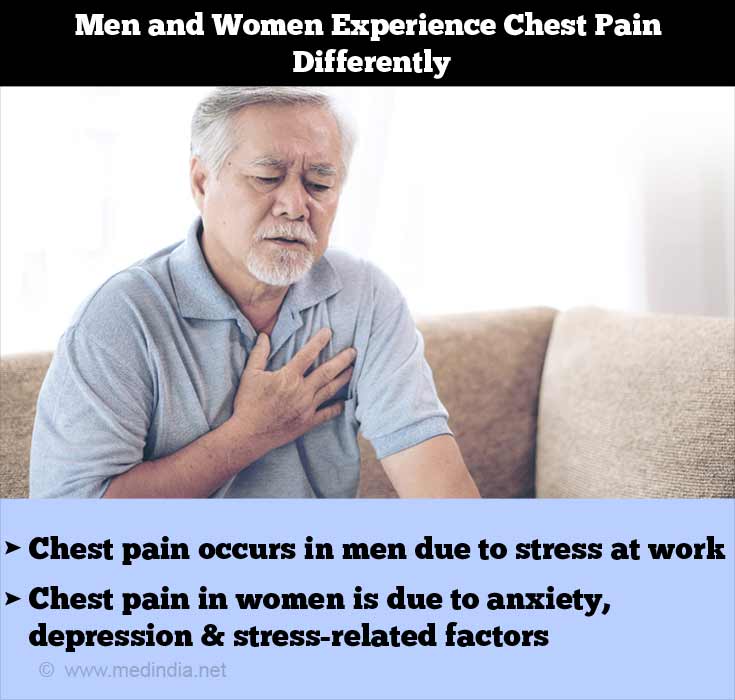
Chest pain occurs in men due to stress at work and in their life in general. Chest pain in women could be due to anxiety, depression and stress-related factors. Men and women experience chest pain differently and therefore must be dealt with accordingly.
Earlier, bouts of chest pain in women were dismissed, even by doctors, as a figment of the imagination, because the necessary tests did not reveal a coronary block This resulted in the condition being dubbed as ‘cardiac syndrome X’!
Better evaluation in recent times has revealed that the condition is not imaginative and that microvascular dysfunction can be detected in these women with chest pain. Experts point out that endothelial dysfunction is the first step towards coronary artery disease (CAD).
In this condition the miniscule blood vessels that supply the heart do not dilate or constrict appropriately, leaving the heart starving for oxygen. This causes chest pain. Besides this, there is also an accumulation of plaque that cannot be easily picked up by the traditional angiogram.
How micro vascular dysfunction increases the cardiovascular risks of these women is not clear but it is pretty evident that it occurs in women who are older, who smoke, lead an inactive life and who have a family pre-disposition.
It is recommended that women with chest pain undergo the regular testing for Coronary Artery Disease (CAD). If it is undetected then the patient must be evaluated for micro vascular endothelial dysfunction, which, if present, must be treated. If this is not detected, despite the presence of chest pain and other symptoms, the patient must seriously consider methods to control the risk factors.(2✔ ✔Trusted Source
Gender Matters: Heart Disease Risk in Women
Go to source)
Hi. For my mother 53 years old, we have already consulted a cardiologist 2 years ago. Did echo test, treadmill test, ECG, all reports normal. Cardiologist diagnosed PSVT and given DILZEM-SR to take daily one tablet. Palpitation of heart stopped with that, but chest pain on left side is severe, feel too much heaviness in the chest while sleeping or lying down. Which specialist we should visit? Kindly advise.
I have been having pains in my left chest for over a year now and have not seen a doctor to complain!I am afraid of this!I have stopped smoking for two years now but still drinks
I have sudden sharp pain in my chest and then it goes away. It doesn't happen every day and it isn't associated with any other symptom. I plan to tell my doctor at my next visit, but he'll send me to the same old cardiologist who makes me feel like a waste of time.
it could be Precordial Catch Syndrome research it or angina
The typical symptoms of Chest pain are:
Chest “tightness,†“squeezing,†or “heaviness.†People describe this feeling as a weight or as a band being tightened around their chest. The pain is usually located on the left side of the chest above the bottom of the ribcage, but it’s often hard to define its exact location.
Shortness of breath. Sweating, nausea, and an anxious feeling
A pain in the left arm, neck and jaw.
The typical symptoms of chest pain in women are:
Chest “tightness,†“squeezing,†or “heaviness.†People describe this feeling as a weight or as a band being tightened around their chest. The pain is usually located on the left side of the chest above the bottom of the ribcage, but it’s often hard to define its exact location.
Shortness of breath.Sweating, nausea, and an anxious feeling
A pain in the left arm, neck and jaw.
Consult Cardiologist Online
Dr. Paresh Patel
MBBS, DNB
8 years experience
Prasann Hospital and Diagnostic Centre[Dr.Paresh.Patel], Vasana, Ahmedabad
Dr. Vijaysinh Patil
MBBS, MD
5 years experience
Wockhardt Hospital in Nashik, Renuka Nagar, Nashik
Dr. Manas Thakur
MD, DM
12 years experience
Cardiac Care Centre [Dr. M.Thakur ], Near Railway Station , Sitamarhi
Dr. Chopda Anand Manaklal
MBBS, MD Medicine, FIN Cardiology, DNB Cardiology
16 years experience
Chopda Hospital, Nashik
What's New on Medindia
Articles
Follow @MedIndia
Chest Pain - Related News
Drugs for Chest Pain