MEDINDIA
 English
 हिन्दी
 Español
 français
 中文
中文
 Email
Email
- Cancer Stat Facts: Common Cancer - (https://seer.cancer.gov/statfacts/html/common.html )
- What causes cancer? - (https://cancer.ca/en/cancer-information/what-is-cancer/what-causes-cancer )
- Risk Factors for Cancer - (https://www.cancer.gov/about-cancer/causes-prevention/risk )
- The genetics of breast cancer: risk factors for disease - (https://www.ncbi.nlm.nih.gov/pmc/articles/PMC3681174/)
- The Risk of Cancer Might be Lower Than We Think. Alternatives to Lifetime Risk Estimates - (https://www.ncbi.nlm.nih.gov/pmc/articles/PMC5796733/)
- Smoking and Lung Cancer - (https://www.ncbi.nlm.nih.gov/pmc/articles/PMC4080902/)
- Cancer - (https://www.who.int/news-room/fact-sheets/detail/cancer)
- Worldwide cancer data - (https://www.wcrf.org/cancer-trends/worldwide-cancer-data/)
- Global cancer burden growing, amidst mounting need for services - (https://www.who.int/news/item/01-02-2024-global-cancer-burden-growing--amidst-mounting-need-for-services)
- Cancer - (https://www.who.int/news-room/fact-sheets/detail/cancer)
- Cancer prevention: 7 tips to reduce your risk - (https://www.mayoclinic.org/healthy-lifestyle/adult-health/in-depth/cancer-prevention/art-20044816)
- Lung Cancer Among People Who Never Smoked - (https://www.cdc.gov/lung-cancer/nonsmokers/index.html )
- Do Frequent Follow-Up Tests Benefit Colorectal Cancer Survivors? - (https://www.cancer.gov/news-events/cancer-currents-blog/2018/colorectal-cancer-follow-up-testing )
- Male Breast Cancer - (https://www.breastcancer.org/types/male-breast-cancer)
- Carcinoma of Unknown Primary Treatment (PDQ®)–Patient Version - (https://www.cancer.gov/types/unknown-primary/patient/unknown-primary-treatment-pdq)
- Survival for cancer of unknown primary (CUP) - (https://www.cancerresearchuk.org/about-cancer/cancer-unknown-primary-cup/survival)
- Global cancer statistics 2022: GLOBOCAN estimates of incidence and mortality worldwide for 36 cancers in 185 countries - (https://acsjournals.onlinelibrary.wiley.com/doi/10.3322/caac.21834)
Calculate your lifetime risk of being afflicted by some of the most common cancers.
Cancer risk refers to the likelihood of developing cancer. Exposure to risk factors over time increases cancer risk , though it may take years for cancer to develop. About 4 in 10 cancer cases can be prevented.
People encounter multiple risk factors in daily life, but having them doesn’t guarantee cancer will occur. Similarly, low risk doesn’t mean immunity. The exact reasons why some develop cancer while others don’t remain unclear.
How Many People Are Diagnosed with Cancer Every year?
In 2024, nearly 2 million people were diagnosed with cancer in United States. An estimated 3,10,720 women and 2,790 men were diagnosed with breast cancer which makes it the most common cancer.
Prostate cancer is the leading cancer diagnosis among men. Lung cancer is the third most common diagnosis with 2,34,580 new cases.
Cancer caused 18.5% of all deaths in the United States in 2022. Deaths due to heart disease and cancer caused nearly half of all deaths in the United States. Cancer is the leading cause of death for those under 65 years of age (1✔).
Why Assessing Cancer Risk is Important?
Cancer risk assessment tool is important in understanding the factors that contribute to the development of cancer. It evaluates lifestyle habits, environmental exposure, genetic influence and medical history. While no single factor guarantees the onset of cancer, certain behaviors and conditions can increase susceptibility.
Assessing the risk factors people and healthcare professional can take proactive measures such as lifestyle modification, routine screening and preventive care to reduce cancer risk.
This assessment serves as a guide for informed decision-making, empowering people to adopt healthier choices and enhance overall well-being (2✔).This cancer risk assessment calculator depends on lifestyle factors, occupational exposure , genetic changes, hormonal factors. Some examples are below which can help in assessing the chances or probability of getting a cancer.
Different Types of Cancers and their Risk Factors
| Category | Risk Factors | Associated Cancer |
|---|---|---|
| 1) Lifestyle Factors | Smoking and tobacco use | Lung, throat and other cancers |
| Alcohol consumption | Liver, breast and digestive cancers | |
| Processed foods, red meat | Colorectal, stomach and pancreatic cancers | |
| Physical Inactivity | Colon, breast, and endometrial cancers | |
| Obesity | Breast, colorectal, and other cancers | |
| 2) Environmental & Occupational Exposure | Radiation exposure | Skin cancer (from UV radiation) |
| Pollutants & Chemicals like Asbestos, benzene, pesticides | Lung cancer, blood cancer, prostate cancer | |
| 3) Genetic & Family History | Hereditary Cancer | Breast and ovarian cancers (e.g., BRCA mutations) |
| Family History | Increased risk if first-degree relatives have cancer | |
| 4) Infections & Chronic Conditions | Human Papillomavirus (HPV) | Cervical, throat, and anal cancers |
| Hepatitis B & C | Liver cancer | |
| H.pylori Infection | Stomach cancer | |
| Early Menstruation/Late Menopause | Increased breast cancer risk | |
| 5) Hormonal & Reproductive Factors | Childbirth & Breastfeeding | Breastfeeding may lower breast cancer risk |
| Hormone Replacement Therapy (HRT) | Breast, endometrial, ovarian and cervical cancers |
Must know Cancer facts
- Relative risk of developing breast cancer is doubled if there is a history of a first degree relative having the cancer(5✔).
- Lifetime risk of an American developing an invasive cancer is 42.05% and 37.58% in males and females respectively(6✔).
- Relative risk of a smoker developing lung cancer is 23 times higher than that of a non-smoker(7✔).
- Around 30 and 50% of cancers can be prevented by avoiding risk factors and prevention strategies(8✔).
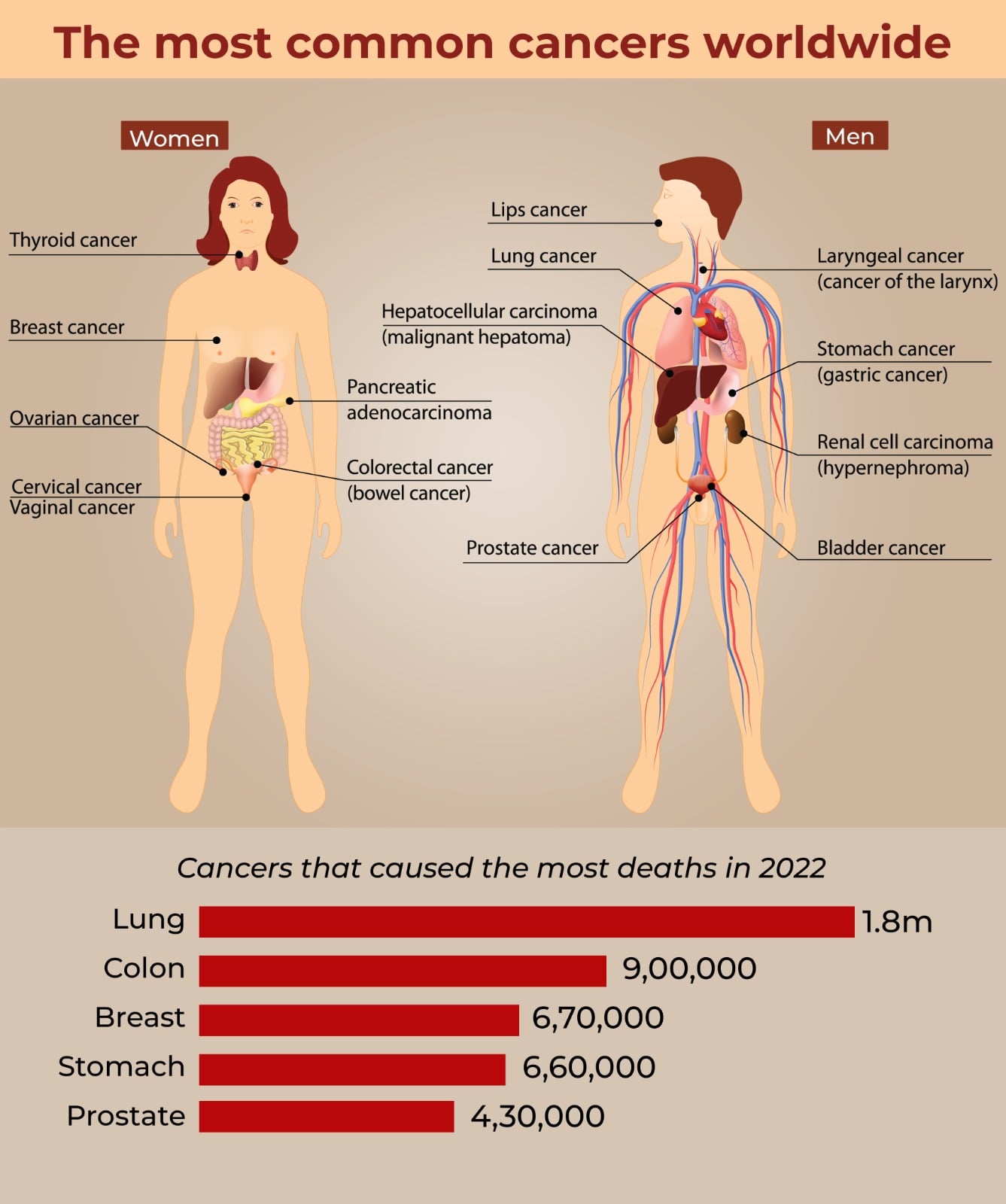
- 18.1 million new cases of cancer were estimated around world in 2020(9✔).
- Most common new cases of cancer in 2020 were breast (2.26 million), lung (2.21 million), colon and rectum (1.93 million), prostate (1.41 million), skin (non-melonoma) (1.20 million), and stomach (1.09 million)(8✔).
FAQs
1. Who is most likely to get cancer?
Cancer risk increases with age, especially after 50, and varies by gender, with men more prone to prostate, lung, and liver cancers, and women to breast, ovarian, and uterine cancers. Family history, inherited genetic mutations, and lifestyle factors like smoking, heavy alcohol use, obesity, and inactivity also raise the risk. Environmental exposures, chronic conditions, and hormonal factors, such as postmenopausal status or long-term hormone replacement therapy, further contribute. Regular screenings and healthy lifestyle choices can help manage these risks (10✔).
2. How to prevent cancer?
While there's no guaranteed way to prevent cancer , certain lifestyle changes can significantly reduce your risk. Key preventive measures include avoiding tobacco use, limiting alcohol consumption, maintaining a healthy weight, staying physically active, and eating a balanced diet rich in fruits, vegetables, and
Regular screenings, such as
3. Is lung cancer in non-smokers more difficult to detect?
Lung cancer in non-smokers can be harder to detect early because it may not be suspected right away. As many of the symptoms overlap with other respiratory conditions, doctors may not immediately consider lung cancer, making early diagnosis more challenging.
Lung cancer is more treatable when detected early, but screening for non-smokers is not as routine as for smokers. However, people with high exposure to environmental toxins or a family history of lung cancer should discuss screening options with their healthcare provider (12✔).
4. Can colon cancer recur after treatment?
Yes, colon cancer can recur, especially if it has spread to other parts of the body. After initial treatment, regular follow-up appointments and screenings are necessary to detect any recurrence early. Lifestyle changes, such as maintaining a healthy diet and exercise regimen, can also help reduce the risk of recurrence (13✔).
5. Can men get breast cancer?
Yes, men can get breast cancer, though it is much less common than in women. Men have a small amount of breast tissue, and while their breasts are not as developed as women's, they are still susceptible to cancer.
The risk of male breast cancer increases with factors such as age (most cases occur in men over 60), family history, genetic mutations (such as BRCA1 or BRCA2), hormonal imbalances (especially elevated estrogen levels), and past radiation exposure. Though rare, men should be aware of signs like a lump in the breast, skin changes, or unusual nipple discharge , as early detection is important for improving outcomes (14✔).
6. What is cancer of unknown primary (CUP)?
Cancer of unknown primary (CUP) is a type of cancer where cancer cells are found in the body, but the original (primary) site of the cancer cannot be identified. In other words, doctors know that the cancer has spread to other parts of the body, but they are unable to pinpoint where it began.
CUP is often diagnosed when a person presents with symptoms like unexplained weight loss, pain, or
7. How long can you live with cancer of unknown primary (CUP)?
The survival rate for cancer of unknown primary (CUP) can vary widely depending on factors such as the type of cancer cells, how far the cancer has spread, the individual’s overall health, and how well the cancer responds to treatment.
On average, the median survival for CUP is around 6 to 12 months after diagnosis, as it is often found at an advanced stage. However, some individuals may live longer, especially if the cancer responds well to treatment or if it remains stable. In rare cases, people with CUP may achieve remission or live for several years (16✔)..
8. What is the likelihood of getting cancer?
Approximately 1 in 2 people will be diagnosed with cancer at some point in their lifetime, based on current statistics. This varies depending on factors such as age, gender, lifestyle, and genetics. While some cancers are more common than others, advances in early detection, treatment, and prevention are improving outcomes and survival rates. It's important to stay aware of risk factors and engage in regular screenings to detect cancer early (17✔)..