MEDINDIA
 English
 हिन्दी
 Español
 français
 中文
中文
Life expectancy is rising, but the years lived in good health are not keeping pace globally.
Highlights:
Although human life expectancy continues to rise, the question remains: Is this increase translating into equally healthy longevity gains?
With advancements in pharmacology, the availability of drugs and medications, and progress in prevention, treatment, disease control, patient education, health promotion, community awareness, and public health screening programs, one might assume that narrowing the gap between lifespan and healthspan would be straightforward (1✔ ✔Trusted Source- Africa has shorter healthy lives and the fastest widening health gap; Europe leads in healthy longevity
- Three global morbidity patterns highlight region-specific disease burdens
- NCDs, injuries, and CMPN conditions drive differences in healthspan-lifespan gaps
Healthspan-lifespan gap differs in magnitude and disease contribution across world regions
Go to source).
However, in reality, the number of years lived (lifespan) and the number of years lived in good health (healthspan) are not the same, and the gap between them is steadily widening.

Life Span (or) Death Clock
Calculate how many more seconds have you got to live. An interesting reminder for us to live these precious moments happily.
Calculate how many more seconds have you got to live. An interesting reminder for us to live these precious moments happily.
TOP INSIGHT

Did You Know?
On average, people spend the last 9 years of their lives battling illness and poor health worldwide, highlighting the urgent need to close the healthspan-lifespan gap! #medindia #healthspan
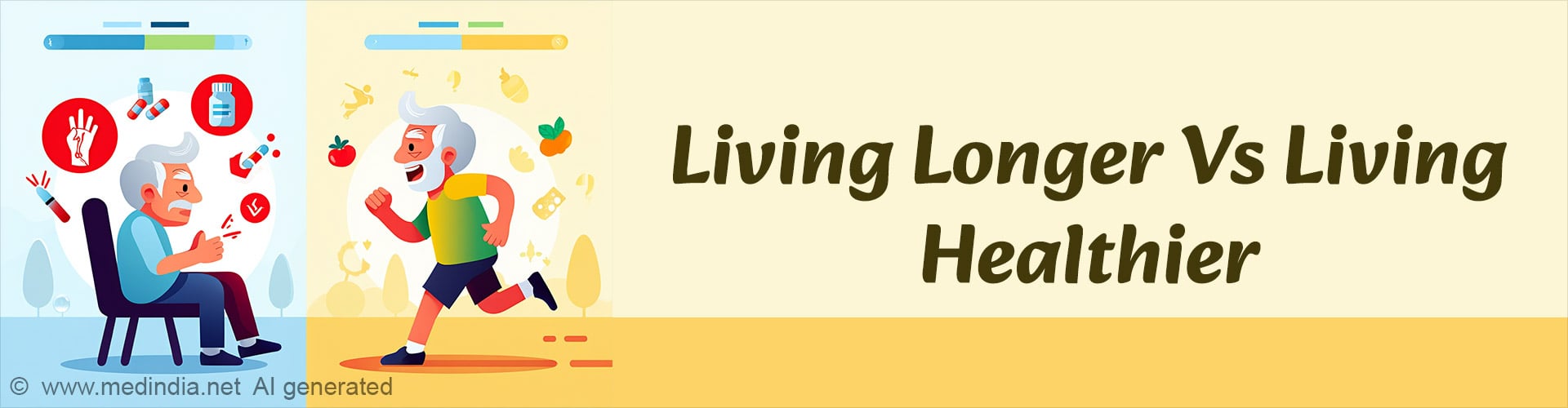
Living Longer vs. Living Healthier
The study examined the difference between life expectancy (longevity) and health expectancy (healthspan) in 183 countries between 2000 and 2019, using data from the World Health Organization (WHO) and the United Nations. The study aims to understand why longer lives do not always mean healthier lives and to identify the factors that contribute to this disparity.Lifespan was described in terms of life expectancy at birth, while healthspan was described in terms of health-adjusted life expectancy (HALE), which is the average number of years a person lives in good health, free from major illness or disability. The gap between them shows how many years, on average, people live in poor health.

Life Expectancy or Longevity Calculator
We all wish to live a long and fruitful life. The life expectancy calculator may just be what the doctor ordered for those curious to know their life expectancy.
We all wish to live a long and fruitful life. The life expectancy calculator may just be what the doctor ordered for those curious to know their life expectancy.
Global Statistics of Lifespan and Healthspan
| Region | Life Expectancy (yrs) | Healthspan (yrs) | Gap (yrs) | Percentage of lifespan compromised by disease |
|---|---|---|---|---|
| Global | 73.7 | 64.5 | 9.1 | 12.7% |
| Africa | 64.1 | 55.6 | 8.3 | 12.9% |
| Europe | 78.6 | 68.8 | 9.9 | 12.4% |
| Americas | 75.9 | 65.8 | 9.6 | 12.9% |
| Eastern Mediterranean | 73.9 | 64.0 | 9.8 | 13.3% |
| South-East Asia | 72.6 | 63.4 | 9.6 | – |
| Western Pacific | 70.4 | 62.1 | 8.4 | 11.8% |
Study Highlights
- The percentage of lifespan compromised by a disease was highest in the eastern Mediterranean populations.
- The non-communicable disease (NCD) was highest among Americans.
- Healthspan decreases with communicable, maternal, perinatal, and nutritional (CMPN) conditions, which are more prevalent among Africans.
- Healthspan decreased with injury burden was the highest among Europeans.
Africa Lags, Europe Leads
People in many African countries live fewer healthy years than expected due to wealth, chronic diseases, and other factors.
While in Europe, people stay healthier longer than expected! The pattern remained consistent regardless of where the countries were.


Decoding Key Reasons For a Longer Life Span
The most important factors for a longer and healthier life span are nutrient dense diet, physical exercise, stress free lifestyle, and genetics to some extent
The most important factors for a longer and healthier life span are nutrient dense diet, physical exercise, stress free lifestyle, and genetics to some extent
Health Patterns Around the World
Researchers grouped countries into three types based on common disease trends:- Cluster 1 (8.3 years gap) – Countries where nutrition problems, infections, and maternal/infant health issues are common. Mostly in Africa.
- Cluster 2 (9.4 years gap) – Countries where eye/ear problems, diabetes, and kidney or urinary issues are more common. Spread across multiple regions.
- Cluster 3 (10.3 years gap) – Countries where cancer, heart disease, musculoskeletal, and brain disorders are the main problems. Mostly in Europe.
The gap between life and healthy years is growing worldwide—but not equally. Africa faces the fastest widening gap, while Europe enjoys longer, healthier lives.
Addressing the crisis requires region-specific solutions and policies guided by local health realities, focusing on preventing the diseases that most undermine quality of life.
Reference:
- Healthspan-lifespan gap differs in magnitude and disease contribution across world regions - (https://www.nature.com/articles/s43856-025-01111-2)
Source-Medindia

Is Calm Within the Key to a Long Life?
Resilience significantly boosts longevity, helping some individuals reach 100+ years, even as science suggests a natural human lifespan ceiling near 115–150 years.
Resilience significantly boosts longevity, helping some individuals reach 100+ years, even as science suggests a natural human lifespan ceiling near 115–150 years.
 Email
Email