MEDINDIA
 English
 हिन्दी
 Español
 français
 中文
中文
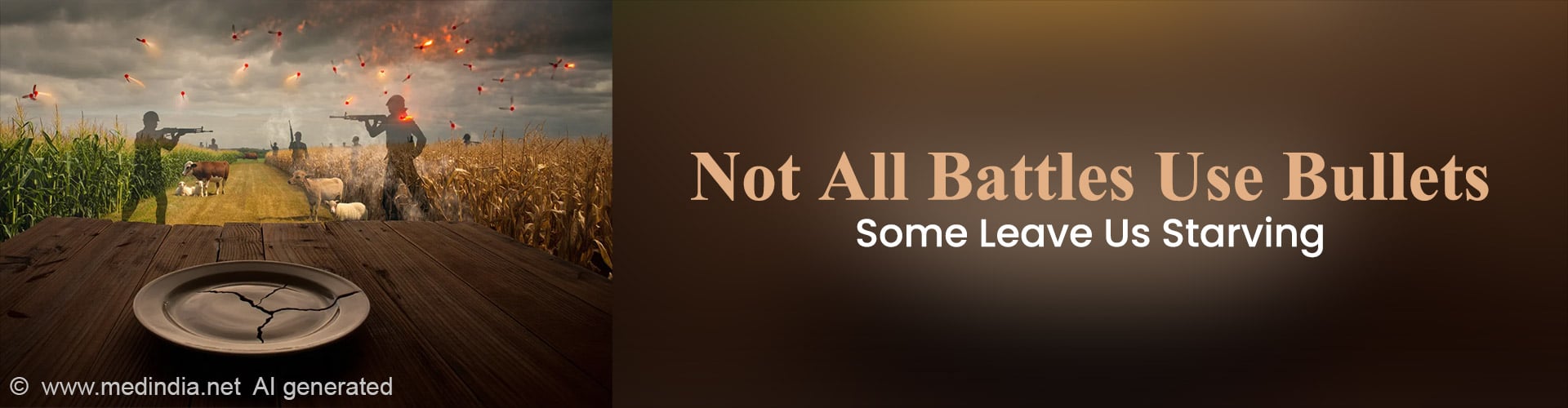
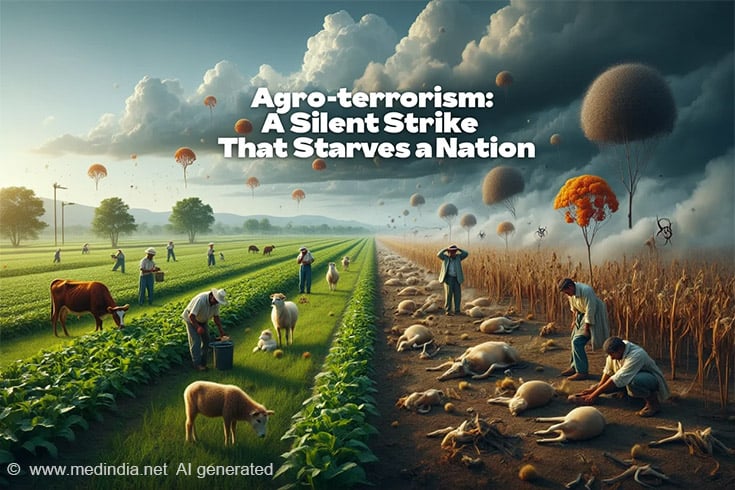
Agro-terrorism poses a growing threat to global food security, public health, and economic stability.
Highlights:
Imagine waking up to the news that millions of chickens have been killed by an unexplained outbreak. You step outside and see that supermarkets are running out of eggs, meat prices are soaring, and farmers are in tears. The situation described here is real—it’s not a plotline but a very real threat quietly lurking in the background of our global food system. It’s called agro-crime, and its most dangerous form is agro-terrorism (1✔ ✔Trusted Source- Chinese researchers were charged with smuggling a crop-destroying fungus into the U.S
- Agriculture is a high-impact, low-surveillance target for bioattacks
- Early detection, intersectoral coordination, and public awareness are key defenses
Agro-crime and agro-terrorism - World Organisation for Animal Health
Go to source).
Shortage of Veterinarians Worry Public Health Experts in US
Public health experts in the US are worried over a looming shortage of farm animal veterinarians. The shortage arising at a time of continued disease outbreaks among animals could prove disastrous.
Public health experts in the US are worried over a looming shortage of farm animal veterinarians. The shortage arising at a time of continued disease outbreaks among animals could prove disastrous.
TOP INSIGHT

Did You Know?
One act of #agroterrorism can cause billions in damage and affect millions. #foodshortage #agriculture #biocrime #agrocrime #medindia
Agro-Terrorism: When Fear Grows in the Fields
The food we eat may seem easily available, but the effort behind harvesting and producing it is immense and often goes unnoticed. Manipulating these systems, whether for selfish or political reasons, could lead to widespread disruption and a severe food shortage.Agro-crime isn’t new. It includes:
- Smuggling infected animals across borders
- Selling fake veterinary medicines
- Secretly introducing diseases to hurt a competitor.
- Even falsifying documents to pass off diseased livestock as healthy.
Furthermore, agro-terrorism is about deliberately sabotaging food resources. The negative effects of crime extend beyond the economy. It’s about creating fear, uncertainty, and instability (2✔ ✔Trusted Source
Chinese researchers charged with smuggling 'agroterrorism weapon' to infect Midwest crops
Go to source).
As one expert put it:
Chronic Food Shortage Facing North Koreans: UN
The United Nations says that millions of North Koreans suffer chronic food shortages and dire health care, leaving one in three young children stunted.
The United Nations says that millions of North Koreans suffer chronic food shortages and dire health care, leaving one in three young children stunted.
The Nebraska Incident: A Wake-Up Call
The Department of Justice accuses two Chinese nationals of smuggling a fungus as an "agroterrorism weapon" into Michigan, which could destroy crops in the Midwest. Authorities in the U.S. suspect that the organism was created to damage crops and commit agroterrorism. On June 2, FBI agents filed a criminal complaint alleging that Yunqing Jian, a student at the University of Michigan, and her boyfriend, Zunyong Liu, brought Fusarium graminearum (fungi). This fungus, if released intentionally, could have infected maize and other staple crops, crippling harvests across the country’s most productive farmland. The accusations include breaking the Biological Weapons Anti-Terrorism Act and conspiring to commit economic espionage.This real-world case highlights just how vulnerable our food systems are—and how high the stakes can be when agriculture becomes a target (3✔ ✔Trusted Source
Agroterrorism
Go to source).

Avoiding Dietary Crisis in India: Re-look at Food Supplies
To make sure all Indians young and old have the necessary food with nutrients India needs more than traditional forms of food production. Increasing international food trade, allowing more food imports, developing food processing and fortification ...
To make sure all Indians young and old have the necessary food with nutrients India needs more than traditional forms of food production. Increasing international food trade, allowing more food imports, developing food processing and fortification ...
Why Target Agriculture?
Agriculture is a soft target—its vulnerabilities unfold slowly, but the consequences ripple far and wide. We can survive without food for a day or two, but what happens next? Starving is the highest form of pain one can experience! It's easy to die in a minute with a nuclear explosion, but agroterrorism kills the person slowly. In short, agriculture has a high impact, and since the food supply chains are globally interconnected, the effects of an attack are delayed but widespread.The 2001 outbreak of foot-and-mouth disease, while it wasn’t a terrorist attack, revealed the scope of such an event.
- Over 6 million animals were culled
- 8 billion pounds in economic losses
- Entire farming communities were devastated

Potatoes Provide Solution for Global Food Crisis
So far potatoes were derided for contributing to expanding waistlines but now they offer solution for alleviating global food crisis.
So far potatoes were derided for contributing to expanding waistlines but now they offer solution for alleviating global food crisis.
So, What Can Be Done?
It’s for this reason that both the World Organization for Animal Health (WOAH) and research groups like RAND support countries in protecting their agriculture.Here’s how:
- Early Detection
Quick response is key. If we notice peculiar diseases or patterns early, we can prevent them from spreading. - Teamwork Across Sectors
Law enforcement, veterinary staff, customs officers, and health workers must communicate with each other. This form of crime has no respect for the lines drawn between departments. - Training and Awareness
In the battle against invasive animal species, farmers, border agents, and vets are the first to step in. If they are trained correctly, they will recognize risky signs in advance. - Clear Public Communication
When a crisis happens, the public needs honest information expressed without panic. Hearing rumors and feeling panic can be just as dangerous as the disease.
Why It Matters to You
You might be thinking, “I’m not a farmer—why should I care?”When agriculture is affected, everything is affected: stocks in stores, more unemployment, possible outbreaks of riots, or new health crises across the world. With diseases that move from animals to people on the rise, the issue affects health as well.
Even though we may not see news about agro-crime and agro-terrorism every day, they are still existent threats. We should all take care and cooperate, since it is not only the authorities’ responsibility to prevent these disasters.
References:
- Agro-crime and agro-terrorism - World Organisation for Animal Health - (https://www.woah.org/en/what-we-offer/emergency-preparedness/agro-crime-and-agro-terrorism/)
- Chinese researchers charged with smuggling 'agroterrorism weapon' to infect Midwest crops - (https://nebraskapublicmedia.org/en/news/news-articles/chinese-researchers-charged-with-smuggling-agroterrorism-weapon-to-infect-midwest-crops/)
- Agroterrorism - (https://www.rand.org/pubs/research_briefs/RB7565.html)
Source-Medindia
 Email
Email