MEDINDIA
 English
 हिन्दी
 Español
 français
 中文
中文
Find out how high heat makes carcinogens in your food and simple ways to cut your exposure without losing flavor.
Highlights:
Cooking food at high temperatures changes its taste and texture and makes it safe to eat. However, when food is exposed to intense heat while grilling, frying, roasting, or smoking, certain chemical reactions occur that lead to the formation of harmful compounds. These compounds are known as carcinogens, meaning they have the potential to increase cancer risk if exposure is frequent over long periods (1). Understanding how these compounds form and how they affect the body can help you make safer cooking choices without giving up flavor.
- High temperatures during cooking produce carcinogens like HCAs, PAHs, and acrylamide
- These compounds can interact with DNA and may contribute to cancer risk over time
- Safer cooking methods and antioxidant-rich marinades can reduce harmful compound formation

Do Not Light That Grill Until You Know These Cancer-Safe Cooking Tips
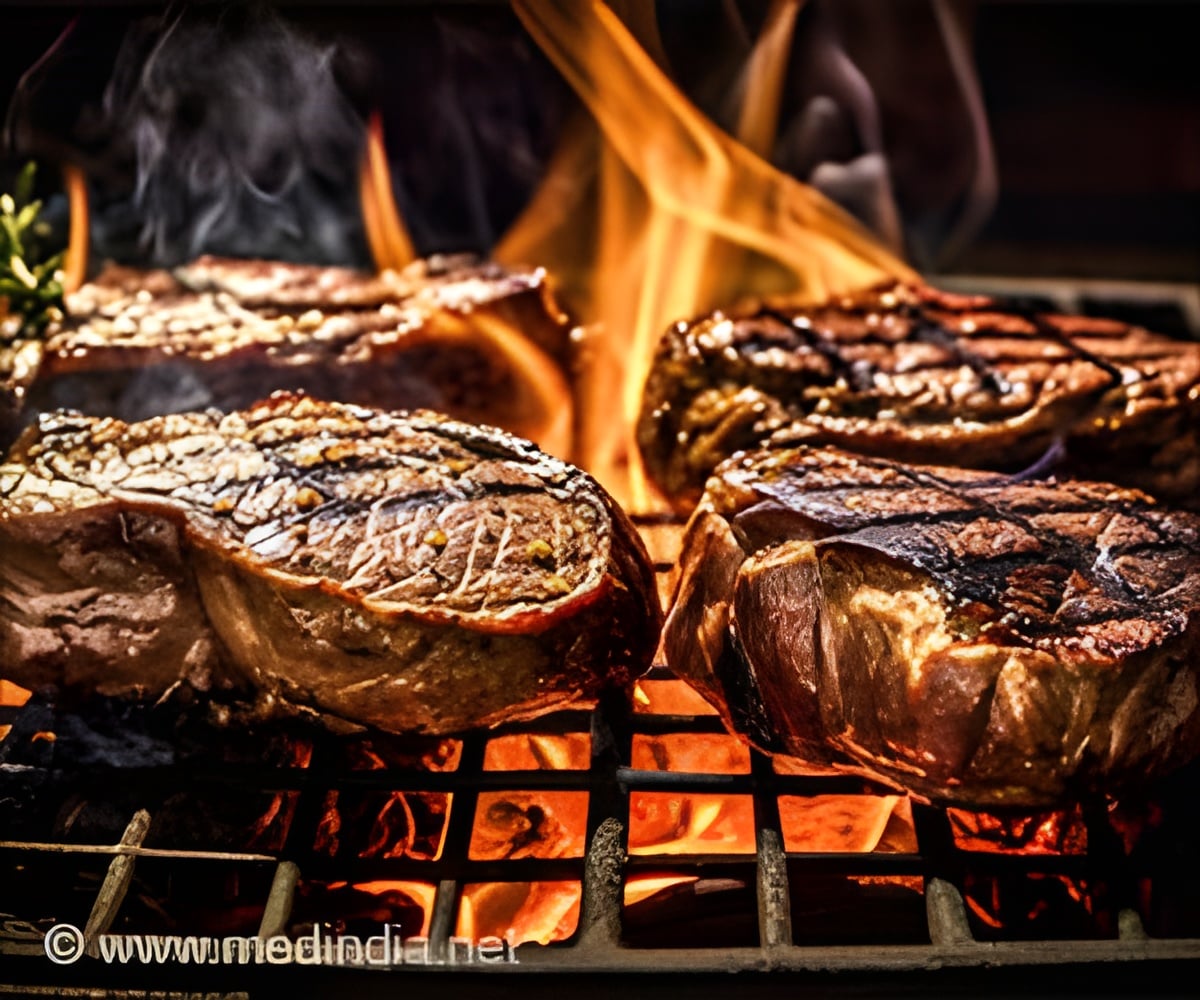
How grilling meat can create cancer-linked compounds and what simple steps can reduce risk.
How grilling meat can create cancer-linked compounds and what simple steps can reduce risk.
TOP INSIGHT

Did you know?
Pre-microwaving meat before grilling can lower cancer-forming compounds. Try it next barbecue day. #healthycooking #carcinogen #medindia
What Happens During High-Heat Cooking?
When food is cooked at temperatures above about 220 degrees Celsius, chemical reactions take place between amino acids, sugars, creatine, and fats. These reactions include the Maillard reaction, which browns food and creates appealing flavors, but they also produce dangerous substances. These include heterocyclic amines (HCAs), polycyclic aromatic hydrocarbons (PAHs), acrylamide, and nitrosamines (2). Each of these compounds forms through different pathways as a result of intense heat exposure.
Can Grilled Meat Give You Cancer?
Grilling meat is associated with increased risk of cancer as it can lead to formation of carcinogens. Adopt Cancer-safe grilling practices to reduce the risk.
Grilling meat is associated with increased risk of cancer as it can lead to formation of carcinogens. Adopt Cancer-safe grilling practices to reduce the risk.
Key Carcinogens Created by High Heat Cooking
One group of carcinogens called HCAs form mostly in muscle meats such as beef, poultry, and fish when they are cooked at high temperatures. The longer and hotter the cooking, the more HCAs are produced. PAHs, another category, emerge when fat drips into flames or hot surfaces and creates smoke. That smoke then coats the food with PAHs (3).Another harmful compound, acrylamide, forms primarily in starchy foods like potatoes and grains when they are fried, roasted, or baked above 120 degrees Celsius. This compound is not limited to meat products and can also be found in toasted bread or chips (4).
In processed meats that contain nitrites, nitrosamines can form during high-temperature cooking when nitrites react with other food components (5). All of these compounds have been linked to cellular changes and DNA damage in laboratory studies and animal research.

Simple Tips to Keep Nutrients Intact in Food
Wash vegetables and fruits before cutting and chopping them (never wash them after it is cut as the nutrients will drain into the water).
Wash vegetables and fruits before cutting and chopping them (never wash them after it is cut as the nutrients will drain into the water).
How Carcinogens Affect Your Health
Carcinogens like HCAs and PAHs are believed to cause harm because they can interact with cellular DNA and create mutations. Once metabolized in the body, these compounds can make DNA adducts, which are alterations that interrupt normal cellular functions (6). Over many years of repeated exposure, these disruptions may contribute to the development of cancer.Epidemiological studies have shown associations between high consumption of well-done and grilled meats and increased risks of several cancers, including those of the colon, pancreas, prostate, and stomach (7). The overall risk depends on the amount and frequency of consumption, as well as individual genetic and lifestyle factors.
Despite these findings, it is important to understand that cancer risk is influenced by many factors. Scientists note that not all studies show strong links, and differences in diet, genetics, and environment can make it difficult to establish direct cause and effect in humans.

Regular Consumption of Grilled Meat May Increase the Risk of High Blood Pressure
The risk of high blood pressure may increase in people who consume grilled beef, chicken or fish meat regularly. Chemicals called HAAs (heterocyclic aromatic amines) are produced when meat is grilled
The risk of high blood pressure may increase in people who consume grilled beef, chicken or fish meat regularly. Chemicals called HAAs (heterocyclic aromatic amines) are produced when meat is grilled
Factors That Increase Carcinogen Formation
Several factors influence how much of these harmful compounds form in food during cooking (8):- Temperature. Higher heat creates more HCAs, PAHs, and acrylamide.
- Cooking time. Longer cooking increases the total amount of carcinogens.
- Fat content. Meats with higher fat content produce more PAHs due to smoke formation.
- Cooking method. Grilling, pan-frying, and barbecuing create more carcinogens than boiling or steaming.
How to Reduce Exposure to Carcinogens
There are practical ways to lessen the formation of these harmful compounds while keeping meals flavorful:Lower-heat cooking methods such as steaming, boiling, poaching, and microwaving generate significantly fewer carcinogens than high-heat techniques like grilling or frying. Reducing cooking duration and avoiding charred or overly browned portions can also help.
Using marinades rich in antioxidants, such as those with lemon juice, garlic, herbs, or spices, can reduce the formation of carcinogens. Research indicates that antioxidant-rich marinades can inhibit the chemical reactions that lead to carcinogen formation (9).
Another strategy is to pre-cook meat in the microwave or boil it briefly before grilling. This reduces the time the meat spends on the grill, lowering HCA and PAH levels. Choosing leaner cuts or trimming excess fat can also limit smoke production that contributes to PAHs (10).
Practical Takeaways for Everyday Cooking
High-heat cooking does create carcinogens in many types of food, especially meats, but it is not necessary to give up favorite foods completely. Simple adjustments to cooking style, temperature, and timing can greatly reduce exposure to harmful compounds. Choosing more plant-based foods and antioxidant-rich ingredients further supports long-term health and lowers oxidative stress.Being mindful of how food is cooked and making small changes over time can help you enjoy a balanced diet without compromising on safety or taste. While the science continues to evolve, the best approach is moderation combined with smart cooking choices that limit heat-induced carcinogen formation.
Frequently Asked Questions
Does high-heat cooking cause cancer?Frequent consumption of heavily cooked foods has been linked to increased cancer risk.
What cooking methods reduce carcinogens?
Steaming, boiling, and poaching create fewer harmful compounds than grilling or frying.
Are all grilled foods bad?
Occasional grilled food is not highly dangerous but frequent consumption increases exposure.
Can marinades help?
Yes, antioxidant-rich marinades can significantly lower carcinogen formation.
Do plant foods form these carcinogens?
Plant foods rarely form HCAs or PAHs and provide antioxidants that protect cells.
References:
- Thermal processing food-related toxicants: a review (Koszucka A, Nowak A. Thermal processing food-related toxicants: a review. Crit Rev Food Sci Nutr. 2019;59(22):3579-3596. doi: 10.1080/10408398.2018.1500440. Epub 2018 Oct 12. PMID: 30311772.)
- Maillard Reaction: Mechanism, Influencing Parameters, Advantages, Disadvantages, and Food Industrial Applications: A Review (El Hosry L, Elias V, Chamoun V, Halawi M, Cayot P, Nehme A, Bou-Maroun E. Maillard Reaction: Mechanism, Influencing Parameters, Advantages, Disadvantages, and Food Industrial Applications: A Review. Foods. 2025 May 26;14(11):1881. doi: 10.3390/foods14111881. PMID: 40509409; PMCID: PMC12154226.)
- Do Grilled Foods Cause Cancer? (https://www.columbiadoctors.org/news/do-grilled-foods-cause-cancer)
- Acrylamide Questions and Answers (https://www.fda.gov/food/process-contaminants-food/acrylamide-questions-and-answers)
- Nitrites in Cured Meats, Health Risk Issues, Alternatives to Nitrites: A Review (Shakil MH, Trisha AT, Rahman M, Talukdar S, Kobun R, Huda N, Zzaman W. Nitrites in Cured Meats, Health Risk Issues, Alternatives to Nitrites: A Review. Foods. 2022 Oct 25;11(21):3355. doi: 10.3390/foods11213355. PMID: 36359973; PMCID: PMC9654915.)
- Carcinogens and DNA damage (Barnes JL, Zubair M, John K, Poirier MC, Martin FL. Carcinogens and DNA damage. Biochem Soc Trans. 2018 Oct 19;46(5):1213-1224. doi: 10.1042/BST20180519. Epub 2018 Oct 3. PMID: 30287511; PMCID: PMC6195640.)
- Cooking temperature, heat-generated carcinogens, and the risk of stomach and colorectal cancers (Ngoan le T, Thu NT, Lua NT, Hang LT, Bich NN, Hieu NV, Quyet HV, Tai le T, Van do D, Khan NC, Mai le B, Tokudome S, Yoshimura T. Cooking temperature, heat-generated carcinogens, and the risk of stomach and colorectal cancers. Asian Pac J Cancer Prev. 2009 Jan-Mar;10(1):83-6. PMID: 19469630.)
- Meat Preparation and Carcinogens: Practical Recommendations
(https://nutrition.org/meat-preparation-carcinogens-practical-recommendations)
- Effect of marinades on the formation of heterocyclic amines in grilled beef steaks (Smith JS, Ameri F, Gadgil P. Effect of marinades on the formation of heterocyclic amines in grilled beef steaks. J Food Sci. 2008 Aug;73(6):T100-5. doi: 10.1111/j.1750-3841.2008.00856.x. PMID: 19241593.)
- Methods of Minimizing Polycyclic Aromatic Hydrocarbon Content in Homogenized Smoked Meat Sausages Using Different Casings and Variants of Meat-Fat Raw Material (Ciecierska M, Dasiewicz K, Wołosiak R. Methods of Minimizing Polycyclic Aromatic Hydrocarbon Content in Homogenized Smoked Meat Sausages Using Different Casings and Variants of Meat-Fat Raw Material. Foods. 2023 Nov 14;12(22):4120. doi: 10.3390/foods12224120. PMID: 38002178; PMCID: PMC10670568.)
Source-Medindia
 Email
Email