MEDINDIA
 English
 हिन्दी
 Español
 français
 中文
中文
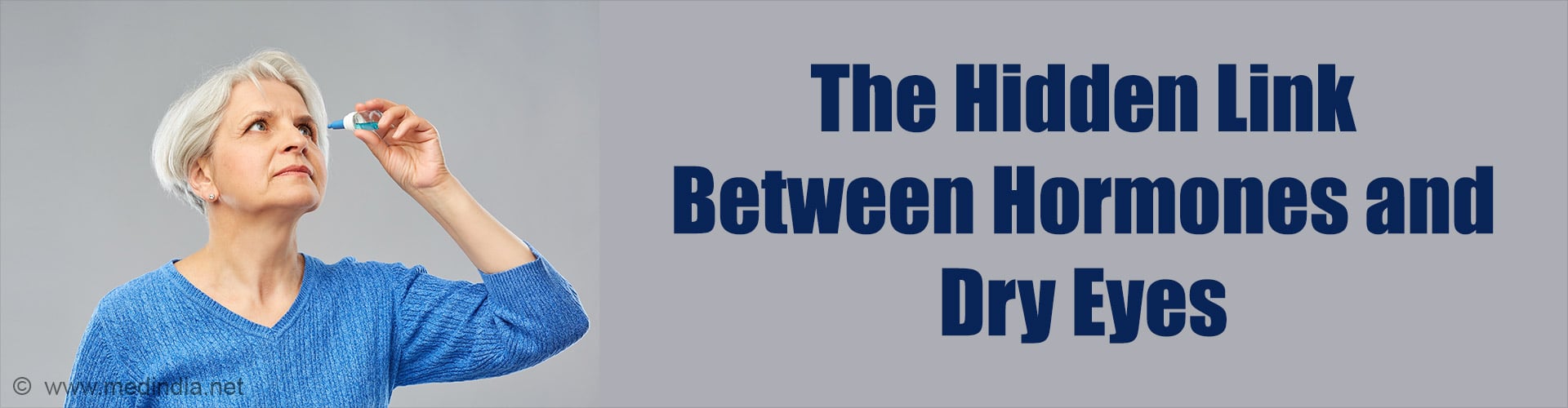
Menopause can affect more than your hormones - it can also dry out your eyes, causing discomfort and vision issues.
Highlights:
Most women are aware that mood swings, sleep issues, and hot flashes are common during menopause. But the so-called dry eye disease (DED), which makes your eyes feel dry, itchy, or gritty, is one of the less known effects of the change!
In contrast to women who are still going through the menopausal transition, postmenopausal women are more likely to develop dry eye disease, according to new research presented at The Menopause Society's Annual Meeting in 2025. With a mean age of 52 years, the study included over 3,500 women. Its purpose was to use the Ocular Surface Disease Index (OSDI) questionnaire to assess the prevalence, symptoms, and insights of dry eye disease in premenopausal and postmenopausal women. The results revealed that around 57.38% of postmenopausal women experienced dry eye symptoms when compared to 53.22% of premenopausal women.- Hormonal changes in menopause reduce tear quality and moisture
- Dry eyes cause irritation, blurriness, and light sensitivity
- Simple habits like hydration and regular eye checkups help
Despite their seemingly low numbers, these figures represent millions of women worldwide who suffer in silence from watery, irritated, and sore eyes on a daily basis (1✔ ✔Trusted Source
Presbyopia, Dry Eye, and Retinal Thickness in the Middle-Aged Population: Focusing on Sex Differences
Go to source).
Age Related Macular Degeneration (AMD) - Causes, Symptoms, Diagnosis, Treatment & Prevention
Age related macular degeneration is a disease of the elderly, wherein the macula or the central part of the retina gets affected, leading to loss of vision.
Age related macular degeneration is a disease of the elderly, wherein the macula or the central part of the retina gets affected, leading to loss of vision.
TOP INSIGHT

Did You Know?
Over 57% of postmenopausal women experience dry eyes due to falling hormone levels. #menopause #dryeyes #medindia
Why Hormones Play a Key Role in Eye Comfort
Tears are not just water but a complex blend of oil, mucus, and saline that ensures that the surface of the eyes is smooth and safe. The ratio of these in this blend is partly determined by sex hormones, particularly estrogen and testosterone.The glands that secrete the oil and watery layers of tears may slow down during menopause as the levels of the hormones change and decrease. This causes tears that dry too fast, leaving the eyes dry and swollen.
- Estrogen: The high concentrations can decrease the percentage of oil in the tear film, leading to increased evaporation.
- Androgens (like testosterone): Help to stimulate the production of tears and oils; upon falling, the eyes become drier.
Risk of Dry Eye Disease Increases During Menopause Transition
Go to source).
Dry Eye Syndrome - Causes, Symptoms, Diagnosis, Treatment and Prevention
Dry eye syndrome, also called keratoconjunctivitis sicca, is a progressive condition characterized by dry eyes due to the absence of tears. There are many causes and symptoms of dry eye. Dry eye syndrome is treatable.
Dry eye syndrome, also called keratoconjunctivitis sicca, is a progressive condition characterized by dry eyes due to the absence of tears. There are many causes and symptoms of dry eye. Dry eye syndrome is treatable.
When Dry Eyes Affect Everyday Life
Dry eye symptoms can go beyond mild discomfort. Women often report:- Burning or stinging sensation
- Redness and irritation
- Blurred vision or difficulty focusing
- Eye strain or sensitivity to light
- Tearing (as the eyes try to compensate for dryness)
Japanese researchers discovered that women in this age category experienced the highest rates of eye strain and blurred vision, potentially because of a flurry of hormonal alterations coupled with quick presbyopia (inability to see close items), as well as dry eye disease.
Enhancing Dry Eye Care Through Modern Strategies
Discover the latest approaches for effective management of dry eye disease, tailored for individual patient needs.
Discover the latest approaches for effective management of dry eye disease, tailored for individual patient needs.
Hormone Therapy: Help or Hindrance?
Hormone replacement therapy (HRT) is used to treat dry eye in menopausal patients, but it remains in its research phase. It has also been shown that estrogen-only therapy or estrogen-progesterone therapy can aggravate the symptoms of dry eyes, and some studies indicate that it could be beneficial in increasing the production of tears.Androgen treatment (testosterone eye drops, eyelid creams, etc.) is also under investigation. Preliminary research has been positive, and certain women have gained a lot of relief. Nevertheless, the outcomes for such treatments may not be the same in all individuals. Overall, hormone-based therapy must be taken with medical advice and after weighing the risks.
Eye Health 101: Simple Habits for Lasting Vision
Tired of eye strain and blurry vision? How can you keep your eyes healthy naturally? Follow these simple, science-backed eye care tips!
Tired of eye strain and blurry vision? How can you keep your eyes healthy naturally? Follow these simple, science-backed eye care tips!
Dry Eyes Treatment Options
- The first line of treatment is lubricating eye drops.
- Anti-inflammatory drugs like steroid eye drops and immunomodulatory eye drops like cyclosporine are part of the second line of treatment if the first one doesn't work.
- Punctal occlusion, eyelid corrective surgery, and treatments like scleral contact lenses and autologous serum tears may be recommended in extreme cases, depending on the underlying cause.
Dry Eyes Prevention
You don’t always need complex treatments to manage dry eyes. Small lifestyle changes can make a big difference:- Regularly use lubricating drops or artificial tears, particularly if you spend a lot of time in front of a screen.
- Drink plenty of water because dehydration can exacerbate dryness.
- Steer clear of wind and cigarette smoke, as they both cause eye dryness.
- During extended computer or reading sessions, take breaks to blink more frequently.
- Utilise a humidifier indoors, particularly in heated or air-conditioned spaces.
- If you experience blurred vision or ongoing irritation, have your eyes examined on a regular basis.
Dry Eye Syndrome in Menopause and Perimenopausal Age Group
Go to source).
Vision Beyond Dryness: Menopause and the Aging Eye
Menopause not only causes dryness but also other eye-related problems. Around the same period, presbyopia, the loss of the power to focus on things near you, may also be evident. Research indicates that the process can occur faster in the course of menopause because of the hormonal alteration in the eye lens and fine-tuning muscles.Hormonal changes can also be associated with other eye conditions like glaucoma, retinal degeneration and retinal nerve layer thinning, although further studies are necessary to determine these relationships fully.
Don’t Overlook Your Eyes During Menopause
Dry eye is mostly considered a trivial nuisance, but in the case of several women, it can be a serious concern that affects the quality of life and daily comfort. Menopause means not only the effects of hormonal rollercoasters on your mood and metabolism, but also on your eyes. Doctors emphasise that regular eye check-ups are needed, especially during and after menopause (between 46 and 55 years). Early identification of the signs of dry eye can lead to timely treatment, preventing long-term damage and enhancing the quality of life.References:
- Presbyopia, Dry Eye, and Retinal Thickness in the Middle-Aged Population: Focusing on Sex Differences - (https://pmc.ncbi.nlm.nih.gov/articles/PMC11378780/)
- Risk of Dry Eye Disease Increases During Menopause Transition - (https://menopause.org/press-releases/risk-of-dry-eye-disease-increases-during-menopause-transition)
- Dry Eye Syndrome in Menopause and Perimenopausal Age Group - (https://pmc.ncbi.nlm.nih.gov/articles/PMC5496280/)
 Email
Email