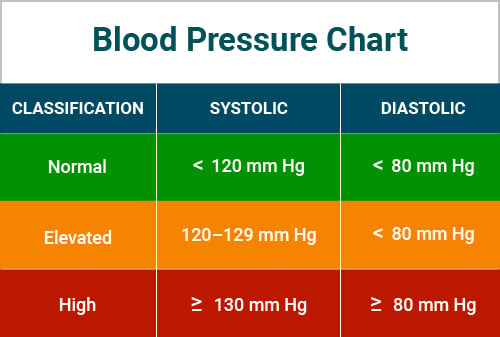
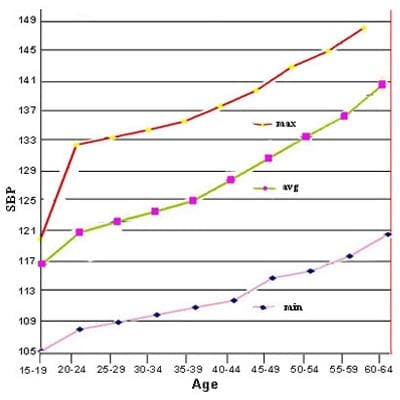
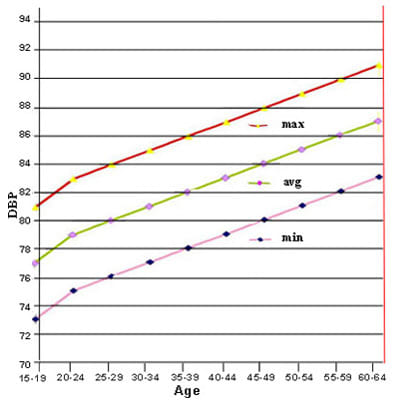
Blood pressure (BP) chart calculates how age can affect systolic and diastolic pressures. As you get older the risk of hypertension (or high blood pressure) rises. The BP chart displays the systolic blood pressure (top number) and diastolic blood pressure (bottom number) readings that are classified as normal or borderline or high (1✔). The likelihood of isolated systolic hypertension too increases with age.
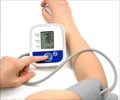
Blood Pressure is the measurement of pressure of the blood flowing through your arteries against the wall. It can be easily checked at home with an electronic or an automated device.
How is the Blood Pressure Checked?
Checking pressure of the Upper arms' major artery (brachial artery) that carries blood from heart to elbow is the most common method. Please remember to put on the cuff properly (watch animation) and if the pressure is high, check it again when you are more relaxed. Also remember that your pressure may be on the high side after a meal or exercise (2✔,3✔).
What is the Average Blood Pressure for Young and Old age?
High blood pressure often has no signs or symptoms and is a silent disease. Adults after the age of 40 years should get blood pressure checked at least once a year(4✔).
About 31.1% of adults worldwide (1.39 billion people) have hypertension (5✔).
In 2017, new guidelines redefined hypertension as a systolic BP of 130 mmHg or higher and/or a diastolic BP of 80 mmHg or higher.** This change increased the number of people diagnosed with hypertension in the US from 32.0% to 45.4% (6✔).
The prevalence of hypertension among adults was higher in low and middle-income countries (31.5%, 1.04 billion people) compared to high-income countries (HICs; 28.5%, 349 million people). (6✔).82% live in low- and middle-income countries, and India alone is home to an estimated 220 million adults with hypertension (7✔).
The global mean age-standardized systolic BP was 127.0 mmHg for men and 122.3 mmHg in women. The mean age-standardized diastolic BP was 78.7 mmHg in men and 76.7 mmHg in women (8✔).
Between 1975 and 2015, systolic and diastolic BP increased in East and Southeast Asia, South Asia, Oceania, and sub-Saharan Africa.
High blood pressure increases the risk of kidney failure by 22 times.** For men with very high blood pressure (systolic BP >210 mmHg or diastolic BP >120 mmHg), the relative risk of end-stage renal disease (ESRD) is significantly higher (9✔).
High blood pressure is responsible for 8.5 million deaths worldwide due to stroke, ischaemic heart disease, other vascular diseases, and renal disease (10✔).
As of 2021, only 21% of people with hypertension had their blood pressure under control (11✔).
Among adults with hypertension, 36.9% had been diagnosed.** Diagnosis rates were higher in urban areas (39.9%) compared to rural areas (35.4%), among older adults (51.3% for those 65 and older), those with more wealth (40.7% in the highest wealth group), and those with higher education levels (39.4% with post-secondary education) (12✔).
FAQ's of Blood Pressure
1. How can high blood pressure be prevented?
Preventive measures include maintaining a healthy diet, regular physical activity, managing stress, avoiding smoking, and limiting alcohol intake (13✔).
2. What are the risks of untreated high blood pressure?
Untreated hypertension can lead to serious health complications, including heart disease, stroke, kidney damage, and vision loss (14✔).
3. What lifestyle changes can help lower blood pressure?
Key lifestyle changes include a balanced diet rich in fruits and vegetables, regular exercise, weight loss, reducing sodium intake, and quitting smoking (15✔).
4. What medications are commonly used to treat high blood pressure?
Common medications include diuretics, ACE inhibitors, calcium channel blockers (e.g., amlodipine), beta-blockers, and angiotensin II receptor blockers (ARBs) (15✔).
5. What is amlodipine, and how does it help with hypertension?
Amlodipine is a type of medication known as a calcium channel blocker. It works by relaxing the blood vessels, which helps to lower blood pressure. By preventing calcium from entering the cells of the heart and blood vessel walls, amlodipine helps to dilate the blood vessels, making it easier for blood to flow and reducing overall blood pressure (15✔).
6. What are beta-blockers, and when are they used for hypertension?
Beta-blockers are a class of medications that reduce blood pressure by blocking the effects of adrenaline on the heart and blood vessels. This decreases heart rate, reduces the force of heart contractions, and lowers blood pressure. They are often prescribed when other treatments are not suitable, or in cases where hypertension is accompanied by other conditions such as heart disease (16✔). .
7. How do ACE inhibitors work to control hypertension?
ACE inhibitors (Angiotensin-Converting Enzyme inhibitors) work by blocking the enzyme that converts angiotensin I into angiotensin II, a substance that narrows blood vessels. By preventing this conversion, ACE inhibitors help to relax blood vessels and lower blood pressure. They are often used to treat hypertension and can also provide benefits in cases of heart failure and kidney issues (17✔).
8. What role does diet play in managing blood pressure?
A diet low in salt, rich in potassium, and based on whole foods can significantly lower blood pressure. The DASH (Dietary Approaches to Stop Hypertension) diet is often recommended (18✔).
9. How much salt can I have to help my blood pressure to be under control?
Excess salt in the diet can cause an increase in blood pressure, To keep blood pressure under control restrict your salt or sodium intake to 2.4 grams/day (19✔).
10. How does stress affect blood pressure?
Chronic stress can contribute to high blood pressure. Stress management techniques such as meditation, deep breathing, and yoga can help lower stress levels and blood pressure (20✔).
11. What is the connection between sleep and blood pressure?
Poor sleep quality and sleep disorders like sleep apnea can increase the risk of developing hypertension. Ensuring good sleep hygiene is important for blood pressure management (21✔).
12. How often should blood pressure be checked?
Adults should have their blood pressure checked at least once every year if it is within the normal range, and more frequently if they have hypertension or are at risk (22✔).
13. Can high blood pressure be cured?
While hypertension cannot be cured, it can be effectively managed with lifestyle changes and medication. Continuous management is crucial to prevent complications (23✔) .
14. What is resistant hypertension?
Resistant hypertension is a condition where blood pressure remains high despite the use of three or more antihypertensive medications, including a diuretic. It may require specialized treatment and lifestyle changes (24✔).
15. What is white coat hypertension and how is it managed?
White coat hypertension occurs when a patient's blood pressure is elevated in a medical setting but normal at home. It can be managed by monitoring blood pressure at home and using ambulatory blood pressure monitoring to get accurate readings (25✔).
16. What is Mean Arterial Pressure (MAP)?
Mean Arterial Pressure (MAP) is the average arterial pressure throughout one cardiac cycle, systole, and diastole. MAP is influenced by cardiac output and systemic vascular resistance, each of which is influenced by several variables (26✔).
17. How Can Blood Pressure Analysis Help You?
Blood Pressure Analysis involves evaluating your blood pressure readings to understand your cardiovascular health. Using tools like a blood pressure calculator by weight or a blood pressure calculator app, you can track changes over time, assess your risk for hypertension or hypotension, and make informed decisions about lifestyle changes or treatments (27✔).
Physiology, Blood Pressure Age Related Changes - (https://pubmed.ncbi.nlm.nih.gov/30725982/)
Hypertension in Adults: Screening - (https://www.uspreventiveservicestaskforce.org/uspstf/recommendation/hypertension-in-adults-screening)
The global epidemiology of hypertension - (https://www.nature.com/articles/s41581-019-0244-2)
ACC/AHA/AAPA/ABC/ACPM/AGS/APhA/ASH/ASPC/NMA/PCNA Guideline for the Prevention, Detection, Evaluation, and Management of High Blood Pressure in Adults: Executive Summary: A Report of the American College of Cardiology/American Heart Association Task Force on Clinical Practice Guidelines - (https://pubmed.ncbi.nlm.nih.gov/29133354/)
Worldwide trends in hypertension prevalence and progress in treatment and control from 1990 to 2019: a pooled analysis of 1201 population-representative studies with 104 million participants - (https://www.ncbi.nlm.nih.gov/pmc/articles/PMC8446938/)
Worldwide trends in blood pressure from 1975 to 2015: a pooled analysis of 1479 population-based measurement studies with 19·1 million participants - (https://pubmed.ncbi.nlm.nih.gov/27863813/)
Time-updated systolic blood pressure and the progression of chronic kidney disease: a cohort study - (https://pubmed.ncbi.nlm.nih.gov/25686166/)
Worldwide trends in hypertension prevalence and progress in treatment and control from 1990 to 2019: a pooled analysis of 1201 population-representative studies with 104 million participants - (https://www.thelancet.com/article/S0140-6736(21)01330-1)
Global Health Estimates: Life expectancy and leading causes of death and disability
- (https://www.who.int/data/gho/data/themes/mortality-and-global-health-estimates)
Hypertension Diagnosis, Treatment, and Control in India - (https://www.ncbi.nlm.nih.gov/pmc/articles/PMC10594142/)
Lifestyle medicine as a modality for prevention and management of chronic diseases - (https://www.ncbi.nlm.nih.gov/pmc/articles/PMC10176046/)
DASH Eating Plan - (https://www.nhlbi.nih.gov/education/dash-eating-plan)
How Salt Can Impact Your Blood Pressure, Heart and Kidneys - (https://health.clevelandclinic.org/kidneys-salt-and-blood-pressure-you-need-a-delicate-balance)
Stress and high blood pressure: What's the connection? - (https://www.mayoclinic.org/diseases-conditions/high-blood-pressure/in-depth/stress-and-high-blood-pressure/art-20044190)
How sleep deprivation and sleep apnea impact heart health - (https://www.uchicagomedicine.org/forefront/heart-and-vascular-articles/2024/january/how-sleep-deprivation-and-sleep-apnea-impact-heart-health )
High blood pressure in adults – hypertension - (https://medlineplus.gov/ency/article/000468.htm)
High blood pressure (hypertension) - (https://www.mayoclinic.org/diseases-conditions/high-blood-pressure/diagnosis-treatment/drc-20373417)
Treatment of Resistant and Refractory Hypertension - (https://www.ahajournals.org/doi/10.1161/CIRCRESAHA.118.312156)
White-Coat Hypertension and Masked Hypertension - (https://www.cedars-sinai.org/health-library/diseases-and-conditions/w/white-coat-hypertension-and-masked-hypertension.html)
Physiology, Mean Arterial Pressure - (https://www.ncbi.nlm.nih.gov/books/NBK538226/)
Measurement of Blood Pressure in Humans: A Scientific Statement From the American Heart Association - (https://www.ahajournals.org/doi/full/10.1161/HYP.0000000000000087)
Post a Comment
Comments should be on the topic and should not be abusive. The editorial team reserves the right to review and moderate the comments posted on the site.
Comments
gregorio-centeno - Nov 20, 2024
My bpm is 120/70 and my pulse rate is at 90 bpm. Is it normal or something is wrong? Sometimes i feel dizziness,my heart beats faster than my the regular at having palpitation sometimes. I do feel head ache while i ate something faty foods. Hope you can help me.
colin-thomson - May 18, 2024
My blood pressure has been between 190 and 210 /80 for a couple of months what should i do ?
nicho-barnard - May 09, 2024
Good day. 50 years old, tonight took blood pressure 6 time and all the 6 time it was between 200/120 and 240/170. Is this normal?
perrone - May 08, 2024
I'm 60 years right now, and my blood pressure was 137 over 90. With a third number of 84. Should I be worry?
thang-mlod - Apr 19, 2024
My name is Thang [Vietnam]. I am 62 years old, my blood pressure readings in the morning both arms are as follows:
- Right hand: 107/70, heart rate 71.
- Left hand: 105/70, heart rate 71.
I am currently a vegetarian, one meal a day (OMAD). I regularly wake up at 4 am (brahma muhurta) to do some yoga asanas, then do nadi shodhana for 15 minutes and meditate for about 60 minutes.
 MEDINDIA
 English
 हिन्दी
 Español
 français
 中文
中文
 Email
Email














My bpm is 120/70 and my pulse rate is at 90 bpm. Is it normal or something is wrong? Sometimes i feel dizziness,my heart beats faster than my the regular at having palpitation sometimes. I do feel head ache while i ate something faty foods. Hope you can help me.