MEDINDIA
 English
 हिन्दी
 Español
 français
 中文
中文
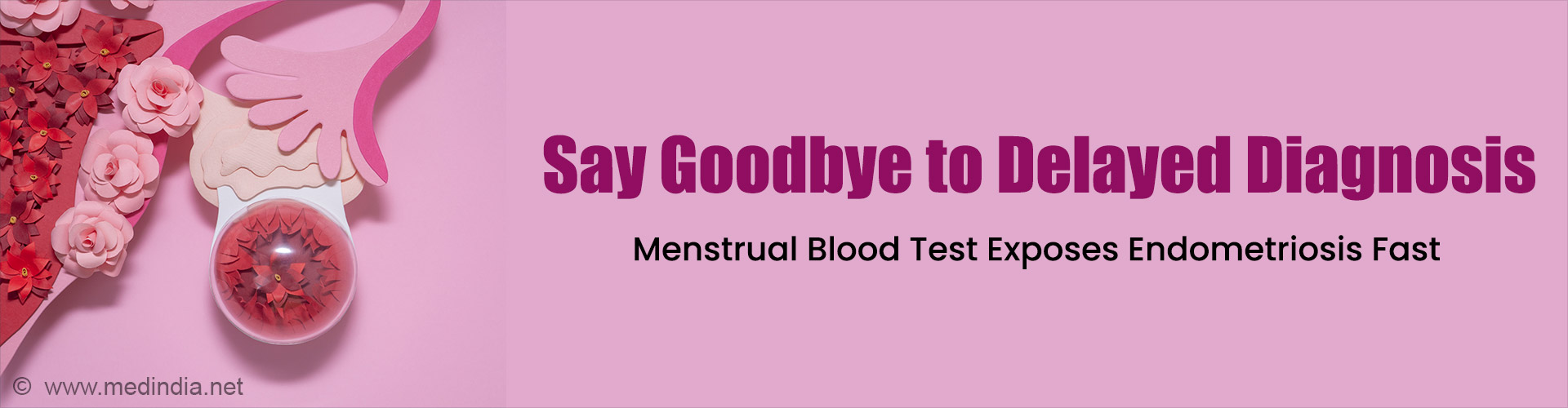
Endometriosis can now be detected five times more sensitively through a borophene-based test using menstrual blood.
Highlights:
Almost 200 million people worldwide, including many children, live with endometriosis—a chronic condition in which uterine tissue grows outside the uterus. Although early detection and treatment can alleviate intense pain and prevent infertility, there is no single diagnostic test available at the point of care, despite the accessibility of the tissue involved (1✔ ✔Trusted Source- Borophene-based menstrual blood test detects endometriosis with five times more sensitivity
- The device works like a pregnancy test and can identify key protein HMGB1 in menstrual blood
- It may allow discreet home monitoring and reduce diagnostic delays up to 12 years
Photoinduced Immobilization on Two-Dimensional Nano Borophene Spatially Orients Capture Antibody for Highly Sensitive Biological Interactions
Go to source).
Penn State Professor Dipanjan Pan noted that menstrual blood, often dismissed and stigmatized as waste, could be used to detect early biological markers that may assist in diagnosing endometriosis. His team developed a prototype device capable of identifying HMGB1, a protein linked to the condition’s onset and development, in menstrual blood with 500% greater sensitivity than current laboratory methods.

Quiz on Endometriosis
Endometriosis is a condition that results in pain associated with menstrual cycle, sexual activity. It is also one of the causes of infertility. Test your knowledge on endometriosis by taking this ...
Endometriosis is a condition that results in pain associated with menstrual cycle, sexual activity. It is also one of the causes of infertility. Test your knowledge on endometriosis by taking this ...
TOP INSIGHT

Did You Know?
A test that works like a #pregnancy test can detect an endometriosis-linked protein in #menstrual blood with 500 percent more sensitivity than traditional lab tests. #endometriosis #womenshealth #medindia #borophene
Detection Through Borophene-Based Device
Functions like a pregnancy test, the newly developed device uses a novel method to produce nanosheets from borophene, an atomically thin two-dimensional material. The team’s work, led by Pan, the Dorothy Foehr Huck and J. Lloyd Huck Chair Professor in Nanomedicine, was published on the cover of ACS Central Science.Pan, who is also a professor of nuclear engineering and materials science and engineering, and associated with biomedical engineering and radiation oncology departments, highlighted the social stigma and limited affordability that hinder broader adoption of menstrual fluid-based diagnostics.
Drugs for Endometriosis
View list of generic and brand names of drugs used for treatment of Endometriosis. Find more information including dose, side effects of the Endometriosis medicine.
View list of generic and brand names of drugs used for treatment of Endometriosis. Find more information including dose, side effects of the Endometriosis medicine.
Challenges with Current Diagnostic Techniques
Conventional diagnosis includes intravenous blood tests, imaging, and a thorough patient history, which are time-consuming and often delay diagnosis. One investigation involving 218 women in the United States revealed delays as long as 12 years before receiving a definitive diagnosis.By using borophene, Pan emphasized that the team’s approach not only enhances diagnostic capability but also combats stigma surrounding menstruation while advancing health care for women.

Blood Biomarkers and Genomics: Powerful Insights into Disease Risk
Discover how blood biomarkers can enhance near-term risk prediction, enabling personalized preventive care for better health outcomes.
Discover how blood biomarkers can enhance near-term risk prediction, enabling personalized preventive care for better health outcomes.
Unique Properties of Borophene
Derived from boron, borophene shares some characteristics with graphene, a carbon-based two-dimensional material, but offers distinct advantages. According to Pan, borophene is both biocompatible and biodegradable, making it particularly useful in biomedical fields.However, producing pure borophene has challenges. Traditional fabrication methods use harsh solvents like isopropyl alcohol, which can damage material quality and render it unsuitable for medical use.
New Blood-based Biomarker to Differentiate Between Bacterial and Viral Infections
New molecular biomarkers developed by scientists can be used in differential diagnosis of acute bacterial and viral infections.
New molecular biomarkers developed by scientists can be used in differential diagnosis of acute bacterial and viral infections.
Water-Based Synthesis and Antibody Integration
To address this, the team replaced alcohol with water, dispersing powdered boron in water to break down and reconstitute it into pristine nanosheets. They then anchored antibodies that recognize HMGB1 proteins onto these sheets.Pan compared the process to gardening: the nanosheets act as soil, antibodies as fertilizer, and the HMGB1 proteins as the plants they aim to grow. Creating a clean and even nanosheet foundation enabled the antibodies to successfully identify and bind to the proteins.
Device Performance and Sensitivity
Extensive imaging and chemical tests confirmed that the antibodies successfully captured HMGB1 proteins. These nanosheets were then incorporated into a test strip that works like a pregnancy test—displaying one line for a negative result and two for a positive.To assess performance, researchers added HMGB1 proteins at varying concentrations to menstrual blood. The test identified the protein even at low levels with five times greater sensitivity than traditional laboratory tests, which typically require extensive preparation.
Broader Applications and Future Expansion
Pan emphasized that clinical data reveals elevated HMGB1 levels in people with endometriosis compared to healthy individuals. Detecting even slight increases is critical for early intervention, especially in mild or asymptomatic cases. The device’s high sensitivity makes it particularly suitable for use in locations without centralized medical facilities.The technology could be integrated into menstrual pads for discreet and convenient at-home use. This accessibility may empower people in rural or under-resourced areas to monitor their health more effectively.
Next Steps for Clinical Development
The team’s future goals include scaling up the device for clinical trials, enhancing its sensitivity further, and expanding its capabilities to detect other biomarkers such as those for human papillomavirus and cervical cancer. Pan noted that this innovation illustrates the potential of two-dimensional materials in driving the future of biotechnology and advanced medical solutions.This innovative menstrual blood test utilizes the power of borophene nanosheets to provide a more accessible, sensitive, and stigma-breaking method for detecting endometriosis. With further development, it may pave the way for early diagnosis not only of endometriosis but also of other gynecological conditions in the future.
Reference:
- Photoinduced Immobilization on Two-Dimensional Nano Borophene Spatially Orients Capture Antibody for Highly Sensitive Biological Interactions - (https:pubs.acs.org/doi/10.1021/acscentsci.5c00474)
Source-Medindia
 Email
Email