MEDINDIA
 English
 हिन्दी
 Español
 français
 中文
中文

Research links emotionally supportive marriages with lower BMI, fewer food cravings and healthier brain gut metabolism patterns that may curb obesity risk.
Highlights:
Strong social relationships are known to improve survival and overall health. New research published in the journal Gut Microbes now suggests that the quality of emotional support in marriage may also help protect against obesity by influencing an integrated brain gut axis regulated by the hormone oxytocin (1✔ ✔Trusted Source- Strong emotional support in marriage is linked to lower BMI and fewer food addiction behaviors
- Brain regions for self-control respond more strongly to food images in well supported married adults
- Supportive relationships show healthier gut tryptophan metabolites and higher oxytocin levels that may protect against obesity
Social bonds and health: exploring the impact of social relations on oxytocin and brain-gut communication in shaping obesity
Go to source). Oxytocin is often called the love hormone because it is closely tied to bonding and trust, but it also affects appetite, metabolism and how the brain responds to food.

Body Fat Calculator
This calculator estimates your percentage body fat, your body type and the amount of calories you have to burn to lose 1% of your body fat and it uses U.S Navy’s Hodgdon-Beckett formula.
This calculator estimates your percentage body fat, your body type and the amount of calories you have to burn to lose 1% of your body fat and it uses U.S Navy’s Hodgdon-Beckett formula.
TOP INSIGHT

Did You Know?
People who feel strongly supported in close #relationships can have up to 50 percent better survival and may also show healthier #weight patterns through #oxytocin linked brain gut pathways. #socialsupport #bmi #lovehormone #braingutaxis #obesity #medindia
Why Supportive Relationships Matter for Obesity Risk
In this study, researchers examined nearly 100 adults and collected detailed information on marital status, perceived emotional support, diet, body weight and other health factors.Participants underwent brain scans while looking at food images, blood tests to measure oxytocin levels, and stool tests to analyze metabolites produced by gut bacteria.
Clinical and behavioral assessments included measures of Body Mass Index (BMI) and symptoms of food addiction such as loss of control eating and persistent cravings.
The analysis showed that being married was not enough by itself to influence weight. Instead, married adults who reported high emotional support from their partner had lower BMI values and fewer food addiction behaviors than married adults who felt less supported.
In contrast, unmarried participants, regardless of how supported they felt by friends or family, did not show the same favorable pattern. This suggests that stable, day to day support within a long-term partnership may create a unique biological environment for weight regulation.

Obesity - Causes, Symptoms, Diagnosis, Complications, Treatment
Obesity is a condition where there is excess accumulation of body fat which poses a risk to the health of the individual. It can affect children and adults.
Obesity is a condition where there is excess accumulation of body fat which poses a risk to the health of the individual. It can affect children and adults.
Inside the Brain: Better Self Control in High Support Marriages
Brain imaging focused on the dorsolateral prefrontal cortex (dlPFC), a region that helps with impulse control, planning and resisting temptations.When participants viewed food images, adults in supportive marriages showed stronger dlPFC activation, indicating more active self-control circuits in response to food cues.
This pattern was not seen in unmarried participants, even when they reported good emotional support from non-marital relationships.
Researchers propose that the day in and day out demands of maintaining a committed partnership may repeatedly train self-control networks in the brain. Over time, this may spill over into better regulation of eating behavior and reduced vulnerability to highly palatable foods.

Food Addiction – Symptoms, Treatment, Tips
Food addiction is the compulsive need to eat junk food that has a lot of carbohydrates, sugar, flour and other fatty substances. This can occur even when you are not hungry.
Food addiction is the compulsive need to eat junk food that has a lot of carbohydrates, sugar, flour and other fatty substances. This can occur even when you are not hungry.
Gut Metabolites and Oxytocin Tie Love to Metabolism
The study also examined the gut microbiome by measuring metabolic products in stool samples. Participants with stronger emotional support showed more favorable patterns of tryptophan metabolites, compounds produced by gut bacteria that influence inflammation, immune regulation, energy balance, and brain function.These metabolites are involved in the production of serotonin and related molecules that affect mood and social behavior as well as metabolism.
Central to the findings was oxytocin. Married adults with high perceived support had higher circulating oxytocin than unmarried adults. The authors suggest that oxytocin may act as a biological messenger connecting social experience with both brain and gut.
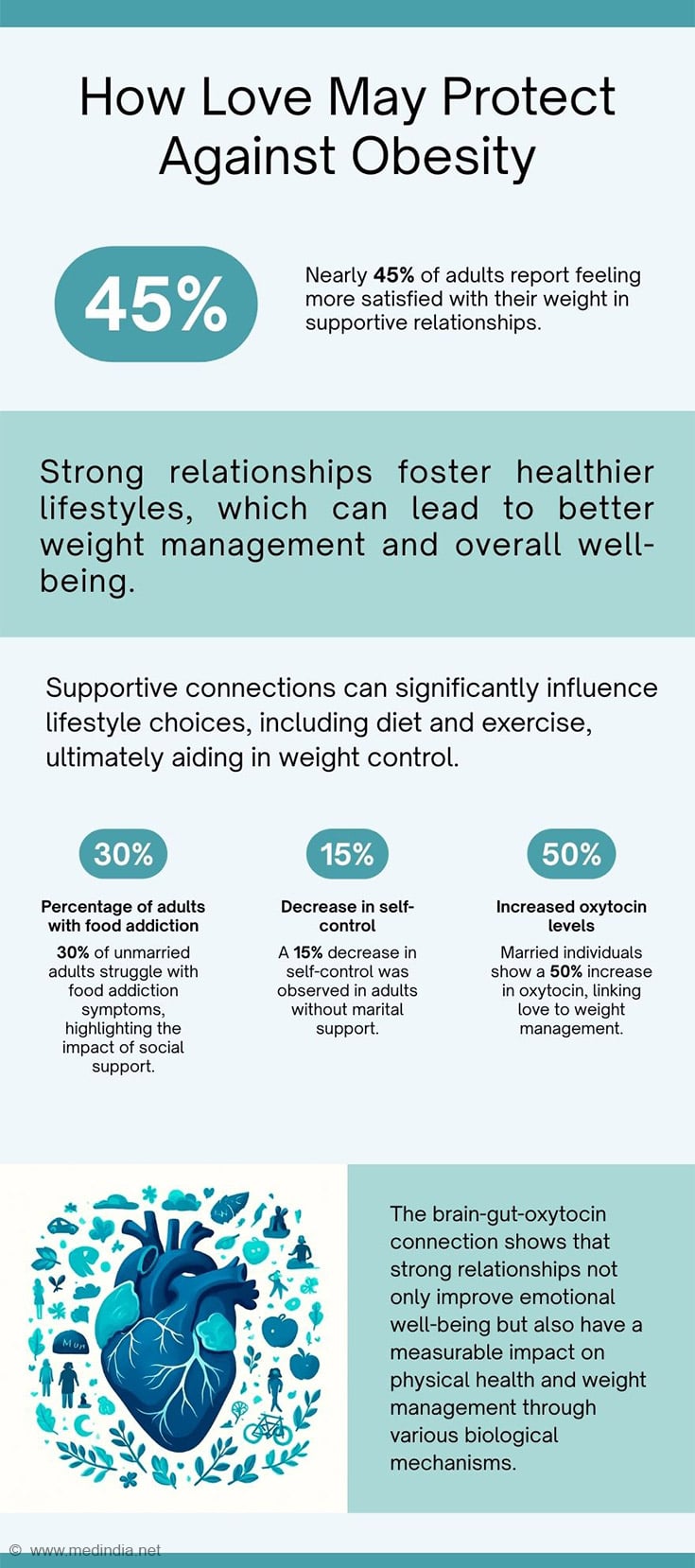
Other research on oxytocin and the microbiome also supports a bidirectional relationship, where gut microbes can influence oxytocin release and oxytocin can shape gut composition and metabolic health.
The authors caution that their data were collected at a single time point, so cause and effect cannot be proven. Most volunteers were already overweight or obese and married participants tended to be older, which may limit generalization. Larger and more diverse longitudinal studies are needed to confirm how social bonds over time shape the brain gut axis and obesity risk.
Oxytocin Shows How Supportive Relationships Shape Appetite and Metabolism
This research highlights that obesity is not only about calories, exercise, and genetics. The quality of close relationships may also be biologically embedded in appetite control and metabolism through oxytocin driven links between the brain and gut. For individuals trying to manage weight, nurturing emotionally supportive bonds could complement healthy diet and physical activity.
Reference:
- Social bonds and health: exploring the impact of social relations on oxytocin and brain-gut communication in shaping obesity - (https://www.tandfonline.com/doi/full/10.1080/19490976.2025.2566978)
Source-Medindia

Yoga - Obesity
The problem of excess weight can be effectively dealt with, by the practice of yoga, which helps to shed unnecessary fat and keep the body in shape and in good health.Yoga - obesity cause
The problem of excess weight can be effectively dealt with, by the practice of yoga, which helps to shed unnecessary fat and keep the body in shape and in good health.Yoga - obesity cause
 Email
Email