MEDINDIA
 English
 हिन्दी
 Español
 français
 中文
中文
Tiny living robots, called AggreBots, are built from human cells and can swim, spin, and move autonomously.
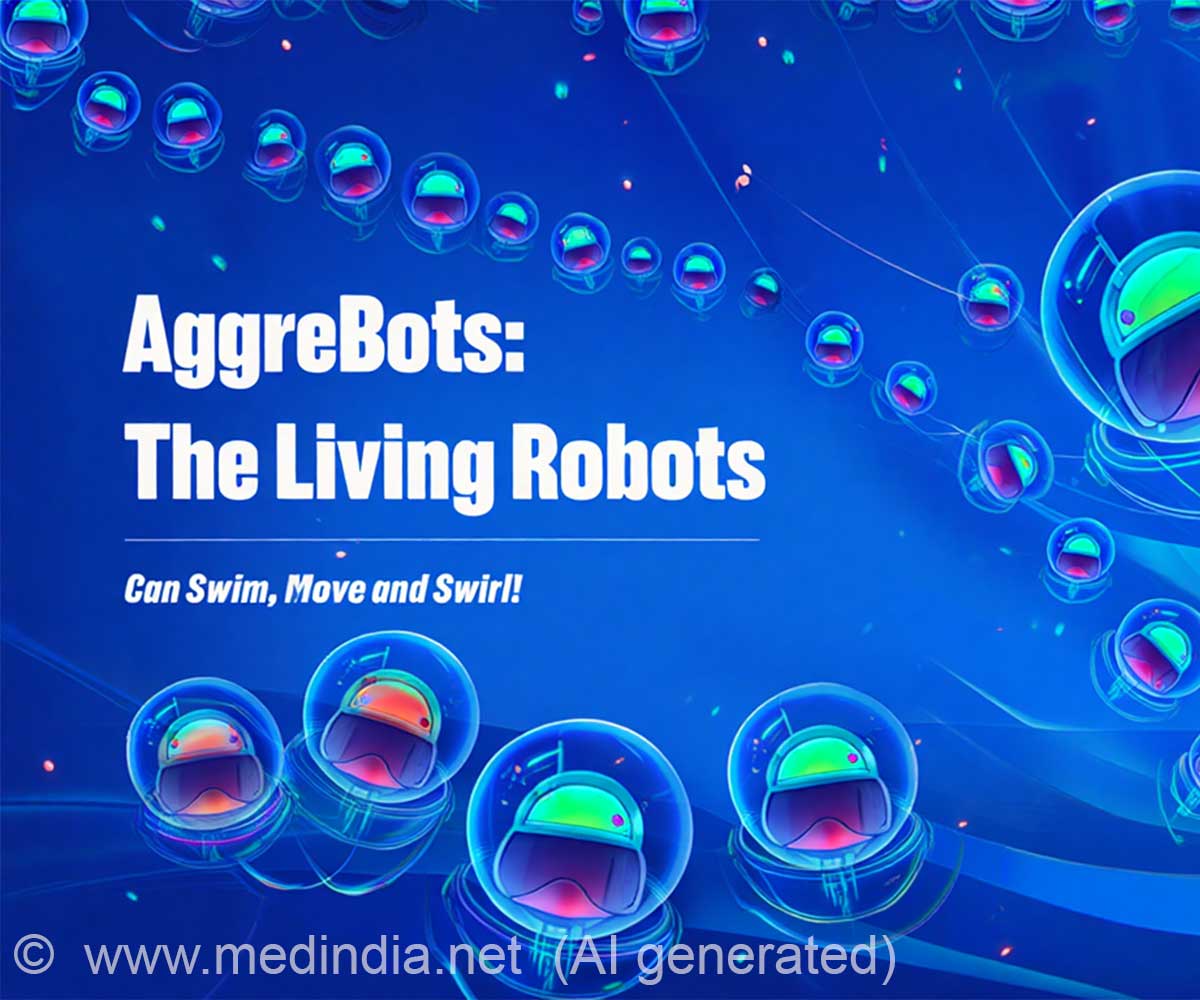
AggreBots: Configuring CiliaBots through guided, modular tissue aggregation
Go to source)!
Living Robots in the Next Two Decades
A scientist has said that we are a lot closer to living robots than we may realize.
A scientist has said that we are a lot closer to living robots than we may realize.
TOP INSIGHT

Did You Know?
#AggreBots use living cells as engines with no motors required!
#livingrobots #medindia
Building Robots from Living Lego
AggreBots start as CiliaBot Building Blocks (CBBs), which are small groups of human cells with cilia naturally growing. On their own, these blocks form simple spherical bots, called UniBots, that can wiggle around. Scientists may create AggreBots in a variety of forms, such as a rod, triangle, or diamond, by stacking many CBBs like Lego pieces. With each novel form, the movement of the bot changes—straight movements, winding, or even spinning.
One Step Closer: Living Human Skin Crafted for Robots!
Robotic finger has a human-like appearance and can improve communication efficiency and evoke likability.
Robotic finger has a human-like appearance and can improve communication efficiency and evoke likability.
Aggrebot's Ability To Program Motion
The real breakthrough is the ability to program motion. Scientists did this by mixing in cell blocks with inactive cilia (from patients with a genetic condition where cilia don’t move). These “silent” modules don’t contribute to movement, so researchers can create zones of active and inactive cilia on the bot’s surface. The result? Bots that can be tuned to move faster, slower, in loops, or in straight lines. Essentially, the bots’ behavior is written into their design.
Robotic Muscles That Move Like Real!
Scientists bioprint living muscle-tendon units that contract for months, offering promise for robotics, prosthetics, and regenerative medicine.
Scientists bioprint living muscle-tendon units that contract for months, offering promise for robotics, prosthetics, and regenerative medicine.
Opening Doors To Revolutionary Applications
AggreBots aren’t just cool lab creations—they may open the door to revolutionary applications:- Medicine delivery: Swimming bots could carry drugs directly to diseased tissue.
- Repair and regeneration: They might one day help patch damaged tissue or clear blockages.
- Diagnostics: Doctors could study how these bots behave in mucus-like environments to learn about lung diseases such as cystic fibrosis or COPD.
- Biohybrid machines: AggreBots offer a way to design “living engines” powered by natural cell activity, without external motors or batteries.

Is Tech the Key to Faster Healing in Rehabilitation?
Explore how cutting-edge robotics, virtual reality, and AI are transforming rehabilitation, enhancing patient outcomes, and redefining motor recovery.
Explore how cutting-edge robotics, virtual reality, and AI are transforming rehabilitation, enhancing patient outcomes, and redefining motor recovery.
AggreBots Hint at a Future of Living Robots
Right now, AggreBots are tiny lab prototypes. But the study proves that we can engineer living robots with predictable behavior by controlling three levers:- Shape (rod, triangle, diamond, etc.)
- Cilia activity (active vs. inactive zones)
- Arrangement (how blocks are positioned)
AggreBots mark an exciting step toward a future where biology and robotics merge. Instead of wires and circuits, these machines run on living cells. By harnessing nature’s own machinery, scientists are building a new class of programmable, living robots that might someday travel inside our bodies—delivering medicine, repairing tissue, and transforming healthcare from the inside out!
Reference:
- AggreBots: Configuring CiliaBots through guided, modular tissue aggregation - (https://www.science.org/doi/10.1126/sciadv.adx4176)
Source-Science Advances
 Email
Email