MEDINDIA
 English
 हिन्दी
 Español
 français
 中文
中文
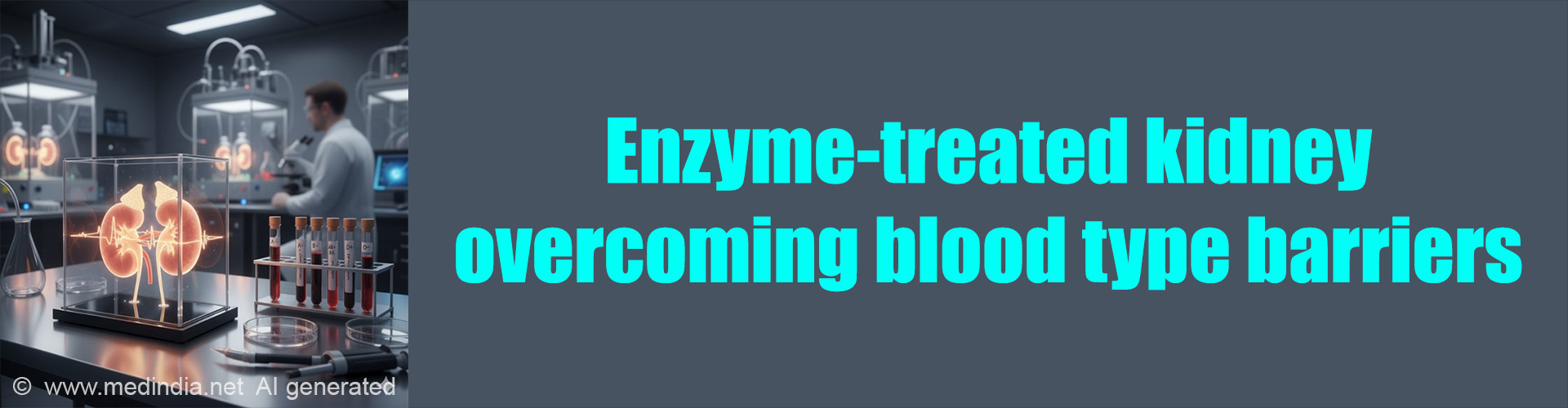
Scientists from Canada and China have created the world’s first universal kidney, capable of being transplanted into any blood type, a major leap in transplant medicine.
Highlights:
A team of Canadian and Chinese researchers has achieved a historic feat in organ transplantation — developing a universal kidney that can be transplanted into recipients of any blood type (1✔ ✔Trusted Source- Enzymes convert donor kidneys into a neutral “type O” form
- Early human model showed strong kidney function post-transplant
- Could drastically cut global transplant waiting lists
Enzyme-converted O kidneys allow ABO-incompatible transplantation without hyperacute rejection in a human decedent model
Go to source). Published in Nature Biomedical Engineering, this breakthrough could overcome one of the biggest challenges in transplant medicine: blood-type incompatibility, which often prevents life-saving procedures.

GFR Calculator
With this easy to use GFR Calculator, calculate your Glomerular Filtration Rate, using creatinine to assess kidney function and support early diagnosis of kidney issues.
With this easy to use GFR Calculator, calculate your Glomerular Filtration Rate, using creatinine to assess kidney function and support early diagnosis of kidney issues.
TOP INSIGHT

Did You Know?
A single enzyme treatment can make a #kidney compatible with any blood type, giving new hope to millions waiting for #organtransplants. #kidneyhealth #transplantation universalkidney #medicalinnovation #medindia
The Science Behind the “Universal” Kidney
The procedure involves using specialized enzymes that act like molecular “scissors,” cutting away surface antigens — the sugar molecules that define blood types such as A or B.Co-author Stephen Withers from the University of British Columbia likened it to “removing red paint from a car to expose the neutral primer underneath.” The treated organ thus becomes immunologically invisible, potentially suitable for any recipient.

Test Your Knowledge on Kidney Transplantation
Kidney transplantation is a surgical procedure done to remove a diseased kidney and replace it with a healthy one from a donor. A person requires one healthy functioning kidney to keep the body functions normal ( ). Once a ...
Kidney transplantation is a surgical procedure done to remove a diseased kidney and replace it with a healthy one from a donor. A person requires one healthy functioning kidney to keep the body functions normal ( ). Once a ...
Testing the Universal Kidney in a Human Model
In a remarkable first, the modified kidney was transplanted into a brain-dead donor subject with family consent. The organ began functioning immediately, filtering blood and producing urine like a normal kidney.By the third day, mild immune responses appeared as traces of type A antigens resurfaced, but overall, the reaction was far less severe than typical rejection.
Encouragingly, researchers noted early signs of immune tolerance, indicating that the body was beginning to accept the modified organ.
Super-Fast Kidney Transplant in Just 9 Days Gives New Life
A 44-year-old received donor kidneys just 9 days after registering, thanks to advanced diagnostics and precision surgery at FIMS, Coimbatore.
A 44-year-old received donor kidneys just 9 days after registering, thanks to advanced diagnostics and precision surgery at FIMS, Coimbatore.
Tackling the Global Kidney Shortage
This innovation could significantly ease the global organ shortage crisis, especially for patients with type O blood — the hardest to match but most in demand. In the U.S. alone, about 11 people die each day while waiting for a compatible kidney.Because type O kidneys can be used universally, their scarcity worsens the waitlist imbalance. The universal kidney approach may drastically reduce waiting times and increase fairness in organ allocation, ensuring patients from all blood groups have an equal chance at survival.

Organ Transplantation Can Now be Done Using Universal Blood Type Organs
Blood group incompatibility adds on as a barrier to organ transplantation. Organ transplantation can be now done easily by utilizing universal blood-types organs.
Blood group incompatibility adds on as a barrier to organ transplantation. Organ transplantation can be now done easily by utilizing universal blood-types organs.
Enzymes That Erase Immunity Barriers
The technique builds upon earlier findings where gut bacterial enzymes could strip antigens from red blood cells.Now, the same principle is applied to kidney tissues, targeting sugar molecules that trigger immune attack. This enzymatic process avoids complex chemical modification and preserves the kidney’s cellular integrity, making it safer and more reliable than genetic or synthetic alternatives.
Challenges Ahead and Future Directions
While the results are promising, researchers caution that residual antigens reappearing after three days show there’s room for improvement. Future work will focus on refining the duration and intensity of enzyme exposure, enhancing complete antigen removal, and possibly combining the method with gene editing or immunosuppressants. The next step is to test the procedure in living donors and recipients, paving the way for clinical trials.Transforming the Future of Transplant Medicine
Experts hail this study as a watershed moment that merges basic biochemistry with life-saving clinical innovation. The ability to make kidneys universally compatible could eliminate the need for expensive desensitization therapies, reduce rejection rates, and reshape global transplant policy. If validated, this discovery could bring organ transplantation into a new era — one where blood type no longer decides who lives or dies.Reference:
- Enzyme-converted O kidneys allow ABO-incompatible transplantation without hyperacute rejection in a human decedent model - (https://www.nature.com/articles/s41551-025-01513-6)
Source-Medindia
 Email
Email