MEDINDIA
 English
 हिन्दी
 Español
 français
 中文
中文
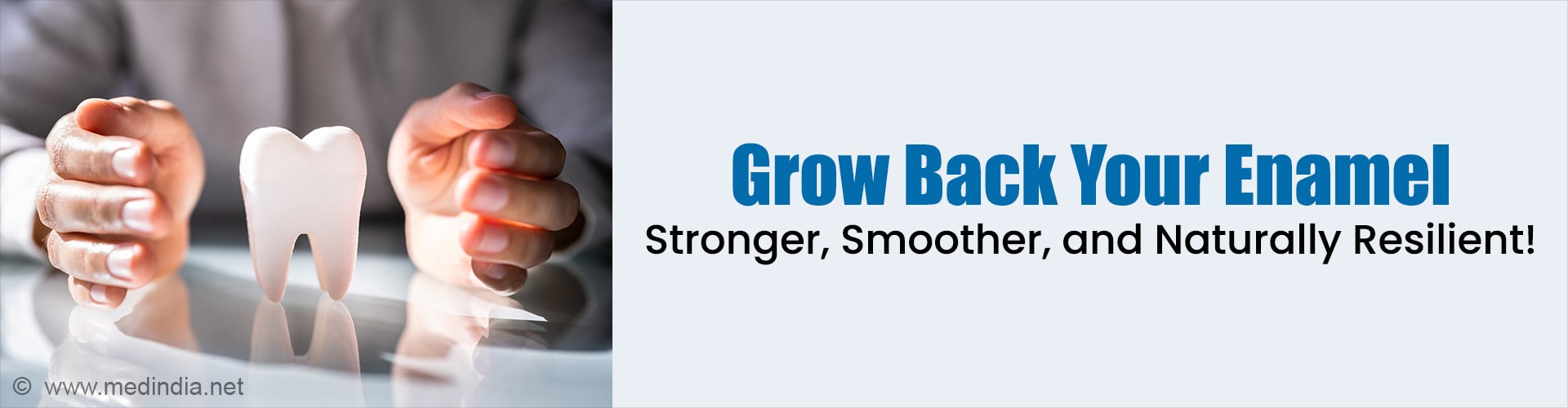
A bioengineered protein coating helps regrow and restore lost tooth enamel, making it even stronger than the original.
Highlights:
Tooth enamel is the hardest substance in the human body; it is tougher than bone and protects our teeth every day from wear and tear due to chewing, grinding, and exposure to acids. But when enamel is lost, it doesn't grow back, and as a result, its resistance to deterioration also diminishes (1✔ ✔Trusted Source- New biomimetic coating regrows natural enamel in minutes
- Restored enamel is stronger and smoother than before
- Potential cure for enamel loss and dentine exposure
Biomimetic supramolecular protein matrix restores structure and properties of human dental enamel
Go to source). Enamel erosion is caused by acidic foods, bacterial colonies, and even over-brushing. Almost half of the world population is exposed to enamel erosion, for which the economic spending alone stands at approximately US $544 billion each year.
Dentists so far could only provide a temporary solution through fillings, veneers, or fluoride treatments, none of which could actually restore enamel!
How Tooth Enamel Forms: Pitt School Of Dental Medicine
Researchers at the University of Pittsburgh School of Dental Medicine are piecing together the process of tooth enamel biomineralization, which could lead to novel
Researchers at the University of Pittsburgh School of Dental Medicine are piecing together the process of tooth enamel biomineralization, which could lead to novel
TOP INSIGHT

Did You Know?
Your enamel endures thousands of chewing cycles per hour and can handle forces up to 770 N-stronger than steel of the same thickness! #enamelregeneration #enamelloss #dentistry #medindia
A New Hope In Restoring Lost Enamel: Biomimetic Protein Matrix
Scientists under the guidance of Professor Alvaro Mata and others from several institutions have designed a biomimetic supramolecular protein matrix capable of regenerating enamel-like tissue and rebuilding its strength and resilience.This innovation is built on elastin-like recombinamers (ELRs), which are synthetic proteins designed to mimic the behaviour of amelogenin (a natural protein responsible for enamel formation during initial stages of tooth development).
The ELR-based coating, when applied to eroded teeth, showed the following results:
- Simulated the natural process of forming enamel.
- Promotes the growth of apatite nanocrystals (the mineral crystals that make enamel strong).
- Recreates the hierarchical layers of real enamel, from the outer aprismatic layer to the deeper prismatic zones.

Soon There Could be Enamel Regrowing Gel That Could Eliminate Tooth Pain
Researchers have now discovered a promising method to regrow nonliving hard tissue, and also lessen or even eliminate pain associated with tooth decay.
Researchers have now discovered a promising method to regrow nonliving hard tissue, and also lessen or even eliminate pain associated with tooth decay.
How the New Enamel Works: Recreating Nature’s Design
The blueprint of this research is purely based on the very nature of enamel. Natural enamel develops through a protein framework known as amelogenin, which acts like a guide to calcium and phosphate ions to form as organised nanocrystals. The researchers replicated this, using a fibril-rich ELR matrix containing special hydrophobic, hydrophilic, and acidic sequences to form fibres on their own in the presence of calcium ions.
Fluoride: Strengthening Teeth or Making Them Weak Over Time?
Learn how enamel remains hard yet becomes brittle with age, and discover tips for maintaining strong, healthy teeth.
Learn how enamel remains hard yet becomes brittle with age, and discover tips for maintaining strong, healthy teeth.
Layer-by-Layer Enamel Regrowth
When applied as a thin coating (2-10 μm) to etch or erode enamel:- The matrix initiates epitaxial growth – i.e., new crystals are produced from the existing old ones.
- The formed layers resemble the microarchitecture of the natural enamel regions (aprismatic, prismatic, and inter-prismatic).
Stronger Than Before: Enamel Fully Restored
The enamel, which had been acid-damaged previously, prior to treatment, had lost the bulk of its strength; it was weak and tender, resembling chalk.
- Flexibility (Young's modulus): Reduced to approximately 37 GPa.
- Hardness: It is only 1.1 GPa, which implies that it can be easily worn or broken.
- Flexibility: Rose to 76 GPa
- Hardness: Had gone up to 3.1 GPa (nearly fully restored).
- The surface became smoother, and the friction was cut down to 0.29.
- The overall wear strength, which is the degree of its resistance to damage, rose by about 92 GPa to 171 GPa, which is higher than the 153 GPa of normal enamel!

Top 10 Dental Problems Everyone Should Know About
Explore the 10 most common dental problems, from cavities to gum disease, and learn how prevention and timely care can help keep your smile healthy.
Explore the 10 most common dental problems, from cavities to gum disease, and learn how prevention and timely care can help keep your smile healthy.
Beyond Healing Enamel, Healing the Dentine Too!
The ELR coating (even when enamel was lost entirely, and the underlying dentine was also revealed) was capable of:- Infiltrating the collagen net of dentine.
- Forming mineral layers that are similar to enamel on its surface.
- Restoring the dentine-enamel junction of natural teeth.
The researchers tested the newly developed enamel with real-life stresses that could cause wear and tear for the natural enamel:
- 1 year of brushing teeth: No structural damage.
- Chewing and grinding (75 N force) for 3.5 years: equivalent wear resistance of natural enamel.
- Acidic beverages (pH 4.0 acetic acid): More resistant to erosion in comparison with untreated enamel.
- Human saliva tests: In the saliva of different donors, the coating demonstrated remarkable efficacy, and under real-world circumstances, enamel regeneration was consistent.
What Importance Does Restoring Enamel Hold?
This study would be a paradigm shift in restorative dentistry. Instead of giving a patchwork to the lost enamel, in the near future, dentists will be able to regenerate it biologically, which can restore enamel’s natural form and functionality.In a situation where they are taken to clinics, this biomimetic method could:
- Lessen dental erosion and sensitivity.
- Provide a quick, safe and least invasive treatment.
- Improve oral health services worldwide, particularly in countries with limited access to quality dental care.
Towards a Regenerative Future With Enamel Regeneration
It was thought to be impossible to regenerate functional enamel, but the research shows that it is possible.The biomimetic ELR matrix can restore enamel's strength, toughness, and chemical resistance in addition to regenerating its intricate nanostructure.
Even though in vivo (live patient) research is still pending before clinical implementation, this innovation is a significant step towards self-healing teeth and regenerative dentistry in the future. The authors conclude that their approach has immense potential in clinical practice and also presents promising opportunities for bio-inspired materials that could enable bio-inspired enamel to work again.
Reference:
- Biomimetic supramolecular protein matrix restores structure and properties of human dental enamel - (https://www.nature.com/articles/s41467-025-64982-y)
Source-Medindia
 Email
Email