MEDINDIA
 English
 हिन्दी
 Español
 français
 中文
中文
Discovering new vulnerable area and biomarker in ovarian cancers can help to identify best candidates for new ovarian cancer treatments.

Ovarian Cancer | Cancer in the Ovaries - Causes, Symptoms, Treatment & Prevention
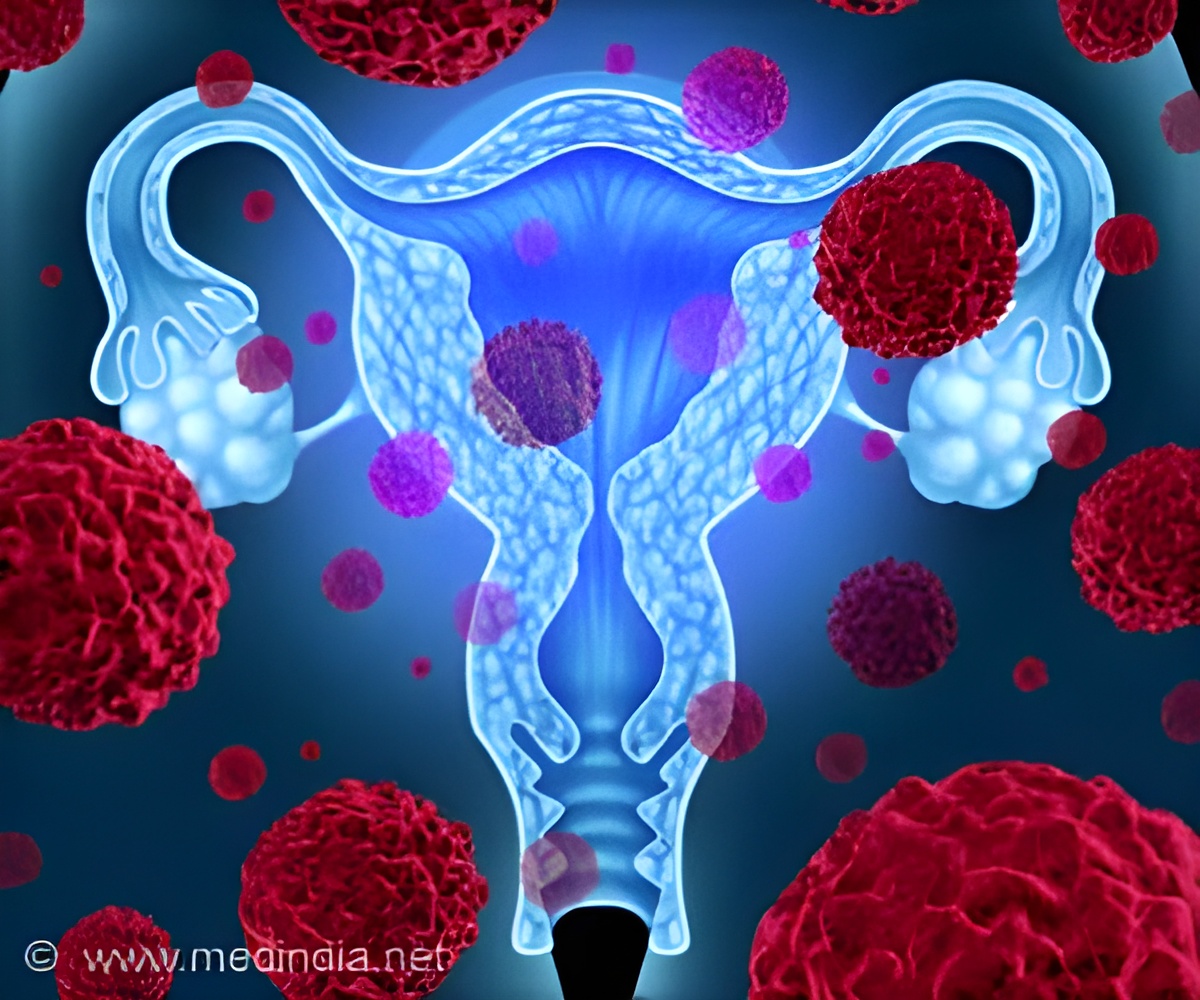
Ovarian cancer affects both the ovaries and is referred to as the 'silent killer' as the symptoms go unnoticed until the disease advances.
Ovarian cancer affects both the ovaries and is referred to as the 'silent killer' as the symptoms go unnoticed until the disease advances.
TOP INSIGHT

New important molecular mechanisms and biomarkers in ovarian cancer are discovered.
These changes give cancer a selective advantage, at the same time they can become a weak area if the alteration is blocked that will kill the cancer or stop its growth.
This new study discovered that ovarian cancers massively amplify an enzyme, NMNAT-2, that makes NAD+. NAD+ is the substrate for a family of enzymes called PARPs, which chemically modify proteins with ADP-ribose from NAD+.

What Women Should Know About Gynecologic Cancer
Cancers arising from the organs of the female reproductive tract (uterine, ovarian, cervical, vulval and vaginal cancers) are termed gynecologic cancers.
Cancers arising from the organs of the female reproductive tract (uterine, ovarian, cervical, vulval and vaginal cancers) are termed gynecologic cancers.
“We were able to show that when ribosomes are mono(ADP-ribosyl)ated in ovarian cancer cells, the modification changes the way they translate mRNAs into proteins,” Dr. Kraus said.

Artificial Intelligence Can Now Predict Survival of Ovarian Cancer Patients
Artificial intelligence (AI) can now predict how ovarian cancer patients will respond to treatment, the likely outcome, and the chances of survival. This will help in planning alternative treatments for the patient beforehand.
Artificial intelligence (AI) can now predict how ovarian cancer patients will respond to treatment, the likely outcome, and the chances of survival. This will help in planning alternative treatments for the patient beforehand.
This finding is not only a great advance in basic science but also a real promise for clinician investigators and cancer care practitioners because it shows a biomarker and a pathway for future drug target.

Here's Why Some Cancers Affect Only Young Women
Scientists have found why certain rare tumors of the ovary and pancreas, the two dissimilar organs have similar characteristics and affect mainly young women. Here’s why.
Scientists have found why certain rare tumors of the ovary and pancreas, the two dissimilar organs have similar characteristics and affect mainly young women. Here’s why.
Source-Medindia
 Email
Email