MEDINDIA
 English
 हिन्दी
 Español
 français
 中文
中文
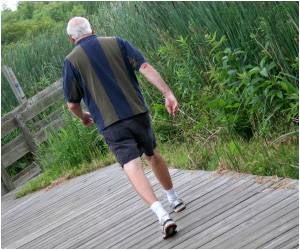
Science says that moderate walking (5000 steps) a day may stall Alzheimer's disease by years and help protect aging brains.

Physical Activity as a Modifiable Risk Factor in Preclinical Alzheimer’s Disease
Go to source)
Older people who aged 50 and above (who already have baseline amyloid plaques in the extracellular nerves) with sedentary lifestyles displayed faster accumulation of toxic tau proteins in the brain, which significantly reduces the cognition.
Participants who walked approximately 5,000-7000 steps per day showed delay in cognitive decline for seven years, while those who walked 3000-5000 steps a day showed delay in cognition for only three years.
The research reveals the power of walking or physical activity against the Alzheimer's disease and brain aging. The findings were published in Nature Medicine.

Quiz On Alzheimer’s Disease
Alzheimer’s disease (AD) is the most common form of dementia. Participate in this quiz to find out how much you know about this debilitating ...
Alzheimer’s disease (AD) is the most common form of dementia. Participate in this quiz to find out how much you know about this debilitating ...
TOP INSIGHT

Did You Know?
Seniors who #walked at least 5,000 steps a day showed about a 3-year delay in #cognitive_decline, while those who walked around 7,000 steps per day showed about a 7-year delay. #walking #alzheimersdisease #seniorhealth #brainhealth #medindia
Lifestyle Factors May Slow Cognitive Decline
“This sheds light on why some people who appear to be on an Alzheimer’s disease trajectory don’t decline as quickly as others,” said senior author Jasmeer Chhatwal, MD, PhD, of the Mass General Brigham Department of Neurology.“Lifestyle factors appear to impact the earliest stages of Alzheimer's disease, suggesting that lifestyle changes may slow the emergence of cognitive symptoms if we act early.”
The researchers analyzed data from 296 participants aged 50-90 years old in the Harvard Aging Brain Study who were all cognitively unimpaired at the beginning of the study.
They used PET (Positron Emission Tomography to reveal biochemical function of tissues and organs) brain scans to measure baseline levels of amyloid-beta in plaques and tau in tangles and assessed the participants’ physical activity using waistband pedometers.
The participants received annual follow-up cognitive assessments for between two and 14 years (average = 9.3 years), and a subset received repeated PET scans to track changes in tau.

Alzheimer's Risk Assessment Calculator
Alzheimer’s Risk Assessment Calculator is a tool to measure the level of Alzheimer’s disease. It also provides tips to prevent Alzheimer’s disease.
Alzheimer’s Risk Assessment Calculator is a tool to measure the level of Alzheimer’s disease. It also provides tips to prevent Alzheimer’s disease.
Physical Activity Curbs Tau Buildup in the Brain
Higher step counts were linked to slower rates of cognitive decline and a slower buildup of tau proteins in participants with elevated baseline levels of amyloid-beta. The researchers’ statistical modeling suggested that most of the physical activity benefits associated with slowing cognitive decline were driven by slower tau buildup.By contrast, in people with low baseline levels of amyloid-beta, there was very little cognitive decline or accumulation of tau proteins over time and no significant associations with physical activity.
“We are thrilled that data from the Harvard Aging Brain Study has helped the field better understand the importance of physical activity for maintaining brain health,” said co-author Reisa Sperling, MD, a neurologist in the Mass General Brigham Department of Neurology and co-principal investigator of the Harvard Aging Brain Study.
Designing Exercise-Based Interventions for Cognitive Resilience
“These findings show us that it’s possible to build cognitive resilience and resistance to tau pathology in the setting of preclinical Alzheimer’s disease. This is particularly encouraging for our quest to ultimately prevent Alzheimer’s disease dementia, as well as to decrease dementia due to multiple contributing factors.”Looking ahead, the researchers plan to dive deeper into which aspects of physical activity may be most important, for example exercise intensity and longitudinal activity patterns. They also plan to investigate the biological mechanisms linking physical activity, tau buildup, and cognitive health.
Critically, the authors believe that this work may help design future clinical trials that test exercise interventions to slow late-life cognitive decline, especially in individuals who are at heightened risk due to preclinical Alzheimer’s disease.
“We want to empower people to protect their brain and cognitive health by keeping physically active,” said first-author Wai-Ying Wendy Yau, MD, a cognitive neurologist in the Mass General Brigham Department of Neurology.
“Every step counts — and even small increases in daily activities can build over time to create sustained changes in habit and health.”
Reference:
- Physical Activity as a Modifiable Risk Factor in Preclinical Alzheimer’s Disease - (https://www.nature.com/articles/s41591-025-03955-6)
Source-Eurekalert
Physical Activity Lowers Cognitive Impairment Risk
In older adults, a link is established between regular physical activity and halt in cognitive impairment, find studies.
In older adults, a link is established between regular physical activity and halt in cognitive impairment, find studies.
 Email
Email