MEDINDIA
 English
 हिन्दी
 Español
 français
 中文
中文
Good news to all heart failure patients: You can continue to drink moderate amounts of alcohol without causing any harm to your health.

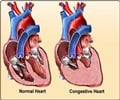
Congestive Heart Failure (Congestive Cardiac Failure) Current Management
Congestive heart failure (CHF) is a condition in which the heart fails to work adequately as a pump that can deliver oxygen rich blood to the body.
Congestive heart failure (CHF) is a condition in which the heart fails to work adequately as a pump that can deliver oxygen rich blood to the body.
TOP INSIGHT

Heart failure patients rejoice! Daily glass of wine is not harmful for you. A new study suggests that drinking moderate amounts of alcohol may not worsen your condition.
Read More..
"My patients who are newly diagnosed with heart failure often ask me if they should stop having that glass of wine every night," said senior author and cardiologist David L. Brown, MD, a professor of medicine.
"And until now, I didn't have a good answer for them. We have long known that the toxic effects of excessive drinking can contribute to heart failure. In contrast, we have data showing that healthy people who drink moderately seem to have some protection from heart failure over the long term, compared with people who don't drink at all. But there was very little, if any, data to help us advise people who drink moderately and have just been diagnosed with heart failure."

Anti-Ageing and Benefits of Red Wine-Starve and Live Long-Resveratrol Benefits
Ageing process has always been an enigma. Recent research indicates that red wine could delay the process.
Ageing process has always been an enigma. Recent research indicates that red wine could delay the process.
The researchers analyzed data from a past study called the Cardiovascular Health Study, conducted from 1989 to 1993. It included 5,888 adults on Medicare. Of these, 393 patients developed heart failure during the nine-year follow-up period. Heart failure occurs when the heart gradually loses the ability to pump sufficient blood to the body. It can be triggered by a heart attack or other chronic conditions such as diabetes or kidney disease.

Wine may Reduce Plaque Build-up in Arteries of Diabetic Patients
Diabetic patients with plaque build-up in arteries showed a decreased amount of debris level in their blood vessels after adding wine to their diet.
Diabetic patients with plaque build-up in arteries showed a decreased amount of debris level in their blood vessels after adding wine to their diet.
The researchers accounted for important variables in their analysis, including age, sex, race, education level, income, smoking status, blood pressure and other factors. After controlling for these variables, the investigators found an association between consuming seven or fewer drinks per week and an extended survival of just over one year, compared with the long-term abstainers.

No Amount of Alcohol is �Safe� for Health
Alcohol consumption even in moderate amounts can be bad for health, says a new study. The authors propose revisiting alcohol control policies and health programs, and considering recommendations for abstention.
Alcohol consumption even in moderate amounts can be bad for health, says a new study. The authors propose revisiting alcohol control policies and health programs, and considering recommendations for abstention.
"People who develop heart failure at an older age and never drank shouldn't start drinking," Brown said. "But our study suggests people who have had a daily drink or two before their diagnosis of heart failure can continue to do so without concern that it's causing harm. Even so, that decision should always be made in consultation with their doctors."
Source-Eurekalert
 Email
Email