MEDINDIA
 English
 हिन्दी
 Español
 français
 中文
中文
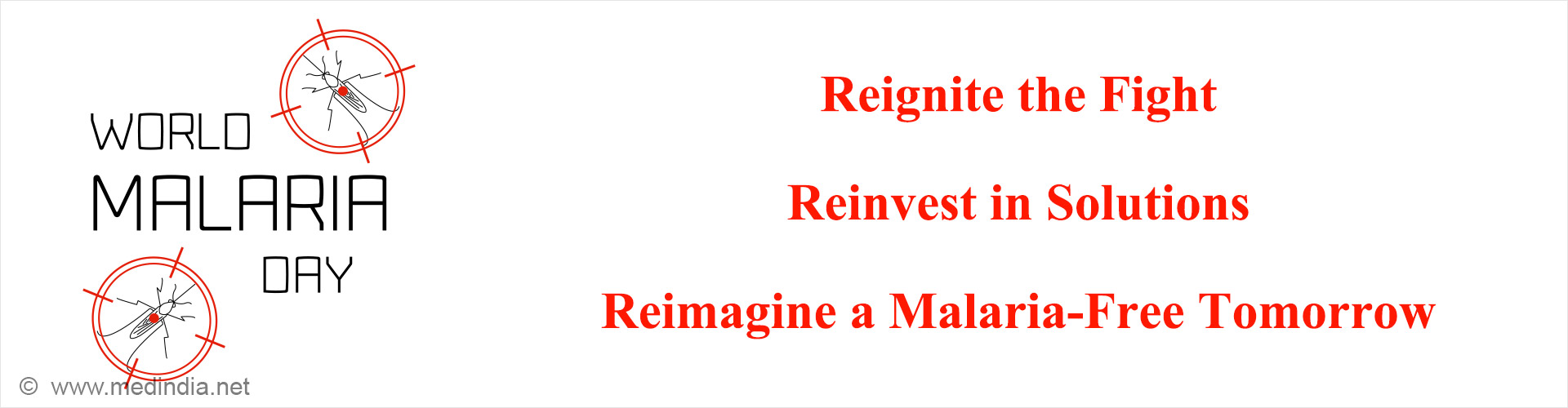
A global spotlight on World Malaria Day 2025 urging renewed action, innovation, and collaboration to eliminate malaria.
Highlights:
Each year, on April 25, World Malaria Day serves as a global platform to spotlight the ongoing need for dedication and investment in defeating malaria. Established in 2007 during the World Health Assembly, this day unites nations and communities in the collective mission to control and eventually eliminate malaria (1✔ ✔Trusted Source- World Malaria Day 2025 unites global efforts under the call to reinvest, reimagine, and reignite the fight against malaria
- Innovation in tools like new vaccines and single-dose treatments is accelerating progress toward malaria elimination
- Equity in malaria response focuses on reaching remote and vulnerable populations often left behind in healthcare access
World Malaria Day 2025
Go to source). For 2025, the global theme — “Malaria Ends With Us: Reinvest, Reimagine, Reignite” — emphasizes a renewed commitment to this cause, urging stakeholders to intensify efforts at every level. The highlights a renewed global commitment to eliminate malaria. It calls on governments, organizations, and individuals to reinvest in life-saving interventions, reimagine strategies through innovation and research, and reignite the collective momentum needed to end malaria for good. This theme reminds us that progress begins with action—and that each of us has a role to play in creating a malaria-free world.
Malaria - Causes, Symptoms, Diagnosis, Prevention, Treatment
Malaria is caused by a parasite that enters blood through the bite of an infected mosquito. It is characterized by fever, vomiting, shivering, sweating and other symptoms.
Malaria is caused by a parasite that enters blood through the bite of an infected mosquito. It is characterized by fever, vomiting, shivering, sweating and other symptoms.
TOP INSIGHT

Did You Know?
Eradicating #malaria by 2030 could return 40 dollars in benefit for every dollar invested, making it one of the most cost-effective global health interventions. #worldmalariaday #medindia #malariaendswithus #globalhealth #zeromalaria
Reinvest: Health as a Catalyst for Economic and Social Progress
Despite progress, malaria remains one of the top causes of mortality in many low-income regions, disproportionately affecting children and expectant mothers. Reinvestment in malaria control isn't merely a public health priority — it drives broader development. As highlighted by Peter Sands, Executive Director of the Global Fund, addressing malaria supports education, economic stability, and societal wellbeing. Studies indicate that eradicating malaria by 2030 could offer an impressive return of forty times the investment— positioning it as a highly effective global health strategy (2✔ ✔Trusted SourceWorld Malaria Day 2025
Go to source).

Malaria - Protection Strategies
Malaria is a dangerous disease with lethal consequences that requires protective measures for prevention and control of malaria in endemic regions of the world.
Malaria is a dangerous disease with lethal consequences that requires protective measures for prevention and control of malaria in endemic regions of the world.
Reimagine: Innovation Leading the Fight Against Malaria
Progress against malaria increasingly hinges on innovation. For instance, researchers are exploring new avenues in chemoprevention, including the first-ever long-acting injectable malaria prophylactic and a historic Phase 3 trial targeting pregnant women. Moreover, the World Health Organization has endorsed the first single-dose treatment for Plasmodium vivax, adding it to official malaria management guidelines. These developments signal a transformative shift in the tools available for fighting the disease.
Quiz on Malaria
Introduction: Malaria is a common parasitic disease of the tropics, resulting in a million deaths every year. It is most commonly found in tropical countries. The symptoms of malaria include fever with chills, headache, ...
Introduction: Malaria is a common parasitic disease of the tropics, resulting in a million deaths every year. It is most commonly found in tropical countries. The symptoms of malaria include fever with chills, headache, ...
Reignite: Revitalizing Collaboration and Community Engagement
Eliminating malaria requires more than science — it demands partnerships and community-driven efforts. Successful models have emerged through organizations like Medicines for Malaria Venture (MMV), which focuses on equitable collaborations and boosting access to antimalarials for vulnerable populations. Additionally, efforts are underway to cultivate a sustainable antimalarial pharmaceutical industry within Africa, ensuring regional resilience.
Interesting Facts and Statistics about Malaria
Malaria is an endemic in many parts of the world. Many lack basic knowledge about preventive measures or medications to fight malaria. Learn about some useful and interesting malaria facts.
Malaria is an endemic in many parts of the world. Many lack basic knowledge about preventive measures or medications to fight malaria. Learn about some useful and interesting malaria facts.
Vaccines: A Turning Point in Malaria Control
In a significant leap forward, two malaria vaccines — RTS,S and R21 — have received WHO approval. These vaccines offer safe and effective protection, especially for children, and production capacity is scaling up to meet global needs. This advancement marks a pivotal moment in reducing malaria’s burden and accelerating progress toward elimination.The Western Pacific: Challenges and Hope
The journey toward a malaria-free world faces unique obstacles in regions like the Western Pacific, where malaria cases often cluster in remote or mobile populations — such as forest goers, migrants, and indigenous groups. Countries such as Papua New Guinea and the Solomon Islands contend with logistical challenges in delivering prevention and treatment services. Despite these hurdles, WHO and national health agencies are intensifying efforts with strategies like community-level drug distribution, rapid fever response, and expanded diagnostic outreach.Between 2000 and 2023, the Western Pacific saw a nearly 50% drop in malaria cases and a similar decline in mortality rates. Several countries, including Cambodia, Vietnam, and South Korea, have also drastically reduced incidence rates, demonstrating the region’s potential for total eradication.
Malaria Ends With Us
World Malaria Day 2025 is more than just a date on the calendar — it’s a global call from millions of voices still affected by this disease. It’s a reminder that the fight against malaria is far from over, and it asks each of us to step forward with urgency, imagination, and solidarity. The theme “Malaria Ends With Us” speaks to a simple truth — real change begins with people. With shared purpose and bold action, we can shape a future where no one suffers or dies from malaria.References:
- World Malaria Day 2025 - (https://www.who.int/campaigns/world-malaria-day/2025)
- World Malaria Day 2025 - (https://www.mmv.org/events/world-malaria-day-2025)
Source-Medindia
 Email
Email