MEDINDIA
 English
 हिन्दी
 Español
 français
 中文
中文
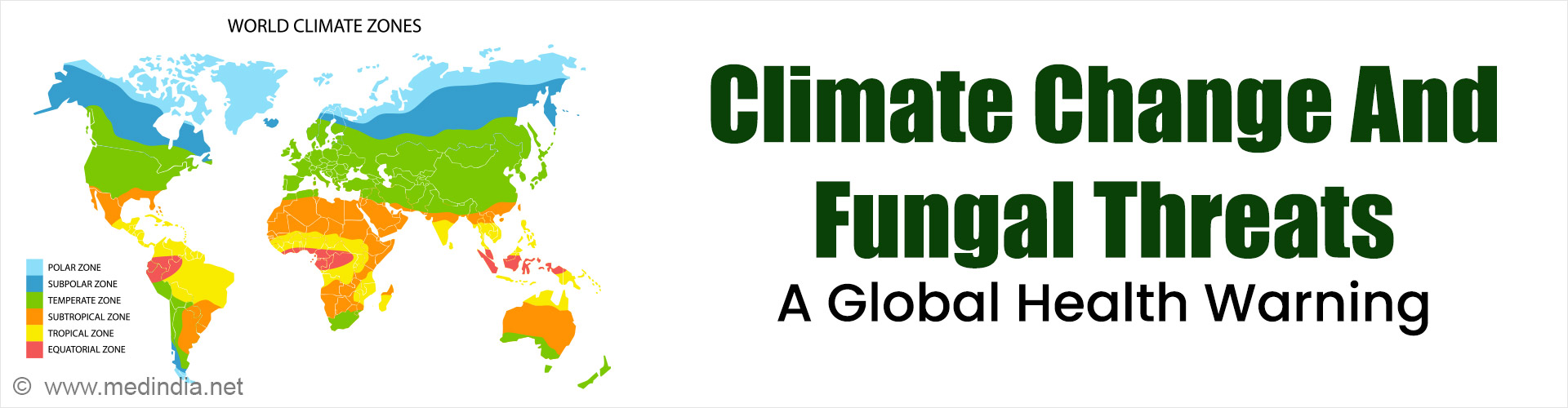
Climate change is shifting the global distribution of Aspergillus species, increasing fungal risks for people and crops-especially in northern latitudes.
Highlights:
As global temperatures rise, the invisible danger of deadly fungal infections is creeping across continents—and the threat is growing. A groundbreaking study published on Research Square reveals how climate change is reshaping the global habitat of three major Aspergillus species that cause serious diseases in humans, animals, and plants (1✔ ✔Trusted Source- Aspergillus fungi are expanding towards the poles due to rising global temperatures
- 1.98 billion people currently live in areas suitable for A. fumigatus, a key cause of invasive aspergillosis
- A. flavus habitat in maize and rice fields could drop by over 50% by 2090, threatening food security
Climate change-driven geographical shifts in Aspergillus species habitat and the implications for plant and human health
Go to source).
Climate Change and the Growing Fungal Threat to Health
Climate change is intensifying the threat of fungal infections to human health, as rising temperatures enable fungi to adapt and become more resistant to treatments.
Climate change is intensifying the threat of fungal infections to human health, as rising temperatures enable fungi to adapt and become more resistant to treatments.
TOP INSIGHT

Did You Know?
Rising temperatures could move deadly fungi closer to your home? #climatehealth #fungalinfections #medindia
Rising Heat, Shifting Fungi
According to the study, over 1.98 billion people currently live in areas suitable for Aspergillus fumigatus, a fungus that causes life-threatening lung infections in immunocompromised individuals. But that number could plummet to just 650 million by the year 2100 under the worst-case warming scenario. The decline isn’t necessarily good news—it signals a major geographic shift in risk, especially toward northern latitudes like Scandinavia, Alaska, and Russia.Meanwhile, A. flavus and A. niger, which also infect crops like maize and rice, are predicted to lose habitat in tropical regions but gain ground in northern zones, increasing the burden of both plant disease and potential food insecurity.

Fungal Infections - Causes, Symptoms, Diagnosis, Treatment & Prevention
Fungal infections are caused by fungi that include yeasts and molds, and occur in those with a weak immunity or following prolonged antibiotic use.
Fungal infections are caused by fungi that include yeasts and molds, and occur in those with a weak immunity or following prolonged antibiotic use.
Three Dangerous Fungi, One Global Problem
The study focused on the three most clinically significant species:- Aspergillus fumigatus – prevalent in temperate climates, and a leading cause of invasive aspergillosis.
- Aspergillus flavus – thrives in warmer regions and produces dangerous aflatoxins, damaging both humans and crops.
- Aspergillus niger – widely distributed and responsible for opportunistic infections and plant spoilage.

Test Your Knowledge on Fungal Infections
Fungal infections usually affect the skin causing an itchy rash, but can affect deeper tissues and cause more serious infections as well. There are several types of fungi that affect humans. Test your knowledge on fungal infections by taking this ...
Fungal infections usually affect the skin causing an itchy rash, but can affect deeper tissues and cause more serious infections as well. There are several types of fungi that affect humans. Test your knowledge on fungal infections by taking this ...
Temperature Drives Their Spread
The single most influential factor in fungal habitat suitability was annual mean temperature. The warmer it gets, the further north A. flavus and A. niger migrate. The model showed:- A. flavus is currently found across India, Brazil, Southeast Asia, and Sub-Saharan Africa, but will lose ground in Africa and Brazil under severe warming, while Russia and northern China become new hotspots.
- A. fumigatus is now common in Europe and North America, and its habitat is expected to push further into Scandinavia and Alaska by 2100.
- A. niger, being more adaptable, retains its foothold globally but shifts slightly northward, especially in coastal regions.

Quiz on Global Warming
The International Conference on Global Warming (GCGW-2012) will be held in Istanbul, Turkey on July 8-12, 2012. Take this quiz to learn what causes global warming, how it can affect your health, and what can be your contribution to contain it. ...
The International Conference on Global Warming (GCGW-2012) will be held in Istanbul, Turkey on July 8-12, 2012. Take this quiz to learn what causes global warming, how it can affect your health, and what can be your contribution to contain it. ...
What It Means for Food Security
The same fungi that cause lung infections also destroy crops. The researchers matched fungal suitability maps with growing areas for seven key crops: maize, rice, sugarcane, apple, grape, wheat, and soybean.The findings were alarming:
- For maize, A. flavus habitat overlap will shrink from 19.1 million km² today to just 6.8 million km² by 2090.
- For rice, the overlap drops from 8.8 million km² to 2.0 million km², especially across Africa and South America.
- A. niger shows a smaller but consistent decline, maintaining some overlap in India and Brazil.
Human Health at Risk
Invasive aspergillosis is a severe infection often seen in patients with weakened immune systems. Researchers found a direct correlation between environmental presence and clinical cases across 14 countries. As fungal habitats shift, so too will patterns of human exposure and infection.By the year 2100, Asia’s population living in high-risk zones for A. fumigatus may drop from 1.5 billion to just 392 million. But areas like Australia could see an increase in exposure to A. flavus, with the number of people at risk rising from 5 million to 16.2 million under SSP585.
The Big Picture
This study does more than track fungi. It signals an evolving pattern of disease emergence driven by climate. The interplay between temperature, precipitation, crop zones, and human populations could reshape where and how fungal diseases appear. Northern regions may face outbreaks they’ve never seen before, while tropical zones may experience a reprieve—at the cost of food yields and economic stability.What You Can Do
We may not see or feel fungi in the air or soil—but they are silently adapting to our warming world. Surveillance, agricultural planning, and healthcare systems need to brace for this northward shift. Climate change isn’t just about melting glaciers; it’s about changing ecosystems that directly impact our lungs and our plates.As our planet warms, so do the threats we cannot see—now is the time to act, protect our environment, and safeguard the health of generations to come.
Reference:
- Climate change-driven geographical shifts in Aspergillus species habitat and the implications for plant and human health - (https://www.researchsquare.com/article/rs-6545782/v1)
Source-Medindia
 Email
Email