MEDINDIA
 English
 हिन्दी
 Español
 français
 中文
中文
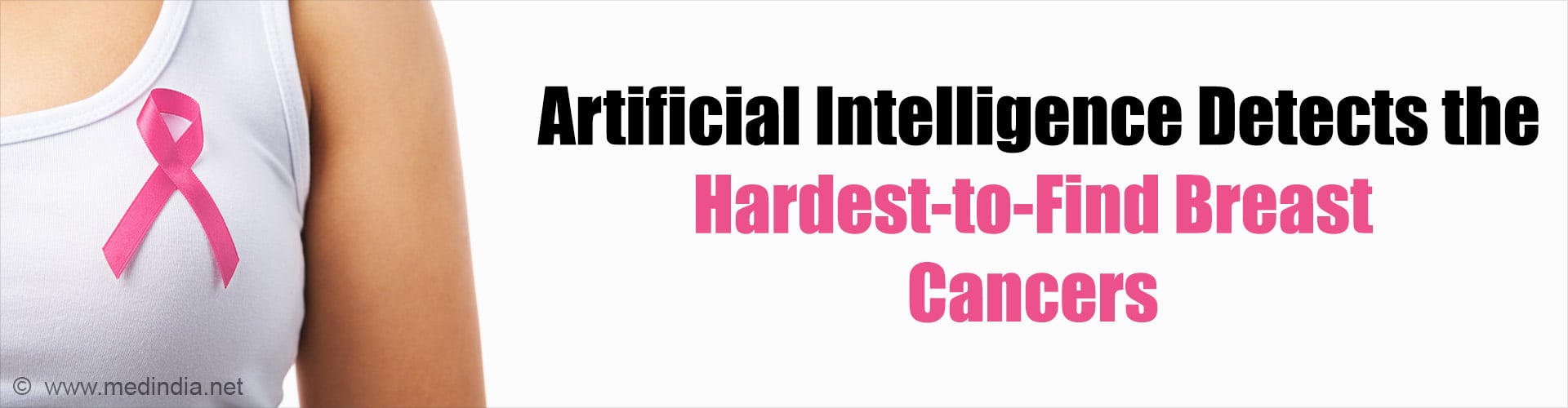
Artificial intelligence is helping detect hard-to-find breast cancers earlier by analyzing mammograms more effectively than the human eye.
Highlights:
Artificial intelligence demonstrated the capability to detect types of breast cancer that emerge between routine mammogram screenings before they progress to more dangerous stages. A study led by investigators at the UCLA Health Jonsson Comprehensive Cancer Center, published in the Journal of the National Cancer Institute, found that this advancement could enhance early detection, optimize screening protocols, and result in better treatment outcomes for patients.
The study revealed that AI could identify certain "mammographically visible" breast cancers that radiologists missed during initial screenings. These cancers appear on mammograms but present with subtle or faint indicators that are easily missed. Researchers estimate that incorporating AI into the screening process could reduce the occurrence of interval breast cancers by up to 30%.- Artificial Intelligence flagged 76% of missed breast cancers in mammograms
- Early Detection could prevent the progression of cancer and enhance survival rates
- Artificial Intelligence identified subtle signs of cancer that radiologists may overlook

Breast Cancer - Causes, Risks, Symptoms, Diagnosis, Staging, Treatment, Prevention & Prognosis
Breast cancer is a cancer that affects the breasts or mammary glands. Early detection and lifestyle changes help in controlling breast cancer.
Breast cancer is a cancer that affects the breasts or mammary glands. Early detection and lifestyle changes help in controlling breast cancer.
TOP INSIGHT

Did You Know?
Artificial intelligence detected 76% of breast cancers that were missed in routine mammograms, and even flagged 69% of cancers that were completely invisible to the human eye. #medindia #artificialintelligence #breastcancer
Early Diagnosis Can Lead to Less Aggressive Treatment
Dr. Tiffany Yu, assistant professor of Radiology at the David Geffen School of Medicine at UCLA and the study’s lead author, emphasized the significance of the findings, noting that detecting these types of interval cancers earlier could lead to more effective treatment. Early detection, she explained, often allows for less aggressive therapies and improves the chances of a positive outcome.While similar studies have been conducted in Europe, this research is one of the first of its kind in the U.S. to explore AI’s role in identifying interval breast cancers. Screening methods differ between regions: in the U.S., annual screenings with 3D mammography (digital breast tomosynthesis) are the norm, whereas in many European countries, 2D mammography is used with screenings typically every two to three years.

The Best Foods to Eat When You Have Breast Cancer
Breast cancer diet covers whole grains, legumes, nuts, and fish. The dietary advice for breast cancer is to avoid raw, processed, and refined foods.
Breast cancer diet covers whole grains, legumes, nuts, and fish. The dietary advice for breast cancer is to avoid raw, processed, and refined foods.
Reviewing 185,000 Mammograms to Identify Interval Breast Cancer Cases
The retrospective study analyzed nearly 185,000 mammograms taken from 2010 to 2019 and identified 148 cases in which women were later diagnosed with interval breast cancer. Using a European classification system, researchers sorted these cases into six categories: reading errors, minimal signs (both actionable and non-actionable), true interval cancers, occult cases (completely undetectable on mammograms), and technical errors.To reassess the original mammograms, the team employed a commercially available AI tool called Transpara, which scores images on a cancer risk scale from 1 to 10—where a score of 8 or higher is flagged as potentially suspicious.

AI Predicts Breast Cancer Four Years Ahead of Time
Artificial intelligence detects breast cancer four years before its development.
Artificial intelligence detects breast cancer four years before its development.
Key Findings: Strong Performance in Many Categories
- AI identified 76% of mammograms that were initially considered normal but later linked to interval cancers.
- It accurately detected 90% of missed reading errors, 89% of cancers with minimal signs that required action, and 72% of non-actionable minimal-sign cancers.
- For occult cancers (those not visible on mammograms), AI flagged 69%.
- The AI was less effective at detecting true interval cancers, identifying only about 50% of them.
"For instance, although the AI flagged 69% of mammograms with occult cancers, it did not perform as well when identifying the exact cancer locations, marking the true cancer only 22% of the time."

New AI Technology Could Revolutionize Breast Cancer Prevention
AI predicts breast cancer risk by identifying ‘zombie cells’—aged, damaged cells that linger in the body, helping doctors detect early signs of the disease.
AI predicts breast cancer risk by identifying ‘zombie cells’—aged, damaged cells that linger in the body, helping doctors detect early signs of the disease.
Potential as a Radiologist's Support Tool
Larger, more comprehensive studies are needed to explore how radiologists would integrate AI into practice and to address key issues—such as how to interpret AI alerts when no visible signs are detectable by the human eye, particularly since AI may struggle to accurately pinpoint the exact location of cancer."Although AI is not perfect and should not be used as a standalone tool, these findings support the notion that AI could help shift interval breast cancers toward being mostly true interval cancers," Yu remarked. "It shows promise as a valuable second opinion, particularly for the types of cancers that are most difficult to detect early. This is about providing radiologists with better tools and giving patients the best chance of early detection, which could ultimately save more lives."
In conclusion, integrating artificial intelligence into breast cancer screening has the potential to improve early detection by identifying cancers that traditional radiology might miss. By flagging subtle indicators and decreasing the likelihood of advanced-stage cancers, AI holds promise as a powerful tool for enhancing patient outcomes and offering a more effective approach to breast cancer diagnosis.
Reference:
- Mammographic classification of interval breast cancers and artificial intelligence performance - (https://academic.oup.com/jnci/advance-article/doi/10.1093/jnci/djaf103/8116029)
Source-Medindia
 Email
Email