MEDINDIA
 English
 हिन्दी
 Español
 français
 中文
中文
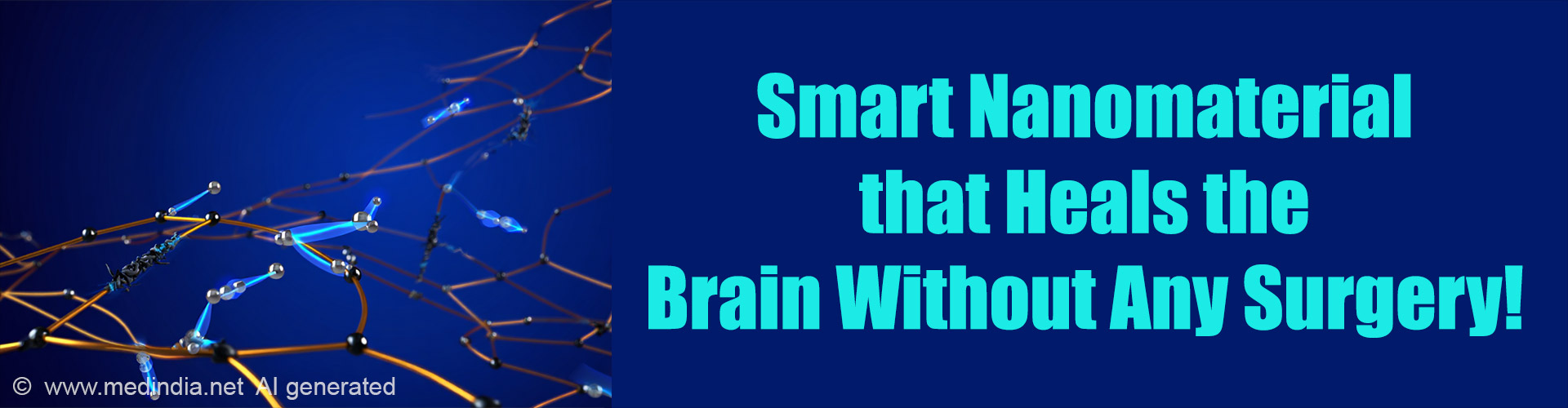
Indian researchers have developed a nanomaterial that can naturally stimulate brain cells—no surgery, electrodes, or external devices needed!
Highlights:
Indian researchers at the Institute of Nano Science and Technology (INST) under the Department of Science and Technology (DST) have come up with a special nanomaterial that stimulates brain cells, without surgery, electrodes, or external devices! (1✔ ✔Trusted Source- Graphitic carbon nitride (g-C₃N₄) stimulates neurons without surgery or devices
- Promotes brain cell growth, dopamine production, and reduces Parkinson’s proteins
- Paves the way for non-invasive therapies and brain-inspired computing
Indian researchers pioneer nanomaterial that stimulates brain cells without surgery
Go to source) It is a material known as graphitic carbon nitride (g-C₃N₄) and is a smart, biocompatible switch. It reacts to the natural electrical impulses of the brain, which assist the neurons to grow, connect, and work more efficiently.

Is Personalized Brain Stimulation the Future of Depression Therapy?
Non-invasive electrical brain stimulation therapy rapidly improves mood in depressed participants, showing effectiveness with minimal side effects.
Non-invasive electrical brain stimulation therapy rapidly improves mood in depressed participants, showing effectiveness with minimal side effects.
TOP INSIGHT

Did You Know?
A tiny nanomaterial can “talk” to your brain cells and boost their health—no wires or implants needed! #brainstimulation #latestbreakthrough #indianresearch #nanotech #medindia
Healing the Brain Naturally?
Deep Brain Stimulation (DBS) and other similar treatments typically involve the invasive and dangerous implantation of electrodes into the brain. However, g-C₃N₄ functions in a different way. By responding to the active and resting states of neurones, the substance functions as a smart switch, establishing the ideal environment for normal brain activity.
Alzheimer’s disease - Causes, Symptoms, Diagnosis, Stages, Types, Prevention, Prognosis & Treatment
Alzheimer's disease is a progressive neurodegenerative disease affecting memory and thinking and making the person increasingly dependent on others.
Alzheimer's disease is a progressive neurodegenerative disease affecting memory and thinking and making the person increasingly dependent on others.
Steps Behind the Stimulation
- Cultured Neurons:
Scientists grow brain cells (neurons) in a dish to study how they react to stimulation. - Stimulus and Membrane Potential:
Neurons naturally send tiny electrical signals — shown here as a spike in the red line (membrane potential). - Creation of an Electric Field:
These voltage changes in the neurons generate an electromagnetic field. - Role of g-C₃N₄ (the Smart Nanomaterial):
- The semiconducting material detects and responds to this natural electric field.
- When the neuron is at a resting position, it becomes conductive (active), which assists in sending subtle signals to the cells.
- Neuronal Response:
The g-C₃N₄ electric field opens the calcium (Ca²⁺) ion channels in the neuron membrane, which are called Voltage-Gated Calcium Channels (VGCCs). - Calcium Influx Promotes Better Communication:
The opening of these calcium pores increases the growth of neurons, their connections and communication, which resembles the signaling of the brain itself.
In laboratory tests, the nanomaterial even enhanced the dopamine formation (which is a major chemical in movement and mood control) and decreased toxic proteins associated with Parkinson's disease in animal testing.

Parkinson’s Disease - Causes, Symptoms, Diagnosis, Treatment
Parkinson’s disease is a neurodegenerative disease caused by progressive dopamine brain cells loss. Symptoms of Parkinson’s disease are correctable to an extent.
Parkinson’s disease is a neurodegenerative disease caused by progressive dopamine brain cells loss. Symptoms of Parkinson’s disease are correctable to an extent.
Can ON-OFF Like Neurons!
Researchers found that the material’s behavior changes with the brain’s voltage signals:- In a resting state (−90 mV), the material turns “ON”, gently activating neurons.
- In an active state (+55 mV), it switches “OFF”, preventing overstimulation.

Depression Calculator
A quick, simple and anonymous self-assessment health tool to assess the level of depression using the famous Zung Self-Rating Depression Scale.
A quick, simple and anonymous self-assessment health tool to assess the level of depression using the famous Zung Self-Rating Depression Scale.
From Brain Healing to Brain Computing
This finding could support modern innovations like "brainware computing" in addition to curing illnesses like Parkinson's and Alzheimer's.Brain organoids are tiny lab-grown brain tissues that scientists are testing as biological processors. They could open the door to bio-inspired computers that learn and think more like the human brain when combined with smart semiconductors like g-C₃N₄.
A Step Toward Non-Invasive Brain Therapy
“This is the first demonstration of semiconducting nanomaterials directly modulating neurons without external stimulation,” said Dr. Manish Singh, who led the study.The INST team made the point that, prior to human applications, further preclinical and clinical research is required.
“We believe this marks a paradigm shift in neuromodulation research. “From treating brain injuries to managing neurodegeneration, semiconducting nanomaterials hold immense promise for the future,” Dr Singh added.
The research, published in ACS Applied Materials & Interfaces, marks a paradigm shift in neuromodulation—offering a safer, simpler, and smarter path to treat brain disorders. Scientists believe this nanotech breakthrough could redefine brain medicine and computing in the years to come.
Reference:
- Indian researchers pioneer nanomaterial that stimulates brain cells without surgery - (https://www.pib.gov.in/PressReleseDetail.aspx?PRID=2170135)
Source-Medindia
 Email
Email