MEDINDIA
 English
 हिन्दी
 Español
 français
 中文
中文
A groundbreaking study uncovers the powerful role of dried fish in fighting malnutrition and fueling food security for millions of women and children across Africa.
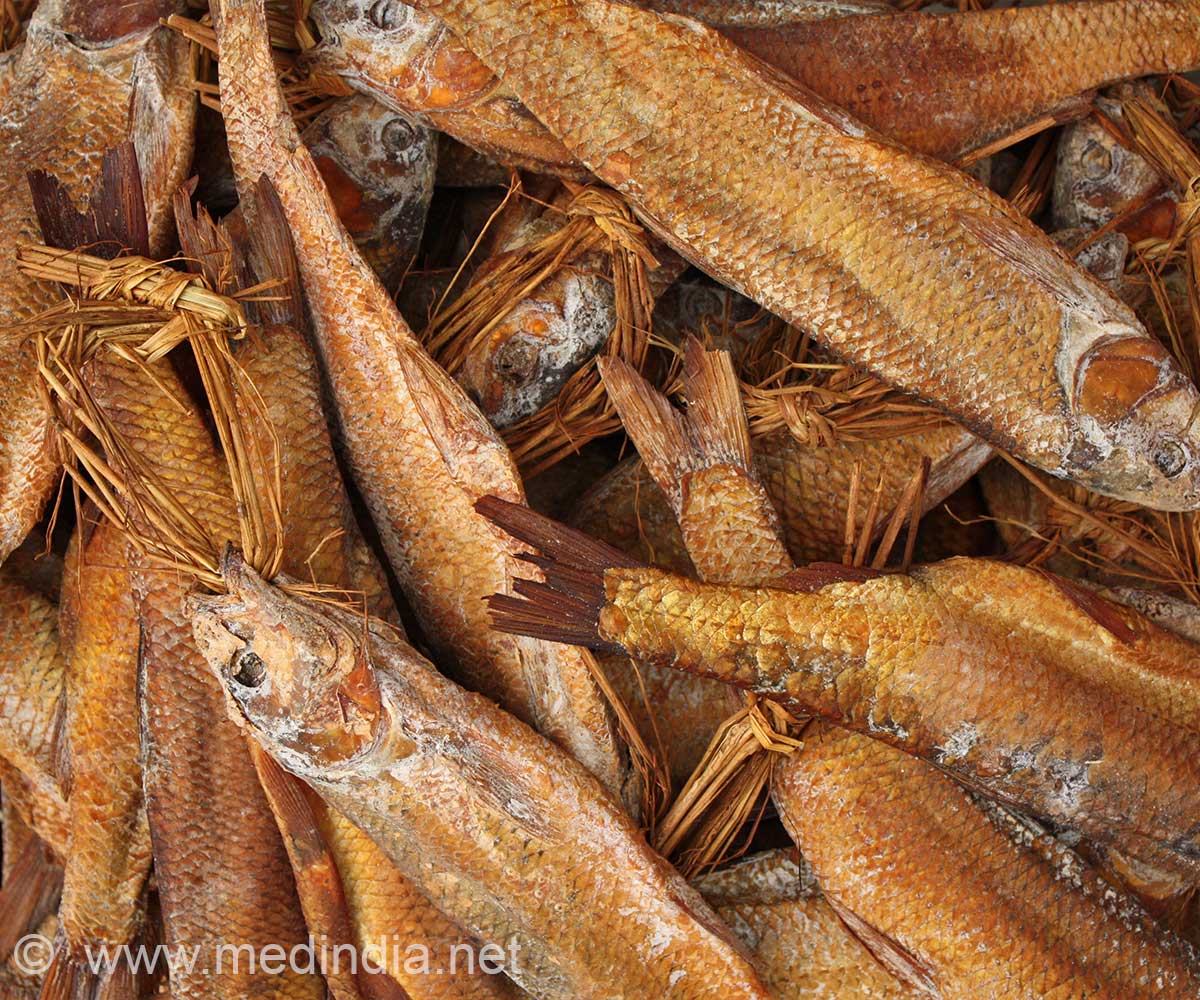
Dried fish are an affordable and readily available food across the tropics. Yet despite this prevalence, because they are often produced by small-scale fisheries, and are usually traded informally, little was known about how widespread this food is produced, consumed or even how nutritious it is. Until now.
In the first large-scale investigation of dried fish consumption, an international team of researchers led by academics at Lancaster University, provides evidence that dried fish contributes significantly to the recommended nutrient intakes for young children and women - underlining their importance for global food security and nutrition.
Health Benefits of Tuna Fish
Tuna, a low glycemic index (GI) food, is rich in selenium, niacin, Vitamin (B12, B6), protein. It prevents wrinkles, stroke and supports bone, heart.
Tuna, a low glycemic index (GI) food, is rich in selenium, niacin, Vitamin (B12, B6), protein. It prevents wrinkles, stroke and supports bone, heart.
TOP INSIGHT

Did You Know?
#DriedFish, often ignored, are loaded with key nutrients vital for growth and health in young children and women across Africa. This latest research spotlights their untapped potential to fight #malnutrition and support #foodsecurity. #africanutrition #foodforall #medindia
How Common is Dried Fish in African Diets?
Using modelling based on data from the multinational Living Standards Measurements Study conducted in Côte d’Ivoire, Ghana, Nigeria, Malawi, Tanzania, and Uganda, the scientists behind the findings estimate that dried fish are eaten weekly by a third of households in these countries, and are even consumed by 54% more people than fresh fish.Dried fish are particularly important to the diets of those in poor households and near to marine coastlines or urban centers. This, researchers say, reinforces the importance of protecting fish catches for local consumption, rather than for international markets.

Dried Fish Can Boost Taste of Low-Salt Foods
For health conscious people who turn to low-salt foods adding dried bonito flakes made from fish may accentuate the salty taste of products, according to a new study.
For health conscious people who turn to low-salt foods adding dried bonito flakes made from fish may accentuate the salty taste of products, according to a new study.
Just How Nutritious Are Dried Fish?
But the question remained - just how nutritious are dried fish? The researchers examined the nutrient content of some of the most readily available dried fish in East and West Africa, as well as the Indian Ocean, to determine their importance in providing nourishment.They analyzed 19 species of fish, including freshwater fish from the Great Lakes (such as the Lake Victoria sardine) and marine species from West Africa (including the Madeiran sardinella) and the Indian Ocean (such as rabbitfish).
Analysis of sun-dried and smoked fish revealed that dried fish are packed with nutrients: even small amounts of dried fish contribute significantly to recommended nutrient intakes for young children and women.
Processing of fish by sun-drying and smoking concentrates essential nutrients into smaller, shelf-stable portions, such that all dried fish forms were found to have a higher nutrient density than fresh fish, for equivalent portion sizes, especially for key minerals for public health such as iron and zinc.
The study reveals that small portions of dried fish contribute more than 15% of recommended intakes for multiple essential dietary nutrients including calcium, iodine, iron, selenium, zinc, vitamins B12 and D.
Nutrients are not equal for all fish. Powdered and smoked marine species, for example, have high iron and omega-3 fatty acid concentrations, whereas freshwater species from Lake Victoria have relatively higher calcium and zinc concentrations.
Will Dried Fish Redefine Food Security?
Dr. James Robinson, Leverhulme Research Fellow at Lancaster University’s Lancaster Environment Centre, said: “Until now, the role and scale of dried fish in supporting food security and nutrition has often been undervalued and hidden, limiting our understanding of how dried fish contribute to healthy diets.“Fish caught in oceans, lakes and rivers across Africa and Asia are dried, smoked or fried, providing large supplies of affordable and nutritious foods that can be stored for long periods of time and easily transported.
“The widespread prevalence of highly-nutritious dried fish show these foods play critical roles in food security and nutrition, particularly for vulnerable populations like women and children, households close to fisheries, and even in places distant from fisheries.”
Following these new insights, the researchers say their findings suggest dried fish could be used to prevent micronutrient deficiencies in women and young children in Africa.
Dried fish rich in omega-3 fatty acids, iodine and selenium could be powdered and mixed with other food products to produce highly nutritious meals for infants that can be used to treat and prevent malnutrition, the researchers add.
Dr. Rucha Karkarey, of Lancaster University and co-author, said: “Dried fish can fill nutrient gaps in seasonal seas, such as reef fish in Lakshadweep Islands that are caught and dried before the southwest monsoon. But here and across the tropics, policies are needed to protect supply for coastal communities against competing international markets.”
Marian Kjellevold, research professor at the Institute of Marine Research, Bergen, said: “High-quality analytical data on small processed fish is presently lacking in most African food composition tables, which limits our ability to fully understand and utilize their nutritional potential. This paper is an important step towards filling that gap, generating robust data that is essential for developing knowledge-based dietary guidelines and ensuring these nutrient-rich foods are used to improve public health.”
Dr. Shakuntala Thilsted, Senior Nutrition Expert, CGIAR said “Many countries look towards biofortification of staple crops as a means of boosting micronutrient intakes. The results presented in this paper show that these nutrients are concentrated in dried small fish. Therefore, we must ensure that dried fish are included in food-based dietary guidelines. We must also use dried fish products in complementary feeding of young children, treatment of malnourished children, school feeding and food assistance programmes.”
The findings of the study, which was supported by the Royal Society and the European Research Council, are outlined in the paper ‘Dried fish provide widespread access to critical nutrients across Africa’, published today in the journal Proceedings of the National Academy of Science of the United States of America (PNAS).
Source-Lancaster University
 Email
Email