Medindia » Consumer Health » Health Information » BedWetting - General Info About Bedwetting

Bedwetting / Enuresis

Rating : 4.32 /5 Comments : 4
Rate this Article:

General info about Bedwetting

RSS Feeds   Text 
Bedwetting or nocturnal enuresis is involuntary urination during sleep.

Bedwetting or enuresis can be a major problem for children and is the most common childhood urologic problem. Bedwetting is found more commonly in boys than in girls. Bedwetting is never done on purpose or due to laziness on the child's part.

Bedwetting

There are two types of bedwetting-

Primary enuresis- Primary bedwetting refers to bedwetting that has been ongoing since childhood without a break. A child with primary enuresis has never been dry at night for a significant length of time.

Secondary enuresis- Secondary enuresis is bedwetting that re-starts after the child has been dry at night for at least six months.

During the first two to three years of life, bedwetting at night is normal and expected. At 5 years of age, around 1 in 6 children still wet the bed. This means that in a school class of thirty, there will be five who wet the bed regularly. Bedwetting is often a natural part of development, and children usually grow out of it. It can be related to toilet training that occurred too early or was too demanding on the child.

Majority of children learn bladder control between the ages of 2-4 years. By the age of 10, only one in 15 still wet the bed. Even in adulthood 1 in 100 still suffer from the problem.

Most often, bedwetting is not a sign of any medical or emotional issues. It is often due to a maturational delay in the development of bladder muscles and the ability of the bladder to withstand the pressure of a large urine volume. Only 5-10% of bedwetting cases are due to underlying medical conditions. However, if bed-wetting continues beyond the age of 6-7 years, it is necessary to consult a doctor.

Enuresis is often hereditary and a child is more likely to encounter the problem if both parents wet the bed when they were young.

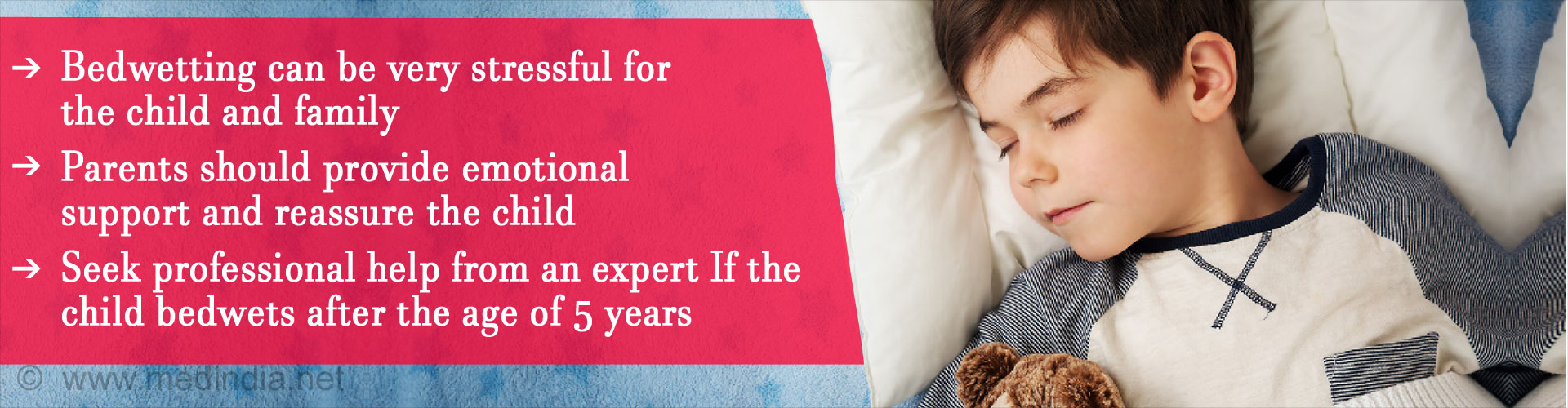
Bedwetting can be very stressful for families. Children can feel embarrassed and guilty about wetting the bed and anxious about spending a night at some other place. Some parents may be very critical putting too much pressure on the child. Parents may also feel helpless, but providing emotional support and reassurance can help your child feel better until the problem resolves.

Advertisement

EmailEmail RSS FeedsRSS Feeds Print this pagePrint Save this pageSave LinkLink SyndicateSyndicate
Share it!

Related Links

Vesico-Ureteric Reflux Causing UTI in Children


Medindia provides a very interesting Paediatric section for ...

Stress Incontinence


Stress incontinence is the most common type of urinary incontinence. Women are more prone to it than ...

Development Milestone


Medindia offers a milestone chart for the growing child, by which we can determine the activities of the baby at various stages of the ...

APGAR


This scoring system is used to identify babies at risk for complications or bad outcome from delivery during the early minutes of their life and ...

Urinary System


The kidneys, ureter, bladder and urethra helps in eliminating the waste products and helps maintain the acid base and fluid balance of the ...
Comment & Contribute
Comments should be on the topic and should not be abusive. Comments are normally moderated and are reviewed after they are posted.
* Your comment can be maximum of 2500 characters

Notify me when reply is posted
I agree to the terms and conditions
  
If you have a question about health related issues, you can now post it in our Ask An Expert section on our community website Medwonders.com and get answers from our panel of experts.
Posted by:  praveensan(Guest)  Posted on: 07/20/2009
My daughter is 7+ years old and once in awhile she has the problem of bed wetting. May I request you to suggest me the way out.


Posted by:  nmartin@shazaaam(Guest)  Posted on: 11/20/2007
Many bedwetters are misdiagnosed with ADD/ADHD. Symptoms of a bedwetter’s deep sleep disorder, such as the inability to stay focused or to concentrate, are almost identical to those of ADD/ADHD. For 32 years, the Enuresis Treatment Center has successfully treated thousands of people from around the world by correcting an unhealthy deep sleep pattern. One this pattern is corrected, the bedwetting is permanently resolved, and the ADD/ADHD symptoms often abate. The Enuresis Treatment Center has put together an informative guide to understanding and treating bedwetting. This free bedwetting guide is available to download at www.freebedwettingguide.com


Posted by:  guest  Posted on: 10/16/2007
Continue and gradually reduce the dosage on doctors advice. Never discontinue the tablets on your own without doctors advice


Posted by:  guest  Posted on: 04/08/2007
i am 19 yrs old having bed wetting problem right from birth last year i consulted a general physician and told my problem.he gave me a tablet antidep 50mg every night.after using this tablet for past 8 months my bedwetting is only few days a month.can i continue this tablet.after stop using this tablet after few months will the habit stop completely please reply me.


X

Medwonders Health Network

Citing this Health Article
The information on Medindia is factual, unbiased and authentic. If you find the content useful - PLEASE INCLUDE A LINK TO THIS PAGE.

Highlight the text, right-click, and select “copy”. Paste the link into your website, email, or any other HTML document.

Latest News/Research of BedWetting
 Bedwetting in Older Children: Analysis and Treatment
 Undiagnosed Constipation May Be Behind Bedwetting
 Simple Steps and Patience Could Help Treat Bedwetting in Kids
 2-year-old Deprived of Fluids for Bedwetting Dies, Child-carers Charged
 Hope For Bedwetting Children
 Bedwetting A Problem Among Almost 1 In 50 Children
 Bedwetting Could Be Curbed By A Simple Change In Diet
 Urinary incontinence linked to bedwetting as a child
Total News Item 8