MEDINDIA
 English
 हिन्दी
 Español
 français
 中文
中文
Pulse-Fi uses Wi-Fi signals and machine learning to detect heartbeats accurately—making heart monitoring simpler, cheaper, and contact-free.
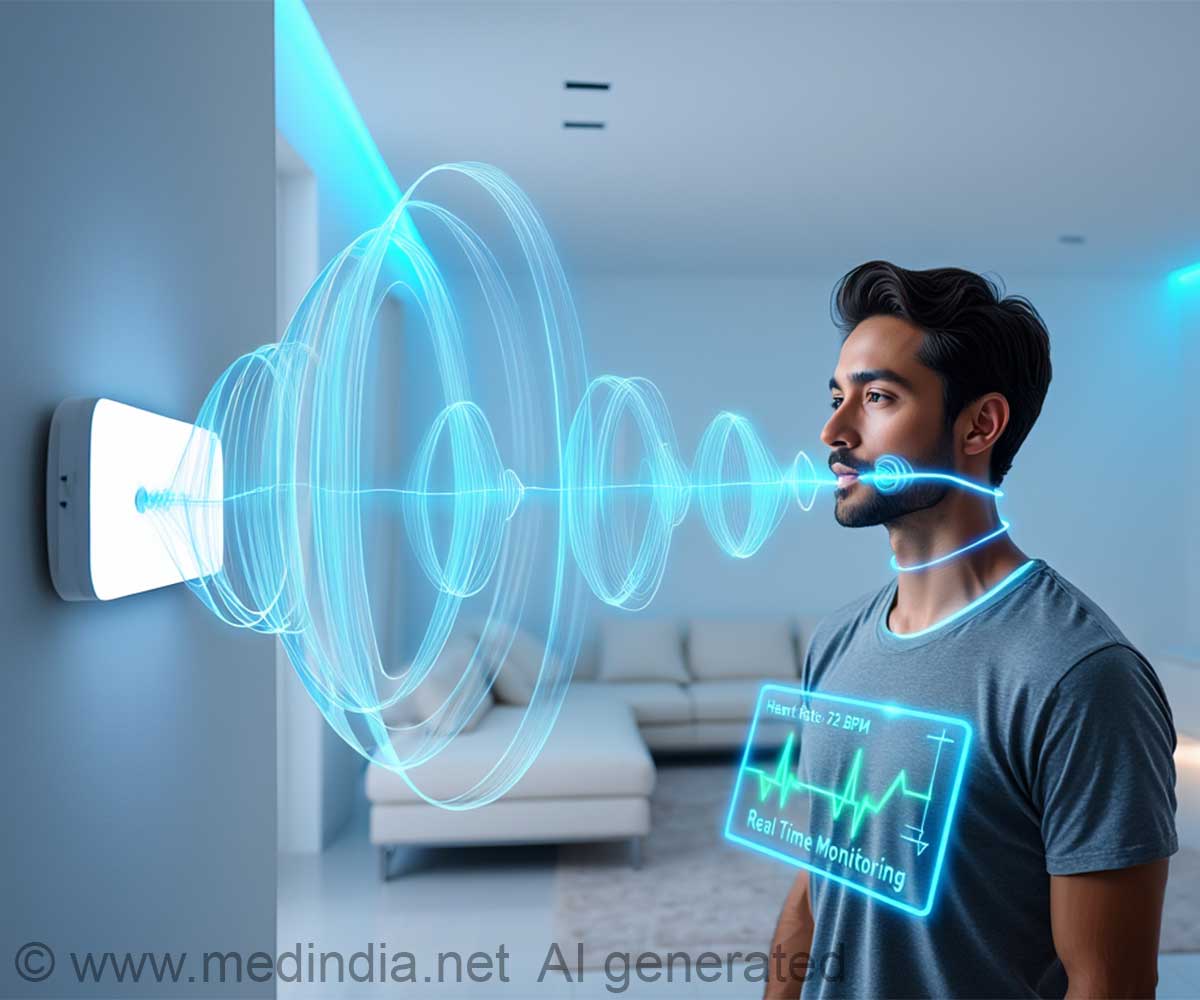
Now, engineers at the University of California have taken it a step further by developing a cutting-edge technique to measure heart rate using Wi-Fi signals (1✔ ✔Trusted Source
Pulse-Fi: A Low-Cost System for Accurate Heart Rate Monitoring Using Wi-Fi Channel State Information
Go to source).
TOP INSIGHT

Did You Know?
Wi-Fi detects your heartbeat even from 10 feet away!
#wifi #healthtechnology #digitalhealth #medindia
Measuring Heart Rate With WiFi
A new method of heart rate measurement with Wi-Fi has been developed by researchers at UC Santa Cruz and is known as Pulse-Fi. The study was submitted to the 2025 IEEE International Conference on Distributed Computing in Smart Systems and the Internet of Things (DCOSS-IoT).The system relies on regular and low-cost Wi-Fi devices and a machine learning algorithm. When Wi-Fi signals pass through a person's body, small changes are observed. The algorithm of Pulse-Fi is specially designed to capture these barely noticeable differences generated by a heartbeat and is also trained to ignore other sources of noise, such as movement or background noise.
With this invention, heart monitoring might become simpler, less expensive, and completely contact-free!

Heart Rate (Pulse Rate) During Physical Exertion
Heart rate (pulse rate) during physical exertion calculator calculates maximum heart rate and safe pulse rate zone for exercise. Know how low and high pulse rate affect your health.
Heart rate (pulse rate) during physical exertion calculator calculates maximum heart rate and safe pulse rate zone for exercise. Know how low and high pulse rate affect your health.
Find Your Heart Rate with Pulse-Fi
In tests with 118 participants, Pulse-Fi was able to measure heart rate with clinical-level accuracy after just five seconds of monitoring, with an error of only about half a beat per minute. Accuracy improved with longer monitoring times. The system worked reliably in different conditions—whether people were sitting, standing, lying down, or walking—and across 17 body positions.The researchers experimented with much cheaper ESP32 chips (between $5 and $10) and Raspberry Pi boards (about 30 dollars), but the latter performed even better. They indicated that the accuracy of the system could be enhanced by commercial-grade Wi-Fi equipment. Pulse-Fi could also be used up to three meters (about 10 feet), and experiments indicate that it can be used over even greater distances.
The researchers say that the machine learning model makes the system accurate at all distances and regardless of body position, an issue with earlier approaches.

Heart Rate and Heart Rhythm
Normal heart rate and rhythm can be measured by checking pulse on the wrist and evaluated with an electrocardiogram. Myths about heart rate can lead to anxiety.
Normal heart rate and rhythm can be measured by checking pulse on the wrist and evaluated with an electrocardiogram. Myths about heart rate can lead to anxiety.
Teaching Wi-Fi to Hear a Heartbeat
To make Pulse-Fi work, the team first had to teach its algorithm how to recognize the tiny changes in Wi-Fi signals caused by a heartbeat. Since no data existed for this using their low-cost ESP32 device, they built their own dataset.At the UC Santa Cruz Science and Engineering Library, they set up the ESP32 system alongside a standard oximeter, which provided accurate “ground truth” heart rate readings. By matching the Wi-Fi data with the oximeter data, they trained the system to spot the heartbeat patterns.
They also tested Pulse-Fi on a larger dataset created by researchers in Brazil using a Raspberry Pi device—the most extensive Wi-Fi heart monitoring dataset available so far.
Reference:
- Pulse-Fi: A Low-Cost System for Accurate Heart Rate Monitoring Using Wi-Fi Channel State Information - (https:inrg.engineering.ucsc.edu/2025/05/30/pulse-fi-a-low-cost-system-for-accurate-heart-rate-monitoring-using-wi-fi-channel-state-information/)
Source-University of California, Santa Cruz
 Email
Email