MEDINDIA
 English
 हिन्दी
 Español
 français
 中文
中文
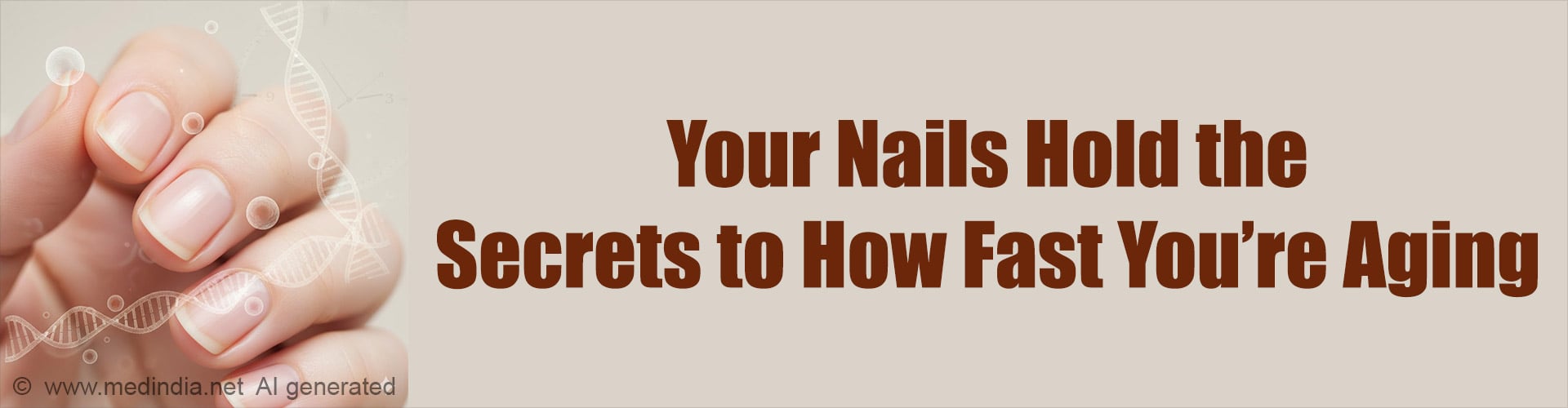
Harvard scientist Dr. David Sinclair reveals that nail growth rate may serve as a subtle marker of biological aging, reflecting your body’s internal health clock.
Highlights:
People often think of aging as birthdays or wrinkles, but the body keeps a quieter score. According to Harvard geneticist Dr. David Sinclair, something as ordinary as your nail growth rate might mirror your internal aging speed (1✔ ✔Trusted Source- Nail growth rate may reveal your biological, not chronological, age
- 1979 study found nail growth declines 0.5% yearly after age 25
- Faster nail growth reflects robust cellular regeneration and vitality
Response to Dr. Buschard and Colleagues' Letter to the Editor: Sulfatide and Longevity
Go to source). In his Lifespan podcast, Dr. Sinclair explained that while chronological age measures years lived, biological age reflects how efficiently our cells and tissues function. Two people of the same age can differ vastly — one might have youthful, regenerating tissues, while the other experiences early cellular fatigue.
Surprisingly, nails, often overlooked as mere beauty markers, may silently track the body’s regenerative rhythm. Faster nail growth can indicate active cell turnover, while slowing growth could point to declining metabolic vitality.

Vitamin Deficiency Calculator
Vitamin deficiency is one of the major factors causing various diseases and conditions. Use this tool to know the vitamin that is deficient for any particular disease or condition.
Vitamin deficiency is one of the major factors causing various diseases and conditions. Use this tool to know the vitamin that is deficient for any particular disease or condition.
TOP INSIGHT

Did You Know?
The speed of your #NailGrowth could reveal how fast your #Body is truly #Aging - offering a simple window into your biological health. #longevity #agingscience #cellularhealth #medindia
The 1979 Discovery That Changed How We See Aging
The idea of nails as biological timers isn’t new. A landmark 1979 study presented at the American Association for the Advancement of Science found that nail growth slows by about 0.5% each year after age 25, eventually halving over a human lifetime.The study tracked 271 participants and even included beagles to compare species with faster aging cycles. The researchers noticed that nail growth didn’t decline steadily but followed a seven-year rhythm, suggesting the body ages in waves rather than a straight line.
These biological rhythms may reflect internal cycles of cell renewal and decline, showing that aging is not a uniform slide but a dynamic, patterned process.

Protein Intake Calculator
Protein Intake Calculator provides the amount of dietary protein for different age groups and bodybuilders. Protein Intake Calculator lists protein rich foods.
Protein Intake Calculator provides the amount of dietary protein for different age groups and bodybuilders. Protein Intake Calculator lists protein rich foods.
More Than Manicures: What Your Nails Reveal About You
Nails are formed in the matrix beneath the skin — a tiny but powerful cell factory that constantly produces new keratin layers.When this matrix works efficiently, nails grow thick and strong. A slowdown, however, signals reduced cellular energy, nutrition, or circulation.
Factors influencing nail growth include:
- Age: Metabolic slowdown reduces cell division.
- Nutrition: Deficiencies in biotin, zinc, or iron weaken growth.
- Lifestyle: Smoking, dehydration, and harsh chemicals damage keratin.
- Stress: Chronic stress alters hormones and reduces blood flow.

Iron Intake Calculator
This is a quick calculator to find out how much iron is needed for babies, girls, boys, men, women, pregnant and breast feeding women. The Intake Calculator also includes iron rich foods.
This is a quick calculator to find out how much iron is needed for babies, girls, boys, men, women, pregnant and breast feeding women. The Intake Calculator also includes iron rich foods.
Beyond Nails: The Broader Longevity Puzzle
While nail growth offers a convenient clue, it’s just one piece of the biological aging mosaic. Other vital indicators include skin elasticity, muscle strength, cognition, and mitochondrial efficiency.Dr. Sinclair emphasizes that no single metric defines aging, but combining visible markers like nail growth with lifestyle monitoring could help people assess and improve longevity.
Simple habits such as nutrient-rich diets, stress control, hydration, and sleep optimization can maintain youthful cellular activity, keeping the nail matrix — and the body — younger for longer.
As Dr. Sinclair puts it, “Longevity isn’t just about adding years. It’s about keeping your cells alive, vibrant, and regenerative for as long as possible.”
Your nails, it seems, may whisper the truth long before your mirror does.
Reference:
- Response to Dr. Buschard and Colleagues' Letter to the Editor: Sulfatide and Longevity - (https://academic.oup.com/biomedgerontology/article/77/9/1717/6603794)
Source-Medindia
Stem Cells That Help Regrow Nails Found
Now, if you lose your nails, don’t lose hope because researchers have found out the stem cells that will aid the nails in coming back after they are lost.
Now, if you lose your nails, don’t lose hope because researchers have found out the stem cells that will aid the nails in coming back after they are lost.
 Email
Email