MEDINDIA
 English
 हिन्दी
 Español
 français
 中文
中文
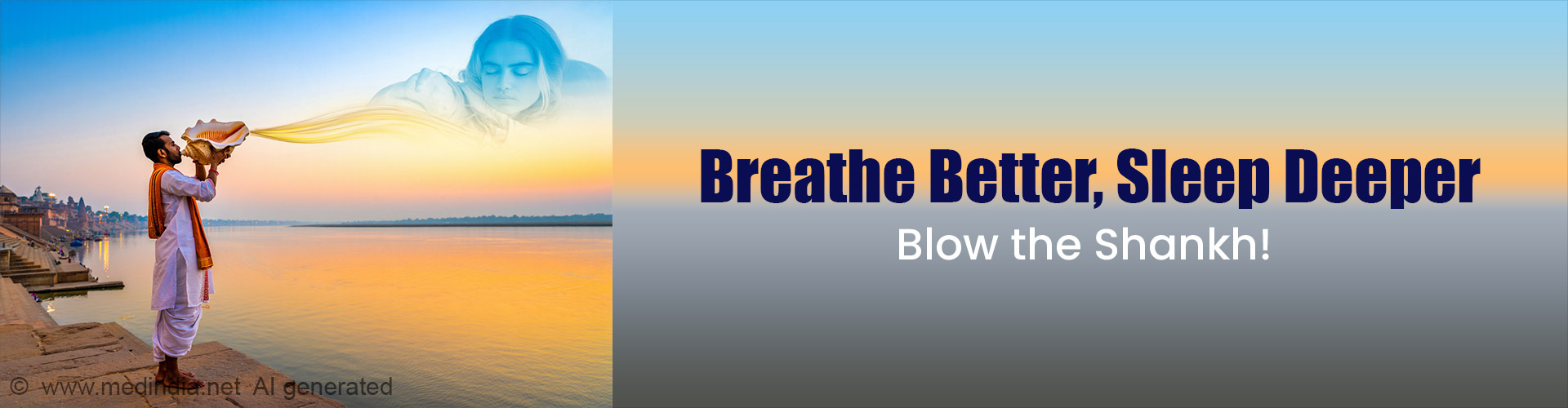
Ancient shankh blowing may help improve sleep quality and alertness in obstructive sleep apnea patients.
Highlights:
An ancient practice is making waves in modern medicine.
A new study has uncovered a remarkable benefit from the yogic tradition of The Shankh (conch) Blowing, exhaling forcefully through a conch shell. - Shankh blowing reduced daytime drowsiness by 34% in OSA patients
- Lowered apnea episodes by 4–5 per hour
- Boosted nighttime blood oxygen levels
Clinical research suggests this centuries-old practice may improve sleep quality and morning alertness in people battling obstructive sleep apnea (OSA).
Obstructive Sleep Apnea - Overview
Obstructive sleep apnea should be suspected in overweight middle aged adults who snore loudly and which can cause interruption of breathing for 10 seconds or more and this results in reduced blood o
Obstructive sleep apnea should be suspected in overweight middle aged adults who snore loudly and which can cause interruption of breathing for 10 seconds or more and this results in reduced blood o
TOP INSIGHT

Did You Know?
A simple ancient conch-blowing ritual could improve #sleepapnea symptoms by reducing daytime drowsiness by 34%. #sleephealth #sleepdisorder #goodnightsleep #medindia
Traditional Shankh Blowing For OSA?
OSA is a condition characterized by repetitive breathing interruptions during sleep (1✔ ✔Trusted SourceAncient Practice of Blowing through Conch Shell Might Help Individuals with Obstructive Sleep Apnea
Go to source). Standard treatment for OSA is continuous positive airway pressure (CPAP), which keeps the patient’s airway open by blowing air through a facemask. While this may be an effective treatment, many patients find it uncomfortable and struggle to use it consistently.
Surprisingly the ancient shankh blowing was reported effective after subjecting the patients suffering with obstructive sleep apnea. Shankh blowing has been a part of Indian wellness traditions for millennia.

Sleep Debt Calculator
Calculate your sleep debt! Track your nightly shortfall, and see how those lost hours add up fast. Use Medindia’s simple Sleep Debt calculator.
Calculate your sleep debt! Track your nightly shortfall, and see how those lost hours add up fast. Use Medindia’s simple Sleep Debt calculator.
How the Study Was Conducted?
In the study, 30 people with moderate OSA, aged between 19 and 65, were evaluated at the Eternal Heart Care Center and Research Institute from May 2022 to January 2024. Participants were observed overnight and asked about their levels of daytime activity and sleep quality in order to assess them using polysomnography.They were randomly assigned to one of two groups:
- Practicing deep breathing exercises or
- Practicing blowing a traditional shankh used in yogic practices.
Ancient shankh blowing practice found to improve sleep and alertness in OSA patients
Go to source).

Quiz on Sleep Disorder
The comfort of modern life comes at the cost of restful sleep! "Laugh and the world laughs with you, snore and you sleep alone-Anthony Burgess" Scientifically it is proven that a good night's sleep is imperative for maintaining a balance between the ...
The comfort of modern life comes at the cost of restful sleep! "Laugh and the world laughs with you, snore and you sleep alone-Anthony Burgess" Scientifically it is proven that a good night's sleep is imperative for maintaining a balance between the ...
Shankh Blowing Proved Effective!
Compared with the deep-breathing group, participants who practiced Shankh blowing showed significant improvements:- 34% less drowsiness during the day
- On average, 4–5 fewer episodes of apnea per hour
- Increased blood oxygen levels at night

Sleep - Overview and Definition
Sleep is a behavioral state of restricted physical activity. It is controlled by our internal biological clock.
Sleep is a behavioral state of restricted physical activity. It is controlled by our internal biological clock.
Reason Behind the Effectiveness?
The physical mechanics behind the effective tradition could be deep breathing followed by a forceful, steady exhalation through a narrow aperture (like pursed lips in the shankh) that generates vibrations and resistance.This activity could strengthen the muscles of the upper airway, particularly the throat and soft palate (often known to collapse during sleep in people with OSA). The unique spiral structure of the conch may also add specific acoustic and mechanical effects.
While the results are encouraging, experts urge caution due to the study's modest scale. Larger, multi-center trials are already in planning to validate and expand upon these findings.
The ancient practice of shankh blowing emerges as a compelling, low-cost complement in the fight against OSA.
References:
- Ancient Practice of Blowing through Conch Shell Might Help Individuals with Obstructive Sleep Apnea - (https://www.sci.news/medicine/conch-shell-blowing-obstructive-sleep-apnea-14127.html)
- Ancient shankh blowing practice found to improve sleep and alertness in OSA patients - (https://www.news-medical.net/news/20250810/Ancient-shankh-blowing-practice-found-to-improve-sleep-and-alertness-in-OSA-patients.aspx)
Source-Medindia
 Email
Email