MEDINDIA
 English
 हिन्दी
 Español
 français
 中文
中文
Disease onset outside of alveolar macrophages is not only possible, but also important in the pathogenesis of tuberculosis infection.
Newly Identified Mechanism of Infection With Tuberculosis Bacteria
A new way that tuberculosis bacteria get into the body, has been identified by researchers, thus revealing a potential therapeutic angle to explore.
A new way that tuberculosis bacteria get into the body, has been identified by researchers, thus revealing a potential therapeutic angle to explore.
TOP INSIGHT

Disease onset outside of alveolar macrophages is not only possible, but also important in the pathogenesis of tuberculosis infection.
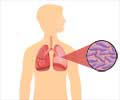
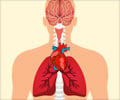
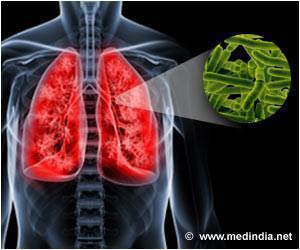
"The current model of disease is that when Mtb bacteria are inhaled, they reach the end of the lung - the alveolus - and then are ingested by a macrophage, a type of white blood cell that swallows and kills invading bacteria," Dr. Shiloh said. "Our study shows that once Mtb bacteria are inhaled, they also can enter the body directly through M-cells that line the airway tissue, and then travel to the lymph nodes and beyond. This is a key finding that suggests disease onset outside of alveolar macrophages is not only possible, but also important in the pathogenesis of tuberculosis infection."
Dr. Shiloh said that this mechanism of M-cell mediated movement of Mtb may help explain an ancient disease called scrofula. In this disease, tuberculosis infection rarely appears in the lung but instead causes disease in the lymph nodes of the neck. Although further studies are necessary, potential clinical applications of the team's finding would involve developing methods or drugs that prevent Mtb from entering M-cells.

Pediatric Tuberculosis: Children Should be Primary Focus to End TB
The childhood tuberculosis epidemic is likely to be much higher because TB in children is often missed due to non-specific symptoms and difficulties in diagnosis.
The childhood tuberculosis epidemic is likely to be much higher because TB in children is often missed due to non-specific symptoms and difficulties in diagnosis.
In addition, because the investigators have data indicating that other important airway pathogens that cause acute bacterial pneumonia also may use M-cells to cause severe disease, they are extending their work beyond tuberculosis.
Tuberculosis Free India: �TB is a Battle We Need to Fight Together�
The goal of universal access to tuberculosis treatment in the private sector can be achieved with public-private partnerships, and various public health programs.
The goal of universal access to tuberculosis treatment in the private sector can be achieved with public-private partnerships, and various public health programs.
Additional authors who contributed to this study were graduate students Haaris Khan and Chelsea Stamm; Dr. Luis Franco, Assistant Instructor in Internal Medicine; Dr. Denise Marciano, Assistant Professor of Internal Medicine; and Dr. Beth Levine, Director of the Center for Autophagy Research, a Howard Hughes Medical Institute Investigator, and holder of the Charles Cameron Sprague Distinguished Chair in Biomedical Science.

WHO Recommends New Rapid Treatment Regimen for Multidrug Resistant Tuberculosis
According to WHO’s Global TB Report of 2015, 5% of all global TB cases are of MDR-TB. This translates into 480,000 cases every year.
According to WHO’s Global TB Report of 2015, 5% of all global TB cases are of MDR-TB. This translates into 480,000 cases every year.
Source-Newswise
 Email
Email