MEDINDIA
 English
 हिन्दी
 Español
 français
 中文
中文
International Stress Awareness Week 2025 focuses on creating healthier workplaces through strategic stress management and employee well-being.
Highlights:
Every year, the first week of November serves as a gentle reminder to slow down, take a deep breath, and focus on our mental well-being. The International Stress Awareness Week 2025, which will take place on November 3-7, brings people from all over the world together to discuss stress: how it occurs, how it affects our bodies and minds, and, most importantly, how we can learn to deal with it. The theme for this year is occupational stress, and the focus is on employee well-being through strategic stress management (1✔ ✔Trusted Source- International Stress Awareness Week 2025 theme: Optimising Employee Wellbeing through Strategic Stress Management
- Promotes an eight-dimension “Wellness Wheel” for balanced workplace health
- Encourages daily mindfulness, gratitude, and stress-reducing lifestyle habits
International Stress Awareness Week 3 - 7 November
Go to source).
TOP INSIGHT

Did You Know?
Chronic stress costs the global economy nearly $1 trillion in lost productivity every year. #internationalstressweek #stressweek #2025 #stress #medindia
What Exactly is Stress?
Stress is the biological alarm clock of the body; it is an inbuilt survival mechanism that makes you alert in times of danger or difficulty. When you're under pressure, your brain secretes hormones like adrenaline and cortisol, which prepare you to fight or flee.Stress in moderation is beneficial; it keeps you energised, focused, and active. However, when stress becomes chronic, it begins to have an impact on both your mind and your health. Your immune system, digestion, and sleep may all be affected, and you may experience anxiety, irritability, or fatigue.

Test Your Happiness Score
Are you leading a happy and fulfilling life? Test your happiness score using these 10 questions.
Are you leading a happy and fulfilling life? Test your happiness score using these 10 questions.
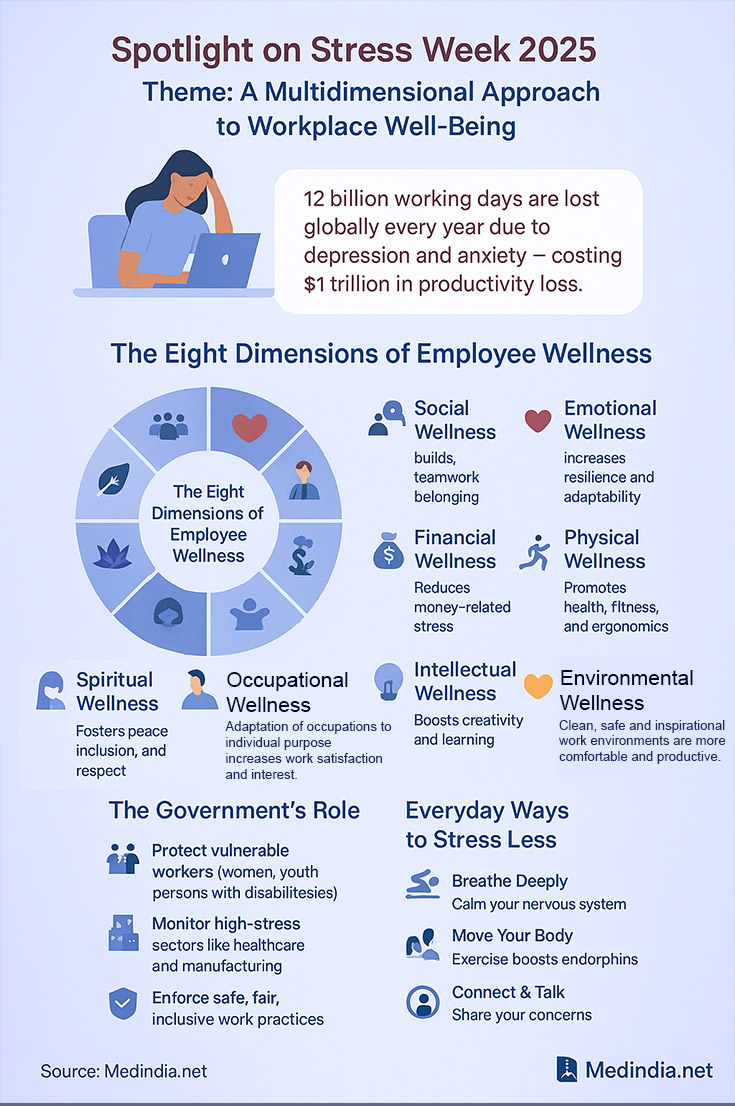
Spotlight On Stress Week Theme 2025
Multidimensional Approach to Workplace Well-Being
Every year, an estimated 12 billion working days are lost globally due to depression and anxiety, costing the economy $1 trillion in lost productivity. The well-being of employees cannot be considered one-size-fits-all; it is a Wellness Wheel having eight interconnected components, which creates a healthy culture within organisations. Each organisation can focus on various points, and once these are sorted, the work environment becomes harmonious and prosperous.
The Eight Dimensions of Employee Wellness
- Social Wellness: Good social connections and cooperation bring about a feeling of belonging and teamwork.
- Emotional Wellness: Mental balance and emotional intelligence help employees become resilient and flexible.
- Occupational Wellness: Adaptation of occupations to individual purpose increases work satisfaction and interest.
- Financial Wellness: The support and literacy of money-related stress enhances happiness.
- Environmental Wellness: Clean, safe and inspirational work environments are more comfortable and productive.
- Physical Wellness: Health checkups, fitness programmes and ergonomics ensure that employees are in shape and orientated.
- Intellectual Wellness: It is innovation and confidence that is motivated by learning and skill-building.
- Spiritual Wellness: Tolerance for other beliefs promotes peace and inclusion.
Optimizing for Employee Well-Being: A Holistic Approach for HR Leaders
Go to source).
Reducing Workplace Stress: Four Key Steps
The World Health Organisation (WHO) specifies the steps to be followed in establishing mentally healthy workplaces, which are practical:
- Analyse the Problem: Determine the productivity loss (which can be high workload, low communication, or an absence of recognition) due to efforts to determine the cause of workplace stress.
- Develop a Policy: Use this information to formulate policies that include all stakeholders in the organisation and which are consistent with the mission of the organisation.
- Plan Implementation: Develop an accurate budget, schedule and timetable to guarantee successful implementation of the policies.
- Review and Refine: To ensure long-term effects, perform periodic analysis of the results, receive feedback and change the strategy (3✔ ✔Trusted Source
Workplace stress: A neglected aspect of mental health wellbeing
Go to source).
Mental health at work
Go to source)
The Government’s Role in Reducing Workplace Stress
Governments play a crucial role in setting standards and enforcing laws that protect workers’ mental health. They must:
- Safeguard vulnerable groups such as women, children, and persons with disabilities.
- Monitor high-stress sectors like healthcare, mining, and manufacturing.
- Ensure fair, inclusive, and stress-free workplaces through regulation and accountability

Burnout and Work Stress: Is It Killing You Slowly?
What are the early signs of burnout? Chronic fatigue, sleeplessness, and frequent illness- don’t ignore these warnings!
What are the early signs of burnout? Chronic fatigue, sleeplessness, and frequent illness- don’t ignore these warnings!
Ways to Stress Less Every Day
Stress management does not require radical changes in lifestyle. Mini, steady steps can be very significant:- Breathe Deeply - Intense and thoughtful breathing helps to soothe your nervous system within seconds.
- Move Your Body – A 20-minute stroll also releases endorphins, which make one feel better.
- Connect and Talk – This involves opening up to a friend or counsellor and offloading your concerns.
- Unplug for a While – You need to take a break to get your mind straight; digital detoxes are a good way to do this.
- Rest and Sleep Well – Sleep acts as a restorative activity, emotionally, and lessens anxiety.
- Practise Gratitude – Concentrating on what is going well can change the mindset and create resilience. Also bear in mind: self-care is not selfish; it is a necessity.
- International Stress Awareness Week 3 - 7 November - (https://isma.org.uk/isma-international-stress-awareness-week)
- Optimizing for Employee Well-Being: A Holistic Approach for HR Leaders - (https://www.shrm.org/in/labs/resources/optimizing-for-employee-well-being-a-holistic-approach-for-hr-leaders)
- Workplace stress: A neglected aspect of mental health wellbeing - (https://pmc.ncbi.nlm.nih.gov/articles/PMC5819024/)
- Mental health at work - (https://www.who.int/news-room/fact-sheets/detail/mental-health-at-work)

Seven Key Signs Indicating It''s Time for a Mental Health Break
Learn the seven key signs that indicate it''s time for a mental health break, including anxiety, stress, and declining motivation.
Learn the seven key signs that indicate it''s time for a mental health break, including anxiety, stress, and declining motivation.
Join the Global Conversation on Stress
As part of this awareness week, the 6th Global Online Stress and Wellbeing Summit is set to be held on Wednesday, November 5, 2025. The event is an international conference that invites everyone to share their knowledge on burnout prevention and how to foster resilience and a mental health culture in the workplace and at home.Stress is unavoidable in life, but it should not be the boss of your life. You can protect your mental and physical health by learning how to identify your triggers, coping strategies to use on a daily basis, and seeking advice from others.
We should remind ourselves and others of the following before stressing out!
References:
Source-Medindia
 Email
Email