MEDINDIA
 English
 हिन्दी
 Español
 français
 中文
中文
AI-driven new scoring system in thyroid cancer progression outperforms 'one-size-fits-to-all' tradition.

Optimized Dynamic Network Biomarker Deciphers a High-Resolution Heterogeneity Within Thyroid Cancer Molecular Subtypes
Go to source). New research from The First Affiliated Hospital of Zhengzhou University tackles thyroid cancer by developing a groundbreaking AI biomarker system. This model uses an enhanced dynamic network biomarker (DNB) algorithm and identified a 'tipping point' in Stage II of DTC that shows a shift from an unchanging state to rapid progression.
Machine Learning-powered Imaging Helps Diagnose Thyroid Cancer
A new non-invasive method to distinguish thyroid nodules from cancer by combining photoacoustic (PA) and ultrasound image technology with artificial intelligence has been devised by scientists.
A new non-invasive method to distinguish thyroid nodules from cancer by combining photoacoustic (PA) and ultrasound image technology with artificial intelligence has been devised by scientists.
TOP INSIGHT

Did You Know?
Just with 12 genes! How “miniPC” (a #simplifiedaibiomarker) offers a #personalizedapproach to #thyroidcancertreatment. #aipoweredbiomarkers #thyroidcancerprogression #medindia
TCPS Level: Discovering Individual Patient Risk
The team developed an automated scoring system called 'TCPS level' to estimate an individual patient risk that features early-warning molecular signals. “This score outperforms traditional staging in identifying high-risk individuals,” notes co-author Dr. Ge Zhang.The researchers applied AI-based consensus clustering to over 1,100 thyroid cancer samples and identified three reproducible molecular subtypes, each with distinct immune profiles and progression risks. The most aggressive subtype was associated with the gene ASPH, which was experimentally validated.
To support clinical use, they developed a simplified classifier (miniPC) based on just 12 genes, enabling accurate subtype prediction across multiple datasets. “This tool offers a practical approach to personalized treatment planning,” says Dr. Haonan Zhang.
By integrating multi-omics data, machine learning, and single-cell analysis, the study provides new insights and tools for early risk stratification and targeted management of thyroid cancer.
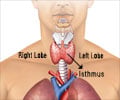
Thyroid Cancer – Symptoms - Risk Factors - Diagnosis - Treatment - Prevention
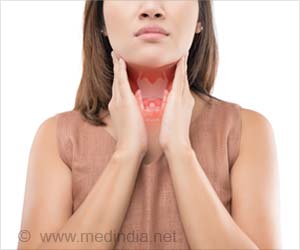
“Shaped like a butterfly she sits within the neck,” that’s what an anonymous poet wrote about the thyroid gland but it can become cancerous and spread to other parts.
“Shaped like a butterfly she sits within the neck,” that’s what an anonymous poet wrote about the thyroid gland but it can become cancerous and spread to other parts.
- Optimized Dynamic Network Biomarker Deciphers a High-Resolution Heterogeneity Within Thyroid Cancer Molecular Subtypes - (https://onlinelibrary.wiley.com/doi/10.1002/mdr2.70004)
Source-Eurekalert

Quiz on Thyroid
Feeling tired or depressed is a common enough complaint, particularly among women. Paying attention to the thyroid might do them a world of good. This quiz on the thyroid is intended to educate those who want to learn ...
Feeling tired or depressed is a common enough complaint, particularly among women. Paying attention to the thyroid might do them a world of good. This quiz on the thyroid is intended to educate those who want to learn ...
 Email
Email