MEDINDIA
 English
 हिन्दी
 Español
 français
 中文
中文

Men’s mental health is often overlooked despite alarming risks and silent struggles.
Highlights:
International Men’s Day is celebrated on November 19 of every year. This year, let’s take care of our men's mental health. Yes! Men’s mental health, a context which is often overlooked.
- Men underreport symptoms and delay seeking help
- Stigma and masculine pressures worsen mental distress
- Early signs, emotional support and professional care save lives

Depression Calculator
A quick, simple and anonymous self-assessment health tool to assess the level of depression using the famous Zung Self-Rating Depression Scale.
A quick, simple and anonymous self-assessment health tool to assess the level of depression using the famous Zung Self-Rating Depression Scale.
TOP INSIGHT

Did You Know?
Men die by suicide 4x more than women-yet seek help the least. Let's change the narrative. #mensday #internationalmensday #Movember #mentalhealth #menshealth #medindia
Why Is Men’s Mental Well-Being Often Overlooked?
Did you know? Men are less likely than women to have mental problems, but they are more likely to kill themselves, according to the CDC report.Quick Facts On Men’s Mental Health
- The government's national well-being survey indicates that men are less satisfied with their lives than women.
- Only 36% of referrals to NHS talking therapies are for men, indicating that men are less likely than women to seek psychological therapies.
- Men make up almost three-quarters of missing adults.
- Men make up 87% of rough sleepers.
- Men are almost three times more likely than women to develop alcohol dependence and to report using drugs frequently.
- Compared to women, men are more likely to be "sectioned", or forced to stay in treatment.
- Males are 1.5 times more likely than females to become victims of violent crimes.
- The majority of prisoners are men. In jails and prisons, there are elevated rates of self-harm and mental health problems (1✔ ✔Trusted Source
Men and women: statistics
Go to source).

Depression Screening Test
Online Depression Screening Test tells if you have mild or chronic depression based on your depression symptoms. Learn how to deal with depression by using this self-assessment calculator.
Online Depression Screening Test tells if you have mild or chronic depression based on your depression symptoms. Learn how to deal with depression by using this self-assessment calculator.
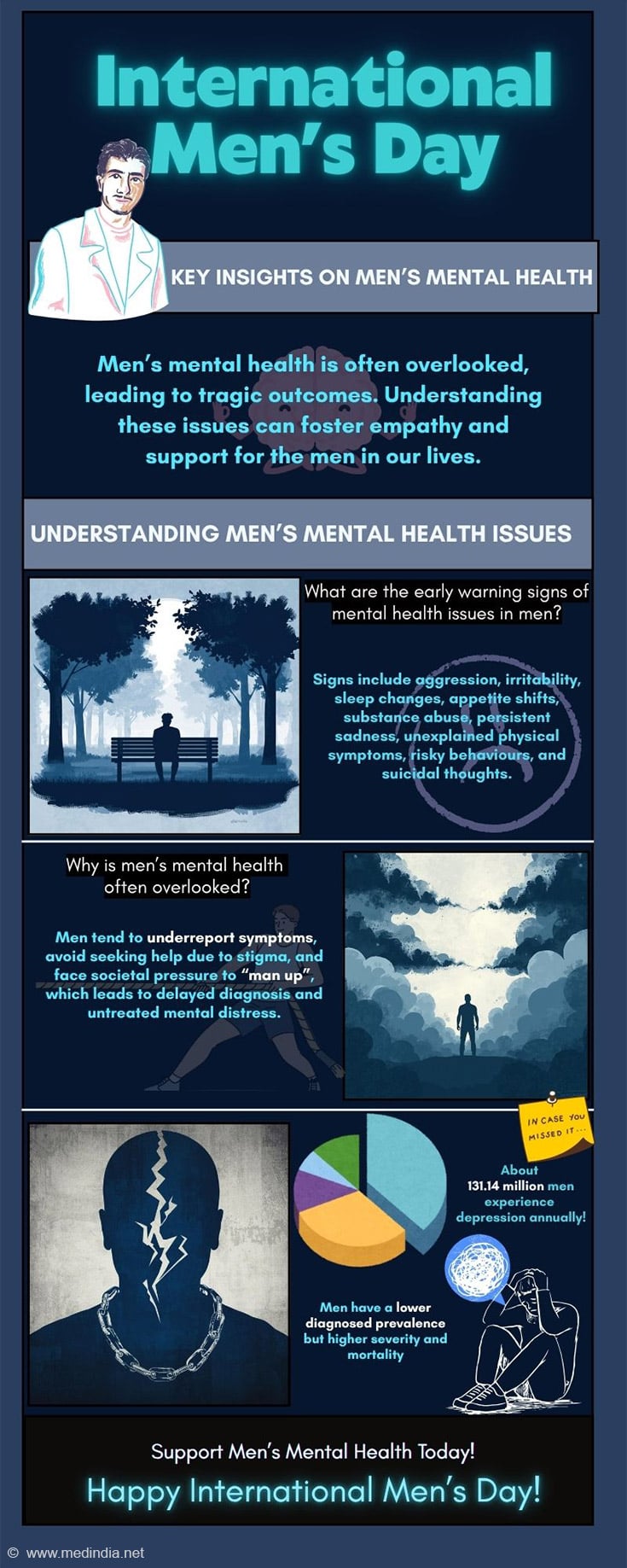
Mental Health Signs To Look Out For In Men
- Aggression, irritability, or anger
- Observable shifts in appetite, energy level, or mood
- Sleeping too much or having trouble focusing, feeling agitated, or tense
- An increase in anxiety or tension
- Abuse of drugs, alcohol, or both
- Persistent sadness or hopelessness
- Having trouble experiencing positive emotions or feeling flat
- Taking part in risky activities
- Headaches, stomach issues, or aches without a known cause
- Compulsive behavior or obsessive thoughts
- Ideas or actions that disrupt social, familial, or professional life
- Suicidal thoughts or attempts (2✔ ✔Trusted Source
Men and Mental Health
Go to source)

Seven Key Signs Indicating It''s Time for a Mental Health Break
Learn the seven key signs that indicate it''s time for a mental health break, including anxiety, stress, and declining motivation.
Learn the seven key signs that indicate it''s time for a mental health break, including anxiety, stress, and declining motivation.
Are You Doing Enough to Support the Men You Love?
1. Talking to someone
Humans are biologically wired to connect; connecting with someone strongly influences both physical and mental health. According to an article published in the American Journal of Lifestyle Medicine, low social connection can be equivalent to
- Smoking 15 cigarettes/day
- Alcohol abuse
- Worse than physical inactivity
- Twice as harmful as obesity
- Hugging, touching, breastfeeding, hand-holding
- Interactions with pets
Five ways men can look after their mental health
Go to source).
2. Stop the ‘Man Up’ Myth
Research shows that when men feel their masculinity is threatened, it can create significant identity stress that affects their mental well-being. To cope with this pressure, many men unconsciously avoid anything perceived as "feminine" and instead try to reassert their masculinity in subtle ways.
Studies found that men under such threats tend to distance themselves from feminine choices and exaggerate traits like height, past relationships, or aggressiveness – behaviors that reflect an attempt to rebuild lost confidence.
These reactions aren't about ego but are psychological coping mechanisms shaped by societal expectations. Such reactions do not concern the ego but are psychological coping mechanisms as dictated by society.
Being continuously under pressure to prove their masculinity, men have fewer opportunities to be vulnerable, express emotions, or ask for help. The first step to promoting men's mental health is to minimize such stigma and establish a place where men feel appreciated without feeling the need to prove and protect their masculinity (4✔ ✔Trusted Source
Manning up: Threatened men compensate by disavowing feminine preferences and embracing masculine attributes
Go to source).
3. Be Active
Even mild exercise, like taking a brisk walk, can improve your mood because it releases endorphins, which have been clinically shown to improve mood, sleep quality, and concentration. To get some fresh air and a change of scenery, try to stay active by getting off the bus one stop early or going for a walk during lunch.
4. See the Signs? Don’t Wait.
If you see the signs mentioned above, you must seek help.
- About 1 in 5 U.S. adults experiences mental illness yearly.
- Men have a lower diagnosed prevalence but higher severity and mortality.
- About 131.14 million men experience depression annually (5✔ ✔Trusted Source
Males and Mental Health Stigma
Go to source).
5. Book an Appointment with a Professional
Professional guidance is often preferable, and there is also a free mental health helpline (Tele MANAS), which is available 24/7. An initiative by the Government of India (6✔ ✔Trusted Source
National Tele Mental Health Programme of India
Go to source).
We often glorify the sacrifices of women, but men, too, have their struggles — their silent cries, their unspoken battles. These are usually dismissed as “their responsibility”, but in reality, men struggle more than we notice.
As a woman writing this, I want to speak to the men in my life: for every silent burden you carry and every challenge you face, you are loved, and we owe you more appreciation than you receive. I dedicate this message to you, and I hope it brings awareness and change.
References:
- Men and women: statistics - (https://www.mentalhealth.org.uk/explore-mental-health/statistics/men-women-statistics)
- Men and Mental Health - (https://www.nimh.nih.gov/health/topics/men-and-mental-health)
- Five ways men can look after their mental health - (https://www.bcu.ac.uk/blog/nursing-and-midwifery/five-ways-men-can-look-after-their-mental-health)
- Manning up: Threatened men compensate by disavowing feminine preferences and embracing masculine attributes - (https://psycnet.apa.org/record/2015-26764-001)
- Males and Mental Health Stigma - (https://pmc.ncbi.nlm.nih.gov/articles/PMC7444121/)
- National Tele Mental Health Programme of India - (https://telemanas.mohfw.gov.in/home)
Source-Medindia

Super 6 Ways to Boost Your Mental Health
World mental health day: Reduce stress, embrace self-love, practice digital detox, seek help and take a break to boost mental health and wellbeing among Indian millennials.
World mental health day: Reduce stress, embrace self-love, practice digital detox, seek help and take a break to boost mental health and wellbeing among Indian millennials.
 Email
Email