MEDINDIA
 English
 हिन्दी
 Español
 français
 中文
中文

 Email
Email
- Barriers to the vaccination of children and adolescents and possible solutions - (https://www.clinicalmicrobiologyandinfection.org/article/S1198-743X(14)60172-5/fulltext)
- Immunization coverage - (https://www.who.int/news-room/fact-sheets/detail/immunization-coverage)
- Addressing barriers to vaccine acceptance: an overview - (https://pmc.ncbi.nlm.nih.gov/articles/PMC5791591/)
- Recommended Solutions to the Barriers to Immunization in Children and Adults - (https://pmc.ncbi.nlm.nih.gov/articles/PMC6179470/)
About
Vaccines are one of public health's greatest triumphs, preventing millions of cases of deadly diseases worldwide. Yet gaps in coverage, waning immunity, and vaccine hesitancy mean preventable illnesses like measles rise. From parents unsure about shots to healthcare systems struggling to reach every child, barriers to vaccination are widespread, but not insurmountable. This article offers evidence-based strategies to close the gap.
Did You Know?
Globally in 2024, there were 14.3 million children who missed routine vaccines due to systemic, provider, or parental barriers. #vaccines #vaccination #immunization #medindia





Barriers to Immunization
Immunization barriers are obstacles that prevent or hinder the uptake of vaccinations, encompassing a wide range of issues(1✔ ✔Trusted Source
Barriers to the vaccination of children and adolescents and possible solutions
Go to source).
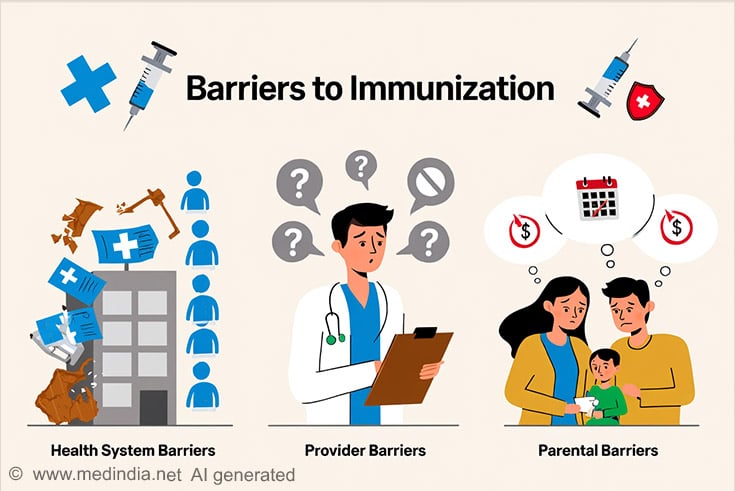
They can be broadly categorized as -
- Health System Barrier
- Provider Barrier
- Parental Barrier
1) Health System Barriers:
Poor health systems can quietly keep life-saving vaccines from reaching those who need them most. Outdated tracking tools, insufficiently trained staff, supply shortages, storage issues, and limited access in rural or low-income areas all create barriers that leave children and communities vulnerable to preventable diseases.
Cost
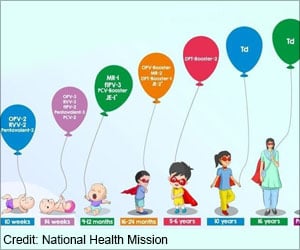
Many free vaccination programs are available to increase the availability of vaccines, especially to low-income and vulnerable populations. India's Universal Immunization Programme (UIP), part of the National Health Mission's RCH program, is one of the world's largest public health initiatives. It provides free vaccines to all pregnant women and children against 12 preventable diseases, of which
Nationwide-11
- Diphtheria,
- Pertussis,
- Tetanus,
- Polio,
- Measles,
- Rubella,
- Severe form of Childhood Tuberculosis,
- Rotavirus Diarrhea,
- Hepatitis B,
- Meningitis & Pneumonia caused by Hemophilus Influenza Type B
- Pneumococcal Pneumonia
Sub-nationally-1
- Japanese Encephalitis (JE vaccine is provided only in endemic districts)
The U-WIN digital platform tracks every vaccination event to ensure coverage and monitoring. https://uwin.mohfw.gov.in/home. Other vaccination programmes worldwide include healthychildren.org , https://www.rivm.nl/en/national-immunisation-programme
Difficult vaccine storage
Vaccine storage challenges can disrupt the cold chain, the critical link that preserves a vaccine's effectiveness from factory to patient. Frequent power outages, fuel shortages, inadequate refrigeration, insufficient ice packs, and poor handling practices often expose doses to damaging temperatures, leaving life-saving vaccines ineffective before they reach those in need.
Reduced vaccine supply and distribution
Delivering vaccines in the factory to individuals is a race against time and temperature. Delays, waste, or unequal access may be generated by weak supply chains, ineffective storage, or inconsistent access to data, particularly when the resources are limited. Without strong planning, reliable cold storage, and smart tracking, even the most effective vaccines risk losing their power before they reach those who need them most.
Missing Unified Vaccination Records
Computerized immunization registries and electronic health records can standardize record-keeping, track missed visits, and speed up vaccination. Reminder systems, age-based adolescent platforms, and vaccination requirements for schools and colleges further strengthen coverage and prevent gaps.
Missed opportunities
A missed opportunity for vaccination (MOV) is defined as any contact with a health service by an eligible individual who is not fully vaccinated, which does not result in them receiving the necessary vaccine doses. These occur at health centers, hospitals, and through various outreach services.
Globally in 2024, there were 14.3 million children missing out on any vaccination—so-called zero-dose children(2✔ ✔Trusted Source
Immunization coverage
Go to source).
2. Provider Barrier
Provider barriers to immunization include lack of provider knowledge, poor staff training, insufficient reminders and recalls for patients, logistical challenges like vaccine cost and storage, and sometimes negative attitudes or communication styles that reduce patient trust and vaccine acceptance. Overcoming these barriers involves provider education, implementing effective reminder systems, ensuring proper vaccine storage, and improving communication about vaccines to patients.
Poor knowledge of immunization
Providers can be doctors, nurses, and other healthcare individuals who are entitled to know the details regarding immunization. The following are mandatory topics to be known for better practice and safe immunization.
- Vaccine indications and contraindications
- Vaccine administration timing
- Vaccine storage
Limited vaccine knowledge can cause missed doses, incomplete records, and poor patient counselling. Regular training, updated awareness programs, and accurate record-keeping are key to ensuring timely and complete immunization.
Poor access to children's immunization records
When vaccination histories are scattered or missing, doctors can't track which shots are due. This can leave children unprotected and parents frustrated. A simple, centralized record could change that.
Missed visits
Every missed appointment is a chance lost to protect a child from preventable diseases. Catching up on vaccines early is key, because every visit counts.
Poor communication with parents and adolescents
Confusing advice or unclear schedules can leave families unsure about what's next. Clear, friendly communication empowers parents and teens to stay on track with vaccinations.
3) Parental barrier
Sometimes, it's not access but hesitation that slows vaccination. Concerns about safety, side effects, or simply forgetting schedules can stand in the way. The barriers can be as follows:
- Limited awareness of the true benefits of vaccines
- Concerns and fears about possible side effects
- Confusion around complex vaccination schedules
- Limited or difficult access to healthcare facilities
- Financial constraints and affordability issues
Honest guidance, empathy, and clear information help parents make confident choices for their child's health.
Immunization Side Effects
The majority of vaccines produce mild and temporary side effects that include fever, fatigue, muscle aches, swelling, or redness at the site of injection. They are symptoms of the normal immune response and generally last 1-2 days.
Severe complications are very infrequent. In extremely rare cases, vaccines may cause anaphylaxis, a serious allergic response, or
Strategies to Improve Immunization
Program-focused strategies
- Detect and address hesitancy in the population/subgroups
- Ensure all health care professionals know and use best immunization practices
- Utilize specific evidence-based strategies known to increase uptake
- Communicate effectively Educate children on the importance of immunization for health
- Work collaboratively
Individual patient-focused strategies
- Don't dismiss a family or patient from the practice because they are hesitant or a vaccine refuser
- Use effective parent/patient discussion-communication techniques
- Use clear language; be aware of effects of framing
- Reinforce the importance of the role of community protection
- Address pain at immunization(3✔ ✔Trusted Source
Addressing barriers to vaccine acceptance: an overview
Go to source)
Improving Vaccination Rates
Improving Vaccination Among Adults
- Education of potential vaccine recipients
- Publicity promoting vaccines
- Increased access to vaccination services such as workplaces, pharmacies
- Reminder-recall systems and internal audits of practice vaccination rates
- Standing order programs
- Audit vaccination rates in practices
- Health-care provider recommendation to patients
- Routine assessment of vaccinations incorporated into clinical practice
- Medical office staff trained to routinely assess vaccination needs of patients
Improving Vaccination Rates Among Children
- Increase knowledge about importance of vaccination for disease prevention
- Stay up-to-date on latest vaccination recommendations
- Become familiar with new vaccines
- Assure office staff are friendly and supportive of families and encourage vaccination at every opportunity, including mild illness visits
- Reminder/recall systems for patients, families and providers
- Reduce out-of-pocket costs
- Standing orders for immunizations
- Assessment of immunization rates for individual providers(4✔ ✔Trusted Source
Recommended Solutions to the Barriers to Immunization in Children and Adults
Go to source)
Vaccination is vital to public health. Disease prevention has been proven to prolong life expectancy and improve quality of life. As anti-vaccination movements gain traction, diseases once thought to be eradicated or nearly eradicated have had significant outbreaks.
Missed doses often occur due to lack of awareness, missed appointments, or overlooked preventive care by both patients and healthcare providers. Implementing recall and reminder systems for families and providers has been shown to improve vaccination rates.
Preventive measures are often overlooked; therefore, coordinated efforts by the healthcare team, including nurses, pharmacists, and physicians, are vital to ensure timely immunization and protect the community.