MEDINDIA
 English
 हिन्दी
 Español
 français
 中文
中文
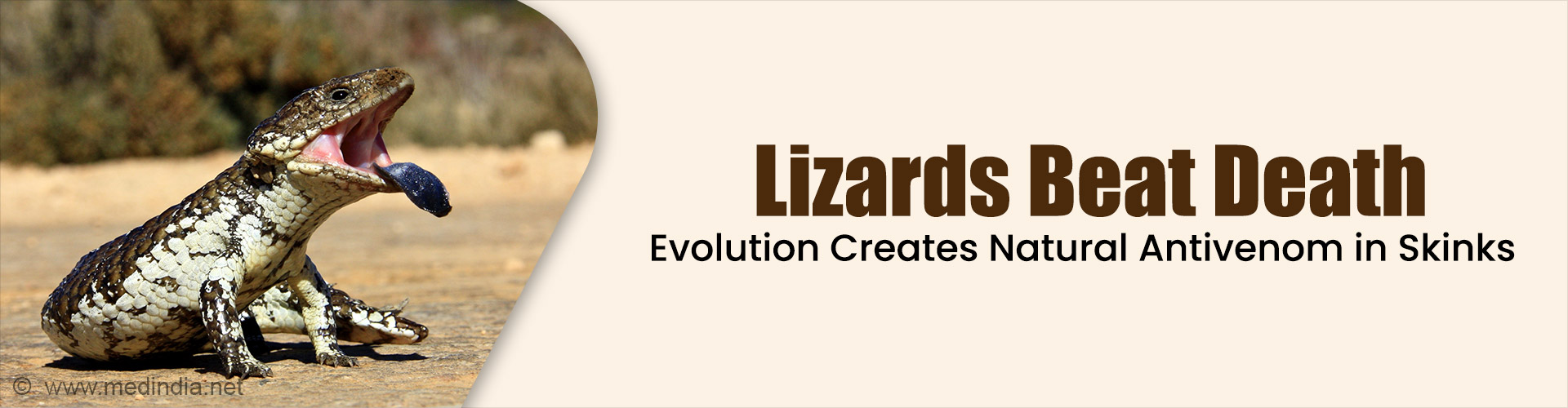
Australian skinks have independently evolved muscle receptor mutations that block snake venom, potentially guiding future treatments for venomous bites.
Highlights:
Australian skinks have developed molecular “armor” that prevents snake venom from shutting down their muscles, as revealed by a study led by the University of Queensland. Professor Bryan Fry from the University’s School of the Environment stated that uncovering how skinks avoid death from venom exposure may guide new biomedical methods for treating human snakebites (1✔ ✔Trusted Source- Australian skinks evolved mutations that prevent snake venom from paralyzing their muscles
- These genetic changes have occurred independently at least 25 times
- Similar venom resistance is seen in animals like honey badgers and mongooses
Make Acetylcholine Great Again! Australian Skinks Evolved Multiple Neurotoxin-Proof Nicotinic Acetylcholine Receptors in Defiance of Snake Venom
Go to source). He described the evolutionary changes as remarkably clever, noting that these skinks have undergone tiny modifications in a vital muscle receptor called the nicotinic acetylcholine receptor. This receptor is normally targeted by neurotoxins which latch on and stop nerve-muscle signals, leading to rapid paralysis and potentially death.
Indian Snake Antivenom - An Overview
Snake antivenom is a medicine used for the treatment of patients suffering from snake envenomation.
Snake antivenom is a medicine used for the treatment of patients suffering from snake envenomation.
TOP INSIGHT

Did You Know?
Some Australian #skinks carry the exact same mutation as the honey badger that blocks cobra venom, a molecular defense evolved completely independently at least 25 times in nature. #snakevenom #evolution #medindia
Independent Evolution of Defense Mechanism
In what he called a striking example of a natural counterattack, Professor Fry explained that in 25 separate instances, skinks developed independent mutations at the toxin binding site to block the venom’s effects. This showcases the evolutionary pressure exerted by venomous snakes following their spread across Australia, during which time these predators likely preyed on unprotected lizards.Astonishingly, similar genetic defenses have also evolved in other species like mongooses, which prey on cobras. According to Professor Fry, functional tests confirmed that the Major Skink of Australia, Bellatorias frerei, carries the exact same resistance mutation seen in honey badgers, a species famous for its immunity to cobra venom.

Homeopathy Research Claims Snake Venom Can Stop the Spread of HIV Virus
Homeopathy has been adapting the process of converting snake venom and poison from deadly scorpions, spiders and wild bees into medicinal substances.
Homeopathy has been adapting the process of converting snake venom and poison from deadly scorpions, spiders and wild bees into medicinal substances.
Mutations Create Venom-Blocking Shield
To see this precise type of venom resistance appear in both a mammal and a reptile is extraordinary, showing that evolution has repeatedly hit the same molecular target. The alterations in the muscle receptors include a strategy to attach sugar molecules that physically prevent toxins from binding, as well as a swap of the amino acid arginine at position 187.The laboratory validation of these mutations was conducted at the University of Queensland’s Adaptive Biotoxicology Laboratory. Dr. Uthpala Chandrasekara, who led the experiments, described the experience as awe-inspiring. Synthetic peptides and receptor models were used to mimic how venom interacts with animal systems, and results showed that some altered receptors were completely unresponsive to venom.

Rattlesnake Venom Offers Hope For Skin Cancer Cure
A recent Brazilian study has thrown light on the use of rattlesnake venom in the fight against skin cancer.
A recent Brazilian study has thrown light on the use of rattlesnake venom in the fight against skin cancer.
Potential for Medical Innovation
Dr. Chandrasekara emphasized that such a minor change in a protein can determine survival or death when encountering highly venomous predators. These discoveries may eventually contribute to creating innovative antivenoms or therapies that counteract neurotoxic venoms.Understanding how natural systems neutralize venom provides valuable insights for biomedical advances, she added. The more we learn about these natural defense mechanisms, the more tools become available for designing next-generation antivenoms.
This research project included partnerships with museums throughout Australia. The findings have been published in the International Journal of Molecular Sciences.
To conclude, the discovery of venom resistance in Australian skinks offers a fascinating glimpse into nature’s evolutionary ingenuity. The repeated emergence of the same molecular defense in unrelated species underscores the powerful selective pressure of venomous predators.
Reference:
- Make Acetylcholine Great Again! Australian Skinks Evolved Multiple Neurotoxin-Proof Nicotinic Acetylcholine Receptors in Defiance of Snake Venom - (https://www.mdpi.com/1422-0067/26/15/7510)
Source-Medindia
Nanoparticles: New Approach to Treat Snakebites
Nanoparticles were found to treat snakebites. Venomous snakebites affect 2.5 million people, and annually cause more than 100,000 deaths and leave 400,000 individuals with permanent physical and psychological trauma each year.
Nanoparticles were found to treat snakebites. Venomous snakebites affect 2.5 million people, and annually cause more than 100,000 deaths and leave 400,000 individuals with permanent physical and psychological trauma each year.
 Email
Email