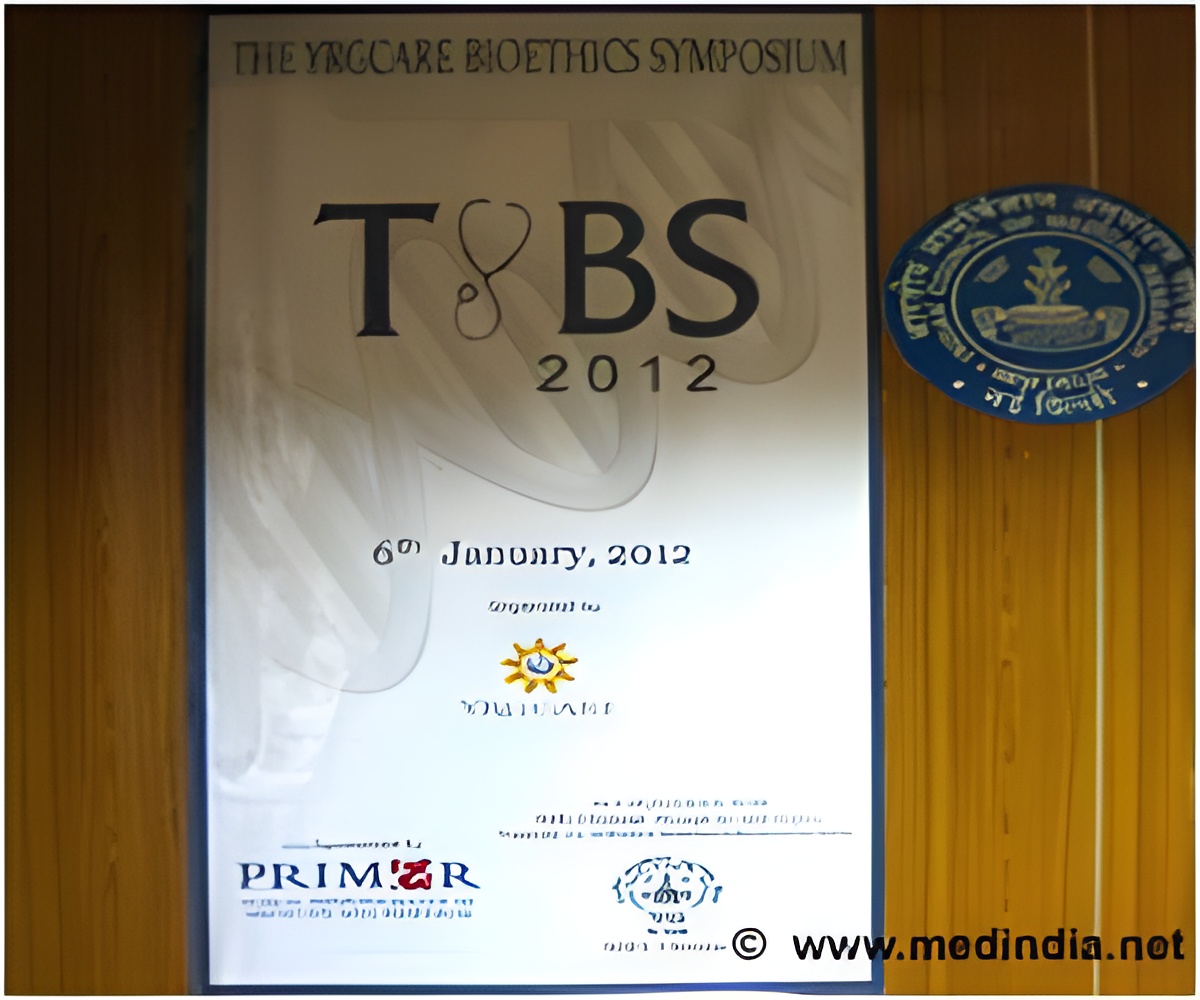
Vital role of Bioethics in research, including the severity of consequences of violation of laws was highlighted in the 4th YRG CARE BIOETHICS SYMPOSIUM 2012.
Taste
may differ from one faction to another but ethics are universal. The 4
th
Annual YRG Care Bioethics Symposium 2012, in collaboration with the National
Institute of Epidemiology, ICMR, Chennai, through the National Institutes of
Health Project “Centrally Co-ordinated Bioethics Education for India” and
National Institute for Research in Tuberculosis, ICMR, Chennai, Co-Sponsored by
Public Responsibility in Medicine and Research (PRIM&R), Boston, USA, was
organized on Friday, January 6
th,
2012 at Robert Koch Auditorium, National Institute for Research in
Tuberculosis, ICMR, Chetpet, Chennai.
Business of Ethics
Differences
in cultural diversity, food preferences and expression through arts are
destined to be celebrated while disparity in the amenities threatening the
basic survival of the underprivileged and undermining people by reducing them
to lab rats and guinea pigs call for condemnation. But unless a person is aware of being taken for granted, war on
unethical practices will remain an ordeal.
During clinical trials, Dr. M.D. Nair, Consultant to Healthcare
Industry and Chairperson emphasized on the regulation against suppression of
any information. Samples on why clinical trials fail included deliberate fraud,
faulty protocols, improper records and documentation, defaulting in Adverse
Drug Reaction (ADR) reporting, deficiency in Informed Consent and neglect in
drug accounting. Drugs are given to patients to take home and they comply but
“you don’t know how many drugs are taken and how many pills are taken and how
many are not taken. And that’s an important bearing on the final outcome.” Dr.
Nair also insisted that the Ethics Committee has a role in minimising the
deficiencies and ensuring that trials are conducted in a proper, established
manner.
Informed Consent, Most Violated Norm
Components
of ethics are concerned with disclosure of information. However the disclosure
is insufficient. It is the duty of the researcher to ensure the subject
understands the disclosure such as technical components, language components,
communication components and understanding of the components regarding the
patient involved, enabling voluntary decision making. Some standards set for
proper clinical trials violated in the past in many developing countries such
as Uganda, Cameroon, Nepal, Uganda, Peru, China to name a few have now been
terminated due to gross unethical practices.
Dr.
Suniti Solomon M.D. with 22 years of teaching experience at the Madras Medical
College explained the background of HeLa Immortal cell line used for growing
viruses and recommended the audience
read ‘Immortal Life of Henrietta Lacks’ by Rebecca Skloot. The book
traces the heart wrenching life story
of Henrietta Lacks out of whose cells millions of dollars were made ,
for making cell lines that researchers bought . Her family gets nothing, making it a true story exposing the ugly
face of abusing ethics. Dr. Solomon wondered if Informed Consents were taken
during the late 1940s. Only after a book on her was released the proceeds made
their way to the family helping them to do better than before.
Grave Disparities
Dr.
Nandini Kumar. M.D., Former Deputy Director General Sr. Grade Co-Investigator,
elaborated on the importance of remuneration cautioning that it should not lead
to undue influence. Further explaining the compensation, she listed the
differences in the bodies providing the compensation reading from the recently
released report by the US Presidential Commission for the study of Bioethical
issues in December 2011. The list has the positioning of compensation in
countries like Australia, Brazil, Bulgaria, and China where the insurance has
to be provided by the sponsors. However in European Union (EU), Canada, Italy
and other countries there are more systems to sponsor. While finishing her
presentation Dr. Kumar showed a slide of a survivor of Nazi experiments. Taking
it from there Dr. Ravi Rengachari, M.D. (Former) Senior Deputy Director,
provided shocking details of USPHS, the accusers and judges of Nazi trials,
were conducting a study deliberately infecting men and women in Guatemala with
syphilis which happened about the same time 1947-48 of the Nuremberg Trials.
Issues in Bioethics
Dispelling
doubts series of presentations were offered beginning with
‘Ethical Challenges in HIV/AIDS Research’
presented by Dr. Sanjay Mehendale. M.D. Director, National Institute of
Epidemiology, Chennai and Principal Investigator, NIH Bioethics Project,
National Institute of Epidemiology, ICMR, Chennai.
‘Ethical Issues in Research with Specimens’
and
‘Responsiveness: Must
Clinical Trials be Responsive to Host Country Health Priorities?’
by Dr. Liza Dawson, M.D. Team Leader, Research Ethics Team, Basic Sciences
Program, Division of AIDS, NIAID/NIH/DHHS, Bethesda, MD.
‘Ethical
Issues in Clinical Trials’ by Dr. M.D. Nair, Consultant to
Healthcare Industry and Chairperson, Ethics Committee, Madras Diabetes Research
Foundation,
‘Compensation
for Participation in Research Projects’ by Dr. Nandini Kumar,
M.D. Former Deputy Director General Sr. Grade Co-Investigator, NIH Bioethics
Project, National Institute of Epidemiology, ICMR, Chennai.
‘International Public Health Research
Ethics’ by Dr. Ravi Rengachari, M.D.(Former) Senior Deputy
Director, (Scientist -7), Indira Vector Control Research (ICMR),
Pondicherry.
‘Ethical Aspects in Paediatric Clinical
Trials’ by Dr.Soumya Swaminathan, M.D. Deputy Director
(Senior Grade), Head of Division of HIV/AIDS, National Institute of Tuberculosis,
Chennai.
‘ICMR
Initiatives in Bioethics Education’ by Dr. Nandini Kumar .M.D.
‘Implementation
of the UNESCO Regional Bioethics Education Action Plan for Asia-Pacific’
by Dr. Darryl Macer, M.D. regional Adviser in Social and Human Sciences in Asia
and the Pacific (RUSHSAP), UNESCO Bangkok, Thailand.
‘On
Public Responsibility in Medicine and Research (PRIM&R)’ by
Dr. S. Swarnalakshmi IRB Manager, YRG CARE.
Ethics in research especially while dealing with lives
of many has many facets to consider. While the Ethics Committee can only
enlighten and do its best to keep a check on violation of laws which are meant
to protect, the integral value of bioethics in everyday research is evolving.
Just like the universal nature of ethics, so is the joint effort to maintain
ethical practices.
Source-Medindia
 MEDINDIA
 English
 हिन्दी
 Español
 français
 中文
中文




 Email
Email