Until recently, humans weren't seen as major virus sources, and human-to-animal virus transmission received little research or attention.
The evolutionary drivers and correlates of viral host jumps
Go to source).
Human-to-Animal Virus Transmission and Implications for Conservation and Food Security
“When animals catch viruses from humans, this can not only harm the animal and potentially pose a conservation threat to the species, but it may also cause new problems for humans by impacting food security if large numbers of livestock need to be culled to prevent an epidemic, as has been happening over recent years with the H5N1 bird flu strain,” said lead author Cedric Tan, a doctoral student at UCL’s Genetics Institute and Francis Crick Institute. “Additionally, if a virus carried by humans infects a new animal species, the virus might continue to thrive even if eradicated among humans, or even evolve new adaptations before it winds up infecting humans again."
How Do Viruses Mutate and Why Does it Matter?
Mutations are the sudden changes that occur in genetic materials. They occur as a part of evolution and give rise to the generation of new variants.
Mutations are the sudden changes that occur in genetic materials. They occur as a part of evolution and give rise to the generation of new variants.
‘Until recently, humans have not been regarded as a significant source of viruses, and the transmission of viruses from humans to animals has been relatively neglected in research and attention. #virus #birdflu’





“Understanding how and why viruses evolve to jump into different hosts across the wider tree of life may help us figure out how new viral diseases emerge in humans and animals,” Tan said. For the study, published in the journal Nature Ecology and Evolution, the team used methodological tools to analyze the nearly 12 million viral genomes. Using the data, they also reconstructed the evolutionary histories and past host jumps of viruses across 32 viral families to search for the viral genomes acquired mutations during host jumps.
The researchers found that “roughly twice as many host jumps were inferred to be from humans to other animals (known as anthroponosis) rather than the other way round. This pattern was consistent throughout most viral families considered. Additionally, they found even more animal-to-animal host jumps that did not involve humans.”
Bird Flu
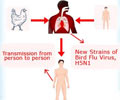
Bird flu (avian influenza/avian flu) is a disease caused by an influenza virus (H5N1) that primarily affects birds but can infect humans also.
Bird flu (avian influenza/avian flu) is a disease caused by an influenza virus (H5N1) that primarily affects birds but can infect humans also.
Reference:
- The evolutionary drivers and correlates of viral host jumps - (https://www.nature.com/articles/s41559-024-02353-4)
Source-IANS

SARS-CoV-2's Becomes a New Normal Among Respiratory Viruses
SARS-CoV-2 may join the ranks of everyday respiratory bugs like the flu, and rhinovirus, say UK experts.
SARS-CoV-2 may join the ranks of everyday respiratory bugs like the flu, and rhinovirus, say UK experts.

COVID-19 Discovery Sheds Light on Coronaviruses' Species-Hopping
The new discovery could potentially provide an explanation for the remarkable ability of coronaviruses to seamlessly transition between different species.
The new discovery could potentially provide an explanation for the remarkable ability of coronaviruses to seamlessly transition between different species.