MEDINDIA
 English
 हिन्दी
 Español
 français
 中文
中文
Chlorine in tap water reacts with common salt added to the food and creates a hypoiodous acid. The acid reacts with food to form iodinated disinfection byproducts.


Constable Succumbs to Chlorine Leak While Saving Others
Constable Tanaji Appa Jadhav sacrificed his life trying to save those who were asleep at the port when the chlorine gas leak occurred
Constable Tanaji Appa Jadhav sacrificed his life trying to save those who were asleep at the port when the chlorine gas leak occurred
TOP INSIGHT

Cooking at low temperatures for a short period of time can reduce the formation of harmful molecules in food.
This in itself is not cause for concern but the acid can react with the food and other organic matter in the tap water to create cooking iodinated disinfection byproducts (I-DBPs).
"I-DBPs formed during cooking with chloraminated or chlorinated tap water are something new to environmental chemists, toxicologists and engineers," said Dr Xiangru Zhang, associate professor at the Hong Kong University of Science and Technology.

Study Says Environmental Exposure to Organochlorines may Affect Male Fertility
A recent study reveals that men exposed to organochlorine chemicals in the environment are at an increased risk of sperm abnormalities.
A recent study reveals that men exposed to organochlorine chemicals in the environment are at an increased risk of sperm abnormalities.
They simulated cooking with different types of tap water at varying temperatures and time, and added wheat flour and iodized salt to see what I-DBPs would be formed.

Airway Cells Regenerate After Chlorine Gas Injury: UofL Scientist Uncovers How
People who were exposed to high levels of chlorine gas from events such as an industrial accident might face long-term breathing problems due to scarring of the airways.
People who were exposed to high levels of chlorine gas from events such as an industrial accident might face long-term breathing problems due to scarring of the airways.
"Considering that these molecules could have an adverse effect on our health, we need to study them more to determine exactly what effects they might have," said Dr Yang Pan, assistant professor at Nanjing University, China.
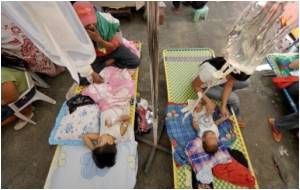
Chlorine Gas Leakage in Pondicherry
Due to leakage of chlorine gas from a factory in Pondicherry, about 300 people had to be hospitalized following complaints of respiratory problems, eye irritation, nausea and vomiting.
Due to leakage of chlorine gas from a factory in Pondicherry, about 300 people had to be hospitalized following complaints of respiratory problems, eye irritation, nausea and vomiting.
Adjusting the cooking conditions can minimize the concentrations of I-DBPs in the water.
Dr Zhang and the team suggest that people should use chlorinated rather than chloraminated tap water and use table salt fortified with potassium iodate instead of potassium iodide. Cooking at lower temperatures, for less time, also limits the formation of I-DBPs, they concluded in the study published in the journal Water Research.
Source-IANS
 Email
Email