MEDINDIA
 English
 हिन्दी
 Español
 français
 中文
中文
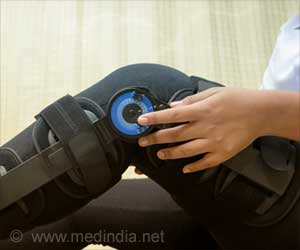
This non-invasive system for leg muscle stimulation is a promising method and is an advance of our current brain-controlled systems that use virtual reality.

Moscow Based Company Introduces Exoskeleton for People With Lower Limb Paralysis
With the help of this advanced exoskeleton, patients will be able to walk again, go up and down the stairs, sit down and stand up all by themselves.
With the help of this advanced exoskeleton, patients will be able to walk again, go up and down the stairs, sit down and stand up all by themselves.
The EEG based system takes electrical signals from the participant's brain which then travel down to electrodes placed around his knees to create movement. Dr. Do said, "We showed that you can restore intuitive, brain-controlled walking after a complete spinal cord injury."
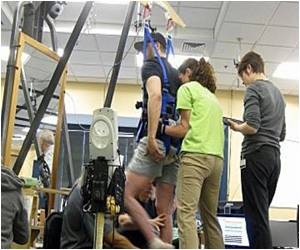
Seated and wearing an EEG cap to read his brainwaves, the participant was trained to control an avatar in a virtual reality environment. He was also guven physical training to recondition and strengthen his leg muscles. The study subject later practiced walking while suspended five cm above ground, so that he could freely move his legs without having to support himself.
Artificial Neurons Work Like Real Ones to Treat Neurological Conditions, Paralysis
Transmission of chemical signals to stimulate neurons may help physicians to bypass damaged nerve cells and restore neural function.
Transmission of chemical signals to stimulate neurons may help physicians to bypass damaged nerve cells and restore neural function.
Dr. Do said, "This non-invasive system for leg muscle stimulation is a promising method and is an advance of our current brain-controlled systems that use virtual reality or a robotic exoskeleton."
Teenager Suffering from Partial Paralysis Cured With Stem Cell Therapy in New Delhi
In the Human Embryonic Stem Cell therapy, doctors in New Delhi injected the isolated stem cells into the 19-year-old Kamini to help her body heal on its own.
In the Human Embryonic Stem Cell therapy, doctors in New Delhi injected the isolated stem cells into the 19-year-old Kamini to help her body heal on its own.
The research was published in the Journal of NeuroEngineering and Rehabilitation.
Paralysis Can Be Averted by Monitoring the Spinal Cord During Surgery: Guideline
Proposal to supervise the spinal cord during spinal surgery and certain chest surgeries to help avoid paralysis or loss of muscle function, related to the surgeries.
Proposal to supervise the spinal cord during spinal surgery and certain chest surgeries to help avoid paralysis or loss of muscle function, related to the surgeries.
 Email
Email