 MEDINDIA
 English
 हिन्दी
 Español
 français
 中文
中文
Mitral Regurgitation
Mitral regurgitation is the most common form of valvular incompetence. About 1 in 5 (20%) of people over 55 years, undergoing an Echocardiogram, have some extent of mitral valve regurgitation.
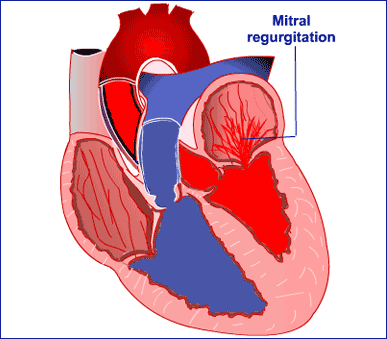
Mitral Regurgitation [MR] is the abnormal back flow or leaking of blood from the left ventricle to the left atrium through the mitral valve.
This is also called “Mitral Insufficiency”. In this condition mitral valve does not close completely. Similar to Mitral Valve stenosis, regurgitation also increases the size of the left atrium. Untreated MR can also lead to heart failure. Patients are usually asymtpomatic with mild Mitral Regurgitation. Patients with moderate to severe MR have abnormal rhythm problems and shortness of breath.
Mitral regurgitation (MR) is one of the most common valve diseases. About 1 in 5 (20%) of all people over 55 years of age, undergoing an echocardiogram, have some extent of mitral valve regurgitation. It occurs in about 5 of 10,000 people in the United States. Mitral Valve prolapse and Myxomatous degeneration are the main cause of MR in the western world unlike the other developing countries where rheumatic heart disease is still the principal cause.
Mitral regurgitation can be acute or chronic. Acute MR is frequently caused by a myocardial Infarction [heart attack] or trauma that causes a rupture of the chordae tendinae. The left ventricular blood flow and volume increases, creating an increase in the left atrial pressure. This can lead to dyspnea or shortness of breath, acute pulmonary edema or even cardiogenic shock. 80% mortality rate is associated with acute mitral regurgitation.
 Email
Email
Methods for Mitral Valve Repair: Annuloplasty:In annuloplasty an artificial ring is placed around the annulus of the valve.This ring reinforces the annulus and restores the valve to its normal shape and size. Balloon Valvuloplasty:Balloon valvuloplasty is performed using a catheter, i.e. a very thin flexible tube which can be inserted into the body, with a balloon at the end. The balloon is put inside the valve and is expanded thus stretching the valve and bringing it back to its normal size. For more info: heart-consult.com/articles
Various symptoms are
* Shortness of breath.
* Pulmonary edema or fluid accumulation in the lungs.
* Orthopnea or shortness of breath while lying flat.
* Paroxysmal nocturnal dyspnea or Cardiac Asthma
* Decreased exercise tolerance.
* Swollen feet or ankles.
Consult Cardiologist Online
Dr. Paresh Patel
MBBS, DNB
8 years experience
Prasann Hospital and Diagnostic Centre[Dr.Paresh.Patel], Vasana, Ahmedabad
Dr. Vijaysinh Patil
MBBS, MD
5 years experience
Wockhardt Hospital in Nashik, Renuka Nagar, Nashik
Dr. Manas Thakur
MD, DM
12 years experience
Cardiac Care Centre [Dr. M.Thakur ], Near Railway Station , Sitamarhi
Dr. Chopda Anand Manaklal
MBBS, MD Medicine, FIN Cardiology, DNB Cardiology
16 years experience
Chopda Hospital, Nashik
What's New on Medindia
Articles
Follow @MedIndia
Mitral valve Regurgitation and Mitral valve Replacement - Related News
Drugs for Mitral Valve Regurgitation and Mitral Valve Replacement