MEDINDIA
 English
 हिन्दी
 Español
 français
 中文
中文
The 2025 UNAIDS report reveals a funding crisis but shows that ending AIDS is still achievable through solidarity and innovation.
Highlights:
As the world prepares for World AIDS Day 2025, a powerful new UNAIDS report titled "Overcoming Disruption, Transforming the AIDS Response" depicts the theme of World AIDS Day 2025.
Decades of progress in the global HIV response are at risk due to a severe funding crisis. Nevertheless, nations, communities, and health systems continue to show that ending AIDS is still possible with investment, cooperation, and creativity despite the obstacles (1✔ ✔Trusted Source- The funding crisis has disrupted HIV testing, prevention & treatment worldwide
- Community-led groups remain the strongest force in sustaining HIV services
- The Global AIDS Strategy 2026–2031 aims to rebuild momentum and end AIDS by 2030
World AIDS Day 2025
Go to source).

Facts on HIV / AIDS
Human Immunodeficiency Virus (HIV) usually targets the human immune system to weaken the body’s defenses against infections. Here are the top facts on HIV/AIDS.
Human Immunodeficiency Virus (HIV) usually targets the human immune system to weaken the body’s defenses against infections. Here are the top facts on HIV/AIDS.
TOP INSIGHT

Did You Know?
Globally, 712 children are newly infected with #HIV every single day-a reminder that urgent action can still save millions. #worldaidsday AIDS #medindia
A Crisis That Shook the Global HIV Response
The year 2025 has brought one of the most serious setbacks in HIV history. A dramatic drop in international funding and declining global solidarity has disrupted prevention programmes, community-led services, and access to lifesaving HIV treatment — especially in low- and middle-income regions most affected by the epidemic.Key impacts include:
- Millions of people were left without a proper diagnosis due to disruptions in HIV testing and prevention.
- Decreased assistance for vulnerable populations, including children, LGBTQ+ communities, sex workers, young women, adolescent girls, and injecting drug users.
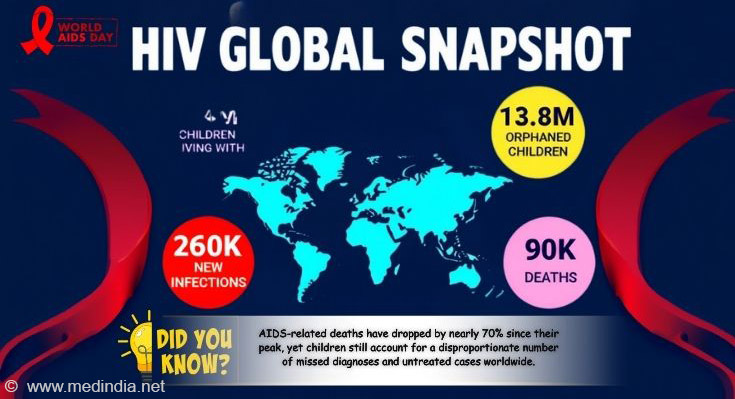
Where the World Stands Today: The Global HIV Snapshot
Despite disruptions, the global community has made remarkable long-term progress! (2✔ ✔Trusted SourceGlobal and regional trends
Go to source)
| CATEGORY | GLOBAL KEY FACTS | FIGURES |
|---|---|---|
| Overall HIV Burden |
➢People living with HIV worldwide ➢Children (0–19) living with HIV ➢Daily new child infections ➢Daily child deaths (AIDS-related) ➢Children orphaned due to AIDS |
➢40.8M (37–45.6M) ➢2.42M (1.85–3.05M) ➢~712/day ➢~250/day ➢13.8M (10.9–17.7M) |
| Children (0–14) |
➢New infections in 2024 ➢Total children living with HIV ➢Share living in sub-Saharan Africa ➢Decline in new infections since 2010 |
➢120k (82k–170k) ➢1.38M (1.13–1.77M) ➢86% ➢62%↓ |
| Adolescents (15–19) |
➢Decline in new infections since 2010 ➢Decline in deaths since 2007 |
➢44%↓ ➢38%↓ |
| Deaths (<20 years) |
➢Children & adolescents who died from AIDS-related causes ➢Share of global AIDS deaths ➢Deaths under age 10 |
➢90k (61k–120k) ➢14% ➢73% of child deaths |
| Geography |
➢Sub-Saharan Africa’s share ➢Children & adolescents with HIV in region |
➢65% ➢86% |
| Key Transmission Patterns |
➢Africa: ➢Eastern Europe & Central Asia: ➢Asia: |
➢Heterosexual & age-disparate sex ➢Increasing sexual transmission ➢Spreading beyond high-risk groups |

Quiz on HIV / AIDS
Statistics tell us that the world HIV+ population has risen drastically from 8 million in 1990 to a whopping 33 million in 2007! Even more alarming is the fact that young people (below the age of 25) account for half of these infections! This is ...
Statistics tell us that the world HIV+ population has risen drastically from 8 million in 1990 to a whopping 33 million in 2007! Even more alarming is the fact that young people (below the age of 25) account for half of these infections! This is ...
Innovation, Community Power & Global Partnerships Against AIDS
Despite limited funding, communities and health workers continue to lead the fight. The report highlights major bright spots:Grassroots Groups: HIV Communities
Grassroots group HIV refers to community-based organizations that work to support people with HIV/AIDS through education, advocacy, and direct services. These groups often focus on
- Local, community-level efforts to address stigma,
- Improving access to HIV testing, treatment and counselling
- Promote public health awareness (SANGRAM, or Sampada Grameen Mahila Sanstha group for sex workers in India or the Grandmothers to Grandmothers Campaign supporting those affected in Africa)
- Condom distribution
- Harm reduction services
- Fighting stigma and discrimination
The New Global AIDS Strategy 2026–2031
The next decade will define whether the world achieves the goal of ending AIDS by 2030.UNAIDS is now crafting the Global AIDS Strategy 2026–2031, which will:
- Set new global HIV targets
- Shape future United Nations policy
- Provide countries with a roadmap to sustain progress
- Focus on inclusivity, innovation, and community leadership
- People living with HIV
- Civil society groups
- Scientists & health workers
- Faith-based groups
- Governments & donors
- Young people and vulnerable communities
Global AIDS Strategy 2026-2031
Go to source). What’s needed is solidarity, renewed investment, and an unwavering commitment to leave no one behind.
References:
- World AIDS Day 2025 - (https://www.unaids.org/en/2025-world-aids-day)
- Global and Regional Trends - (https://data.unicef.org/topic/hivaids/global-regional-trends/)
- Global AIDS Strategy 2026-2031 - (https://www.unaids.org/en/2026-2031-global-aids-strategy)
Source-Medindia
 Email
Email