MEDINDIA
 English
 हिन्दी
 Español
 français
 中文
中文
Icahn School of Medicine researchers say that disabling a protein in Ebola virus cells can stop the virus from replicating and infecting the host.
Treatments Needed for the Deadly Ebola Virus
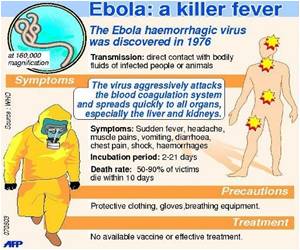
The Ebola virus, claiming the lives of around 90% of those infected, is probably one of the most deadliest viruses on the planet, with practically no approved vaccines or treatment.
The Ebola virus, claiming the lives of around 90% of those infected, is probably one of the most deadliest viruses on the planet, with practically no approved vaccines or treatment.
With the help of collaborators at the University of Texas with access to special high containment facilities, Dr. Basler and his team infected healthy cells with Ebola virus cells that had mutated versions of VP35. The mutations disabled VP35's ability to interact with PACT, therefore allowing it to activate the immune system and prevent the virus from replicating. Next, the researchers overexpressed PACT in healthy cells, and infected them with Ebola virus cells. They found that overexpressing PACT also inhibited viral replication.
Armed with this discovery, Dr. Basler and his team hope to develop drugs that disrupt the interaction of VP35 with PACT, or drugs that overexpress PACT.
Scientists Discover Ebola's Secret Weapon
The mechanism behind one of the Ebola virus' most dangerous attributes has been identified by scientists.
The mechanism behind one of the Ebola virus' most dangerous attributes has been identified by scientists.
Diagnostic Achilles' Heel for Biothreat Detection Identified in Highly Lethal Ebola Virus
A potential weakness in the make-up of deadly agents such as Ebola that can immediately yield a sensitive test has been identified.
A potential weakness in the make-up of deadly agents such as Ebola that can immediately yield a sensitive test has been identified.

Potential Treatments for Ebola and Other Deadly Viruses Revealed in New Study
Despite exhaustive efforts, illnesses caused by many of the world's most deadly viruses cannot be effectively treated with existing drugs.
Despite exhaustive efforts, illnesses caused by many of the world's most deadly viruses cannot be effectively treated with existing drugs.
 Email
Email