MEDINDIA
 English
 हिन्दी
 Español
 français
 中文
中文
A new structured therapy, SwallowFIT, offers promising improvements for swallowing problems in Parkinson’s disease.

UT Health San Antonio scientists launch innovative therapy study to help Parkinson’s patients swallow safely
Go to source).
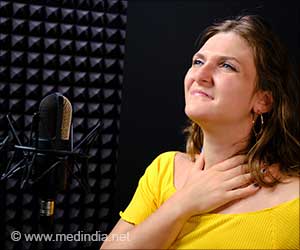
Is Speech Therapy the Answer to Voice Problems in Parkinson's Disease Patients
In Parkinson’s disease patients voice disorders are quite common. A new combination therapy had greater effects on the voice.
In Parkinson’s disease patients voice disorders are quite common. A new combination therapy had greater effects on the voice.
TOP INSIGHT

Did You Know?>
Up to 80% of Parkinson’s patients face serious swallowing issues—SwallowFIT aims to change that.
#parkinsons #medindia
A $1.9 Million Push to Improve Swallowing in Parkinson’s Disease
The Department of Defence has awarded UT Health San Antonio researcher Giselle Carnaby, PhD, MPH, a three-year, $1.9 million grant to oversee a phase 2 multisite clinical trial. “SwallowFIT”, a novel, structured therapy programme designed to improve swallowing function in individuals with early Parkinson's disease, will be tested in this trial.About 80 people with Parkinson's disease who are active-duty U.S. service members, veterans, or close relatives of service members between the ages of 30 and 90 will be enrolled in the upcoming randomised, double-blind clinical trial.
According to Carnaby, "This study represents an important step forward for people who struggle with swallowing disorders." "We are aware that these issues have a significant impact on independence and health, but there are still few options for treatment."

Quiz on Parkinson’s Disease
Introduction: Parkinson's disease (PD) is a chronic and progressive nervous system disorder that results in a gradual loss of muscle control. It has an impact on the body's ability to control movement. ...
Introduction: Parkinson's disease (PD) is a chronic and progressive nervous system disorder that results in a gradual loss of muscle control. It has an impact on the body's ability to control movement. ...
Why Parkinson’s Disease Disrupts Swallowing
Parkinson's disease is a long-term neurodegenerative condition that develops when the neurons of the brain that produce dopamine degenerate.Though the majority of the population identifies Parkinson's disease as a condition associated with shaking, stiffening of the muscles, and slow movements, this disease also has effects and implications on the motor control of tongue, throat, and mouth muscles, which complicates the process of swallowing.
Swallowing, in turn, necessitates coordination of several brain areas and nearly thirty muscles. Nevertheless, brain channels that normally supply these muscles with accurate and timely signals degenerate in Parkinson's.
Carnaby puts it this way:
"The signals to the muscles can become haphazard, which can disrupt the timing and coordination of swallowing. It's like the brain's radio is slightly off the station."

Early Diagnosis of Parkinson's Disease Through the Power of Voice!
Early signs of Parkinson's disease can now be detected by analyzing voice data through AI.
Early signs of Parkinson's disease can now be detected by analyzing voice data through AI.
Early Pilot Results Show Strong Improvements
The pilot study on the SwallowFIT programme produced impressive results for Parkinson's patients.The participants reported better swallowing, reduced cases of choking and more confidence in eating. These findings prompted researchers to conduct a larger controlled trial. Three to six months postintervention, the participants will undergo follow-up on aspiration risk, swallowing measures, nutrition, hospitalisation, and alteration of swallowing physiology.
Because of the considerable amount of benefits manifested in the sections above, even though the control group did not receive therapy at the time of the research, SwallowFIT will be offered to them afterwards.

Parkinson’s Disease - Causes, Symptoms, Diagnosis, Treatment
Parkinson’s disease is a neurodegenerative disease caused by progressive dopamine brain cells loss. Symptoms of Parkinson’s disease are correctable to an extent.
Parkinson’s disease is a neurodegenerative disease caused by progressive dopamine brain cells loss. Symptoms of Parkinson’s disease are correctable to an extent.
How the SwallowFIT Program Works
Neuroplasticity, or the brain's capacity to rewire itself, is the foundation of SwallowFIT. For six weeks, patients work with speech-language pathologists, attend twice-weekly sessions, and complete daily exercises at home. These focused exercises enhance timing and coordination while strengthening the tongue, mouth, and throat muscles. Recalibrating motor pathways to make swallowing safer, easier, and more effective is the aim.One of the most dangerous side effects of Parkinson's disease is difficulty swallowing. SwallowFIT has the potential to become a standard therapy, preventing aspiration, malnourishment, and infections while boosting self-esteem and quality of life. For those with Parkinson's disease, this research offers genuine hope for safer eating and increased independence.
Reference:
- UT Health San Antonio scientists launch innovative therapy study to help Parkinson’s patients swallow safely - (https://news.uthscsa.edu/ut-health-san-antonio-scientists-launch-innovative-therapy-study-to-help-parkinsons-patients-swallow-safely/)
Source-UT Health San Antonio
 Email
Email