MEDINDIA
 English
 हिन्दी
 Español
 français
 中文
中文
Fear memory encoding is influenced by a sparse but potent population of inhibitory cells called parvalbumin-interneurons (PV-INs) in the amygdala.


Lab-Grown Nerve Cells Make Heart Cells Pound
Sympathetic nerve cells more or less automatically activates and regulates breathing, heart rate, visual focus, digestion and fear response.
Sympathetic nerve cells more or less automatically activates and regulates breathing, heart rate, visual focus, digestion and fear response.
TOP INSIGHT

All sensations, movements, thoughts, memories and feelings are the result of signals that pass through nerve cells (neurons), the primary functional unit of the brain and central nervous system.
The Mount Sinai study focused on identifying the synaptic connections between inhibitory PV-INs, sensory pathways and neighboring principal neurons in the basolateral amygdala, a brain region involved in detecting and responding to dangerous situations.
"Our study is the first to show that this default silencing may, in part, be attributable to a sparse population of inhibitory PV-INs," says Roger Clem, PhD, Assistant Professor of Neuroscience and Psychiatry at the Icahn School of Medicine at Mount Sinai and lead investigator of the trial. "The complex anatomy of these cells may allow them to function like master regulators on a hair trigger, springing into action to suppress their neighbors when they detect even the slightest sensory perturbation."
Aggression Causes Production of New Nerve Cells in the Brain
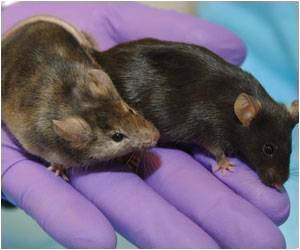
A series of experiments on male mice have experimentally proven that aggression has an influence on the production of new nerve cells in the brain.
A series of experiments on male mice have experimentally proven that aggression has an influence on the production of new nerve cells in the brain.
When a signal passes from the cell body to the end of the cell axon that stretches away from the cell body, chemicals known as neurotransmitters are released into the synapse, the place where signals are exchanged between cells. The neurotransmitters then cross the synapse and attach to receptors on the neighboring cell, which can change the properties of the receiving cell. Found throughout the brain and produced by neurons, gamma aminobutyric acid (GABA) is an inhibitory neurotransmitter that binds to GABA receptors, making the neighboring neuron less excitable. Fear-related disorders like anxiety and post-traumatic stress disorder (PTSD) are thought to partly result from an imbalance of excitatory and inhibitory nerve cells in the basolateral amygdala.

Genetically Identifying and Manipulating the Nerve Cells in a Mouse Brain
The complexity of the human brain depends upon the many thousands of individual types of nerve cells it contains.
The complexity of the human brain depends upon the many thousands of individual types of nerve cells it contains.
The study findings indicate that inhibitory plasticity is a normal consequence of memory encoding and when dysregulated, it could lead to the hyper excitability of the amygdala, a hallmark of PTSD.
Graphene Shown to Safely Interact With Nerve Cells in the Brain
Researchers have successfully demonstrated how it is possible to interface graphene - a two-dimensional form of carbon - with neurons, or nerve cells.
Researchers have successfully demonstrated how it is possible to interface graphene - a two-dimensional form of carbon - with neurons, or nerve cells.
This research was supported by NIH grants MH105414 (R.L.C.) EY026053 (H.M.) and MH096678 (E.K.L.); a NARSAD Young Investigator Award (R.L.C.); and The Friedman Brain Institute at the Icahn School of Medicine at Mount Sinai.
Source-Newswise
 Email
Email