MEDINDIA
 English
 हिन्दी
 Español
 français
 中文
中文
Two proteins in the inner ear that are critical for hearing, which, when damaged by genetic mutations, cause a form of delayed, progressive hearing loss have been discovered by scientists.

Presbycusis (Age-related Hearing Loss)-Causes-Symptoms-Diagnosis-Treatment-FAQs
Presbycusis (age related hearing loss) is the gradual loss of hearing that occurs as people get older. Presbycusis involves progressive sensorineural hearing loss.
Presbycusis (age related hearing loss) is the gradual loss of hearing that occurs as people get older. Presbycusis involves progressive sensorineural hearing loss.
The study involved so-called Beethoven mice that carry mutations on TMC1 and become deaf by their second month of life. Each mutation has a human counterpart that causes a prominent form of genetic deafness, causing children to become completely deaf by the age of 10 to 15 years.
Studies of sensory hair cells from the cochleas of the mice, which sense sound vibrations and signal the brain, showed that the TMC1 and TMC2 proteins are necessary to get calcium into the cells. The researchers showed that when TMC1 was mutated, the calcium influx was reduced and the resulting electrical current was weaker in response to sound. "This is the smoking gun we've been looking for," says Holt.

Quiz on Hearing Loss
A little difficulty in hearing is natural with the aging process but if the auditory damage occurs because of other reasons, it can be a cause for concern. Take this quiz to find out how much you know about hearing loss.
A little difficulty in hearing is natural with the aging process but if the auditory damage occurs because of other reasons, it can be a cause for concern. Take this quiz to find out how much you know about hearing loss.
- The TMC1 and TMC2 proteins act as backups for each other, explaining why hearing loss is gradual and not immediate. "TMC2 can compensate for loss of function of TMC1, but not completely," Holt says.
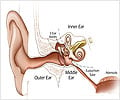
 Anatomy of Ear and Hearing
Ear converts sound waves into electrical impulses that are transmitted to the temporal lobe of the brain through the auditory nerve. It consists of outer, inner and middle sections. - The two proteins can create channel structures either singly or combined in groups, suggesting they may help make different hair cells sensitive to different pitch ranges. "There are gradients of expression of these two proteins, which we think are involved in tuning of the sensory cell," says Holt.


Hearing Loss Caused by Loud Explosions may Not be Untreatable
Long-term hearing loss caused by loud explosions that was previously thought to be untreatable could in fact be treated, says a new study.
Long-term hearing loss caused by loud explosions that was previously thought to be untreatable could in fact be treated, says a new study.
 Email
Email