MEDINDIA
 English
 हिन्दी
 Español
 français
 中文
中文
Having a meal activates the functioning of brown adipose tissue (BAT). Human brown adipose tissue (BAT) oxygen consumption increased as significantly after a meal as it did during exposure to cold.


Brown Fat to Fight Flab
Around 50 grams of white fat stores 300 kilocalories. In contrast the same amount of brown fat burns 300 kilocalories a day. Such is the magic of this good fat.
Around 50 grams of white fat stores 300 kilocalories. In contrast the same amount of brown fat burns 300 kilocalories a day. Such is the magic of this good fat.
TOP INSIGHT

Human brown adipose tissue (BAT) oxygen consumption increased as significantly after a meal as it did during exposure to cold.
One of the main functions of BAT is heat production. Heat production is obviously generated in cold environments, but, using animal testing, it has already been proven before that eating also stimulates heat production in BAT.
Even though there are few direct tools for measuring this in humans, researchers at Turku PET Centre in Finland were able to utilize non-invasive imaging to measure oxygen consumption in BAT. In Turku, there is extensive expertise and long-term experience in researching human metabolism with PET imaging. Examining BAT in humans is extremely interesting, and it seems that several basic functions of BAT in humans remain unknown.

Understanding of Human Brown Adipose Tissue Advanced by Joslin Scientists
Significant findings about the location, genetic expression and function of human brown adipose tissue (BAT) are being reported by Joslin scientists.
Significant findings about the location, genetic expression and function of human brown adipose tissue (BAT) are being reported by Joslin scientists.
Healthy volunteers participating in the study were given a standard and balanced meal which included vegetable lasagna, salad, bread and margarine, and a glass of milk. After the meal, a PET scan was performed on the upper thoracic region containing BAT in order to measure oxygen uptake and tissue perfusion. The PET scan was repeated on another day during exposure to cold.

Brown Adipose Tissue Beneficial for Metabolism and Glucose Tolerance
Brown adipose tissue (BAT) has beneficial effects on glucose tolerance, body weight and metabolism, is being demonstrated by Joslin Diabetes Center scientists.
Brown adipose tissue (BAT) has beneficial effects on glucose tolerance, body weight and metabolism, is being demonstrated by Joslin Diabetes Center scientists.
After eating, there is quite a hormonal storm in the human body. Insulin is one of the most significant hormonal signals, and it promotes the transferring of nutrients, glucose (sugar), and fatty acids to be oxidized in the tissues. In addition, several genes regulating fatty acid metabolism in BAT are expressed after eating.
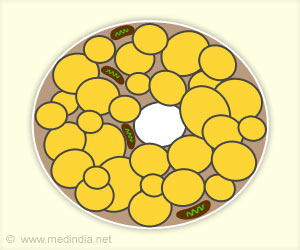
Humans Have 3 Times More Brown Fat
Until now, the proportion of brown fat in humans was thought to be quite small.
Until now, the proportion of brown fat in humans was thought to be quite small.
Source-Eurekalert
 Email
Email