
Low Blood Pressure | Hypotension
If your blood pressure is persistently less than 90/60 mm Hg you are suffering from Low blood pressure or Hypotension.
If your blood pressure is persistently less than 90/60 mm Hg you are suffering from Low blood pressure or Hypotension.
- About 11 percent of patients who developed heart failure had orthostatic hypotension at the start of the study, compared with only 4 percent of those who did not develop heart failure.
- People with orthostatic hypotension had 1.54 times the risk of developing heart failure than those without orthostatic hypotension; however, after excluding those with high blood pressure, the risk fell to 1.34 times.
"Researchers found that even when adjusting for existing diseases, such as high blood pressure, diabetes, and coronary heart disease, participants with orthostatic hypotension at the start of the study were still more likely to develop heart failure than those without it. The study is the first of its kind to include both Caucasian and African-Americans. Prior studies in Europe included mostly Caucasians."The association of orthostatic hypotension with heart failure did not vary greatly when we compared white and African-American participants," Jones said. Study participants were part of the Atherosclerosis Risk In Communities (ARIC) Study, an ongoing longitudinal study of men and women in communities throughout the United States.Heart failure, which affects about 5.7 million people in the United States and caused over 281,000 deaths in 2008, cost the healthcare system about $34.4 billion in 2010, according to the American Heart Association.The disease occurs when the heart pumps inefficiently, which results in inadequate delivery of blood to the body's cells and organs. Discovering factors that may predict heart failure is important to preventing the disease, Jones said.
Source-Eurekalert
Congestive Heart Failure (Congestive Cardiac Failure) Current Management
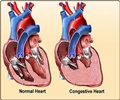
Congestive heart failure (CHF) is a condition in which the heart fails to work adequately as a pump that can deliver oxygen rich blood to the body.
Congestive heart failure (CHF) is a condition in which the heart fails to work adequately as a pump that can deliver oxygen rich blood to the body.
Blood Pressure Chart
Blood pressure is the pressure of the blood flowing through your blood vessels against the vessel walls. Just by entering you age, you can get the accurate range of blood pressure value.
Blood pressure is the pressure of the blood flowing through your blood vessels against the vessel walls. Just by entering you age, you can get the accurate range of blood pressure value.

Test Your Knowledge on Heart
The heart is a fist-sized organ that pumps blood throughout the body. It is the primary organ of the human circulatory system that helps in circulation of blood throughout the body...
The heart is a fist-sized organ that pumps blood throughout the body. It is the primary organ of the human circulatory system that helps in circulation of blood throughout the body...