MEDINDIA
 English
 हिन्दी
 Español
 français
 中文
中文
An experimental oral drug has been shown to protect healthy tissue from radiation effect in patients suffering from advanced non-small cell lung cancer.
Lung Cancer - Types, Causes, Symptoms, Diagnosis, Treatment and Prevention
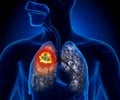
Lung cancer is a malignant tumor in the lung tissues. Smoking is the main cause of lung cancer with symptoms like recurrent respiratory diseases.
Lung cancer is a malignant tumor in the lung tissues. Smoking is the main cause of lung cancer with symptoms like recurrent respiratory diseases.
For the safety study, 10 patients with inoperable stage III non-small cell lung cancer took oral doses of MnSOD plasmid liposome twice weekly for a total of 14 doses during seven weeks of conventional chemotherapy and radiation treatment. The agent, which boosts levels of an antioxidant the body makes naturally, is made of fat droplets containing the gene that produces MnSOD.
When swallowed, it is absorbed by cells in the esophagus, which is a common site for severe side effects during radiation treatment for lung cancer.
One patient experienced mild heartburn and a slight rash and another had mild constipation and a fluctuation in blood sodium, problems that might be associated with MnSOD treatment. No other toxicities were thought to be due to the experimental drug.
“The results of this initial trial indicate that MnSOD plasmid liposome can be safely administered,” Dr. Greenberger said. “It did not linger in normal cells after treatment, nor did it protect cancer cells from radiation treatment. The next study, which is underway at UPCI, is to determine whether it protects normal tissue, particularly the esophagus, from radiation exposure.”
New Discovery Holds Promise Against Non-Small Cell Lung Cancer
Scientists have discovered a mechanism in non-small cell lung cancer (NSCLC) cells that contributes to their ability to maintain and grow tumors.
Scientists have discovered a mechanism in non-small cell lung cancer (NSCLC) cells that contributes to their ability to maintain and grow tumors.
Preclinical testing has shown that generating higher levels of MnSOD in healthy cells can suppress the production of inflammatory molecules and reduce cell death, micro-ulceration and esophagitis. Because the agent is delivered to healthy tissue, it does not protect tumor cells from radiation treatment. In fact, Dr. Greenberger noted, experiments hint that when it is given to cancer cells, it actually encourages cell death because of abnormalities in their cellular metabolism.

The Lungs
The lungs are our organs of respiration. It is within these, that exchange of gases takes place.
The lungs are our organs of respiration. It is within these, that exchange of gases takes place.
The findings have been published in this month’s issue of Human Gene Therapy.
Source-Medindia
 Email
Email