MEDINDIA
 English
 हिन्दी
 Español
 français
 中文
中文
If people with a diabetic foot syndrome (DFS) receive hyperbaric oxygen therapy (HBOT) in addition to conventional treatment, this can promote wound healing.
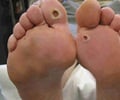
Diabetes Foot Care Treatment Prevention
Valuable information on diabetic foot care, treatment and prevention.
Valuable information on diabetic foot care, treatment and prevention.
TOP INSIGHT

If people with a diabetic foot syndrome receive hyperbaric oxygen therapy (HBOT) in addition to conventional treatment, this can promote wound healing.
HBOT is recommended in addition to conventional wound care if all options to revascularize the tissue, that is, to supply a sufficient amount of blood again, have failed and there is a threat of amputation.
In HBOT, the patients sit in a special chamber and inhale (mostly) pure oxygen under increased ambient pressure. This is supposed to enrich the blood with oxygen and promote a better oxygen supply, also in the area of the wound.

Non-Healing Skin Cells From Diabetic Foot Ulcers Reprogrammed as Stem Cells
Skin cells from diabetic foot ulcers can be reprogrammed to acquire properties of embryonic-like cells, revealed researchers.
Skin cells from diabetic foot ulcers can be reprogrammed to acquire properties of embryonic-like cells, revealed researchers.
Furthermore, the studies included very different patients; this applied, among other things, to disease severity. In part, great deviations between studies were also shown for the time of analysis. These could be the main reasons why, for single aspects of treatment, the results of the studies were very heterogeneous. However, other causes cannot be excluded.
FDA Clears Cardium's Excellagen For Diabetic Foot Ulcers
Cardium Therapeutics has received 510(k) clearance from the US FDA to market and sell the Company’s new Excellagen.
Cardium Therapeutics has received 510(k) clearance from the US FDA to market and sell the Company’s new Excellagen.
In the preliminary report, the IQWiG researchers had still assumed proof of a benefit. However, in the final report they were able to include a further study that was only published in full in January 2016. Now not only one, but two studies with a low risk of bias are available. However, these two studies yield discrepant results for wound closure. In the final report IQWiG therefore downgraded the certainty of conclusions from 'proof' to 'a hint' of a benefit.
Proper Care Can Prevent Amputations in Diabetic Foot Infections
Diabetic foot infections are the most common problem which can result in lower extremity amputations.
Diabetic foot infections are the most common problem which can result in lower extremity amputations.
At the same time there is no hint of harm from additional HBOT in the form of adverse effects. Overall, the rate of complications is comparable between both study groups, which is why HBOT is regarded to be safe.
Source-Eurekalert
 Email
Email