MEDINDIA
 English
 हिन्दी
 Español
 français
 中文
中文
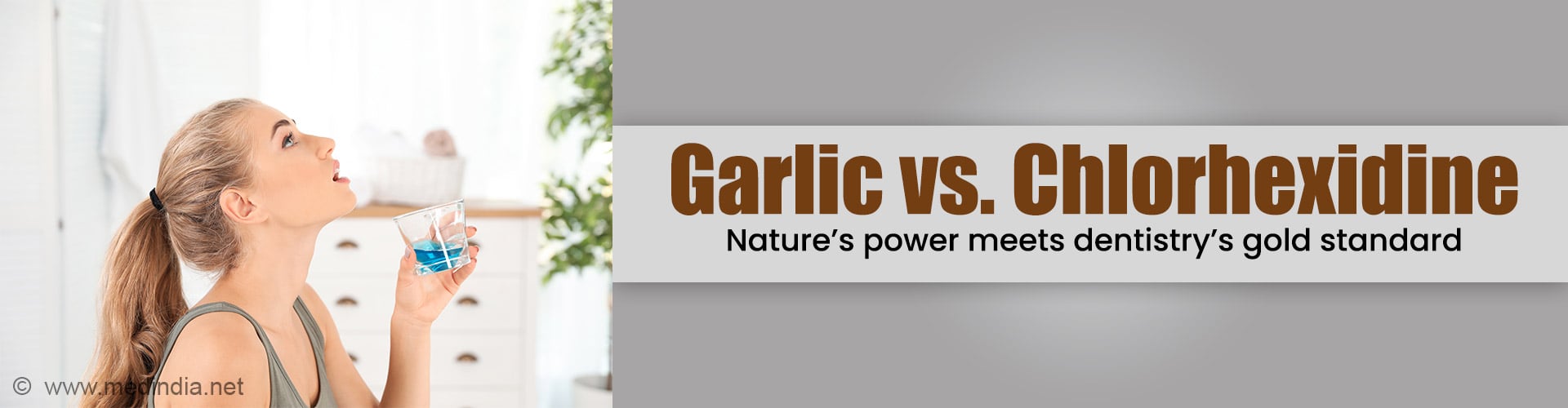
A new review compares garlic extract with chlorhexidine to see whether nature can rival the gold-standard mouthwash.
Highlights:
The human mouth hosts a bustling community of microorganisms, some helpful, others harmful. Disease-causing microbes may cause problems within the oral cavity when they become predominant, leading to problems like gingivitis, periodontitis, and caries of the dentine. Antimicrobial mouthwashes are important in oral disease prevention and daily dental care because these microbes fuel the disease (1✔ ✔Trusted Source- Garlic extract shows clinically meaningful antibacterial effects
- Chlorhexidine still outperforms garlic for key bacteria like mutans streptococci
- Side effects like burning and taste changes limit garlic mouthwash use
The Clinical Antimicrobial Efficacy of Garlic Extract (Allium sativum) Compared to Chlorhexidine Mouthwash: A Systematic Review
Go to source).
Mouthwash - Components, Types, Benefits & Risks
Explore the role of mouthwash in oral hygiene. Learn about types, benefits, and risks. Expert insights for a healthy smile.
Explore the role of mouthwash in oral hygiene. Learn about types, benefits, and risks. Expert insights for a healthy smile.
TOP INSIGHT

Did You Know?
Crushed #garlic instantly produces #allicin (one of nature’s strongest #antimicrobial compounds), giving garlic its powerful ability to fight bacteria, fungi, and even some viruses! #oralcare #mouthwash #medindia
Chlorhexidine Mouthwashes: An Essential Piece of Oral Health
Chlorhexidine (CHX) is considered the gold-standard antimicrobial rinse due to its broad-spectrum action and ability to slow or kill bacteria. It is well known for reducing plaque, gingivitis, bleeding, and bad breath.Chlorhexidine mouthwash is typically used for a short period of time, usually 2 to 4 weeks or up to 30 days, as directed by a dentist or healthcare professional. But CHX has drawbacks. It may cause long-term side effects such as tooth and tongue staining, taste changes, dry mouth, burning, numbness, and calculus. What is more concerning is that long-term or low-dose exposure may promote antimicrobial resistance and cross-resistance to antibiotics. This concern is what has led to the search for safer, natural alternatives.

Using Antibacterial Mouthwash Could Affect Your Daily Exercise Benefits
Using mouthwash regularly can reduce the health benefits of daily exercise by interfering with oral bacteria, reveals a new study.
Using mouthwash regularly can reduce the health benefits of daily exercise by interfering with oral bacteria, reveals a new study.
Garlic: An Ancient Remedy with Modern Potential
In 2024, there were around 30 million metric tonnes of garlic consumed worldwide, with China accounting for almost 80% of both production and consumption. The global market for garlic extract was estimated to be worth more than $15 billion that same year.Antimicrobial properties of plants have always been investigated. Garlic (Allium sativum) is one of them, which has historic and scientifically substantiated medicinal qualities. On crushing the garlic, allicin is formed, the strongest antimicrobial compound.
Garlic extracts have been very active against most of the bacteria, fungi and viruses. Studies have investigated its application in controlling denture stomatitis, dentinal tubule disinfection and as an intracanal agent.

Your Mouth is a Mirror of Your Body
Did you know that systemic diseases show signs in the oral cavity first?
Did you know that systemic diseases show signs in the oral cavity first?
Chlorhexidine Versus Garlic: Which Fights Better?
Antimicrobial mouthwashes are used in the treatment of gingivitis, caries, periodontal disease, halitosis, and other oral cavity infections, targeting harmful bacteria, fungi, or viruses. One of them is chlorhexidine, which has been widely accepted.The comparisons with chlorhexidine have given encouraging results: CHX proved to be superior to garlic in relation to some pathogens, such as Porphyromonas gingivalis, and garlic extract is very active in the case of multidrug-resistant bacteria.
"The effectiveness varied based on mouthwash concentration and duration of application, contributing to differences in outcomes," the study found. While some research found that garlic extract was more efficient at specific quantities, others preferred chlorhexidine for maintaining higher plaque/salivary pH. Garlic mouthwash also caused greater discomfort.
However, the majority of studies are in vitro, use different methodologies, and are not clinically standardized. This discrepancy underscores a significant evidence gap in terms of the clinical efficacy of garlic – a gap that this systematic review attempts to fill.

Mouthwash Overuse may Lead to Cancer
Using mouthwash more than three times a day ups the risk of mouth and throat cancer, says study.
Using mouthwash more than three times a day ups the risk of mouth and throat cancer, says study.
How Garlic Stacks Up Against Chlorhexidine
The studies contributed to the realization that there is indeed some actual clinical antimicrobial effect of garlic extract mouthwash, and it is indeed capable of reducing levels of bacteria as compared to baseline.However, differences emerged:
- Chlorhexidine tended to be more effective against certain bacteria like mutans streptococci (MS).
- Garlic extract showed promising reductions, particularly at higher concentrations.
- Garlic also demonstrated strength against multidrug-resistant organisms, increasing its value in the era of rising antibiotic resistance.
- Burning sensation
- Unpleasant taste
Can Garlic Replace Chlorhexidine?
Garlic extract mouthwash exhibits a tremendous decrease in the number of bacteria as compared to the baseline and has clinically significant antimicrobial effects. Despite chlorhexidine being better than garlic in terms of reducing cases of mutans streptococci (MS). Garlic extract, particularly at high levels, may be used as a natural and effective substitute under selected conditions.But its use can be restricted by side effects such as a burning sensation and taste disorders. It requires more standardized and quality clinical trials to prove its place in regular dental practice.
Reference:
- The Clinical Antimicrobial Efficacy of Garlic Extract (Allium sativum) Compared to Chlorhexidine Mouthwash: A Systematic Review - (https://www.sciencedirect.com/science/article/abs/pii/S2210803325000648)
Source-Medindia
 Email
Email