MEDINDIA
 English
 हिन्दी
 Español
 français
 中文
中文
Cancers are known to have the ability to co-opt or evade host anti-tumor responses, a key protein Chitinase 3-like-1 helps to fight infections and stimulates tissue healing.


HOXA5 Protein Acts as Tumor Suppressor in Breast Cancer
HOXA5 have an increased capacity to renew themselves and are more invasive than normal breast cells and they become more tumor like.
HOXA5 have an increased capacity to renew themselves and are more invasive than normal breast cells and they become more tumor like.
TOP INSIGHT

People have a directly analogous version of the protein called YKL-40 and, in cancer patients, high levels of its expression correlate strongly with advanced cancer spread and a poor prognosis.
Ina 2014 study, Elias's team at Brown and Yale found evidence that CHI3L1 has a central role in making tissues receptive to cancer spread. "It seems to be a very fundamental pathway," said Elias, a specialist in pulmonary medicine and immunology. "It's not a pathway that's just in this disease or that disease. It's a fundamental way that the body responds, and as a result it has many different consequences."
In the new study, the researchers not only explained more about how CHI3L1 promotes cancer spread but they also tested a new intervention that had especially widespread effects. The scientists exposed mice to melanoma or breast cancer cells and then treated different mice at different times over the next eight days to suppress expression of CHI3L1. In treated mice they restored several mechanisms that the body has to fight tumors and were able to prevent the lungs from becoming hospitable to the cancer. Mice left untreated as experimental controls quickly developed cancer in their lungs after exposure to cancer cells.

Consumption of High-Fat Foods in Adolescence Increase Breast Cancer Risk
High intake of saturated fat and low intakes of mono- and polyunsaturated fat were associated with higher dense breast volume in adolescent girls.
High intake of saturated fat and low intakes of mono- and polyunsaturated fat were associated with higher dense breast volume in adolescent girls.
Several experiments revealed the details of what was going on in the lungs of the mice. They defined a pathway that contributes to cancer spread by stimulating CHI3L1, a novel pathway that blocks CHI3L1 and cancer spread, and highlighted the ways that tumors evade this antitumor response.
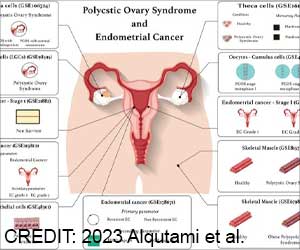
Promising Biomarker to Predict the Recurrence of Endometrial Cancer
The deubiquitinating enzyme (DUB) USP14 is a promising biomarker for identifying risk of recurrence in endometrial cancer patients.
The deubiquitinating enzyme (DUB) USP14 is a promising biomarker for identifying risk of recurrence in endometrial cancer patients.
The new intervention that Elias's team tested was to bolster RLH immunity by stimulating its pathway with an RNA-like molecule called Poly(I:C). In mice this intervention reduced CHI3L1 production and its cancer-augmenting responses. While untreated mice went on to develop cancer in their lungs within two weeks, mice given Poly(I:C) fended the cancer off. Notably, among the effects was an increase in natural killer cells, natural killer cell recruiting proteins, stimulation of the proteins LIMK2 and PTEN and suppression of B-Raf and Nlrx1proteins. Recently scientists have attempted to develop cancer-fighting drugs by focusing on some of these individual proteins, but not multiple ones at the same time.

Isoforms of Transcription Factor Play a Key Role in Colon Cancer and Colitis
Isoforms P1 and P2 perform non-redundant functions in the intestine and are relevant to colitis and colitis-associated colon cancer.
Isoforms P1 and P2 perform non-redundant functions in the intestine and are relevant to colitis and colitis-associated colon cancer.
In several of the experiments the team didn't just compare treated mice with untreated mice. Often they also used the additional controls of mice engineered to lack the gene that produces a particular protein, like CHI3L1. These steps helped to test whether the particular protein being investigated really played the suspected meaningful role.
It was clear that giving RLH the upper hand against CHI3L1 proved meaningful for suppressing cancer spread in the lungs of the mice. "The thing that's exciting is that [stimulating the RLH pathway] is going to allow multiple antitumor response to be augmented vs. just one," Elias said. "If you can agonize the RLH pathway, you might get a really good effect in cancer."
Source-Eurekalert
 Email
Email