MEDINDIA
 English
 हिन्दी
 Español
 français
 中文
中文
Cancer cells have the ability to sense the stiffness of their environment. The ability of cancer cells is to move depending upon their environment.
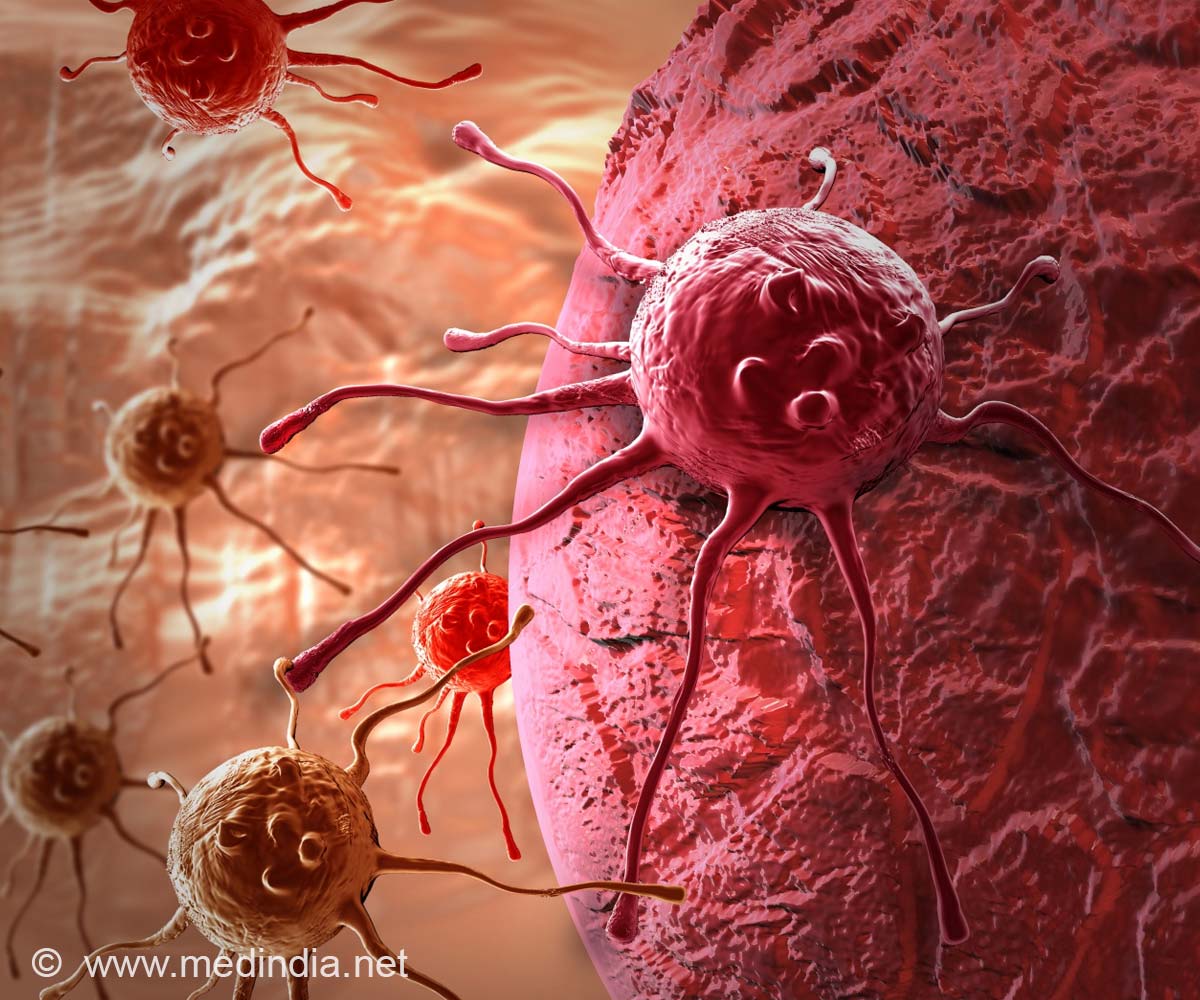

MicroRNA Specifically Targets Cancer Cells With Common Mutation
Small pieces of genetic material was used to specifically kill cancer cells with common mutation in the KRAS gene.
Small pieces of genetic material was used to specifically kill cancer cells with common mutation in the KRAS gene.
TOP INSIGHT

Researchers are working to improve cancer vaccines that could easily make their way to the tumors.
"Cells are a little like the storybook character Goldilocks. They don't like their environment too hard or too soft--it needs to be just right or they won't move," said David Odde, a University of Minnesota biomedical engineering professor and Masonic Cancer Center researcher who led the study.
"If we can trick cancer cells into believing it is not a good environment for migration, we can prevent the cancer cells from spreading."
Scientists Study the Role of Cancer Cells and Some Fibroblasts in the Breakage of Cellular Membrane
Though a carcinoma in situ means a cancer in place, it often does not keep its place.
Though a carcinoma in situ means a cancer in place, it often does not keep its place.
During their study, Odde and his colleagues compared cells from human brain cancer to mobile but normal cells from embryonic chick brains. They did five different experiments that included environments with six different stiffnesses. They also tested the effects of two different cancer drugs on the cell movements.

T-cell Therapy Destroys Cancer Cells, Prevents Relapse
Scientists use the natural killing capacity of T-cells to identify, memorize and attack tumor cells using the chimaeric antigen receptor.
Scientists use the natural killing capacity of T-cells to identify, memorize and attack tumor cells using the chimaeric antigen receptor.
Cells, it turns out, are like cars. They have motors that generate force, and a clutch to transfer that force to structures that grip the tissue along which they move.

How Cancer Cells Avoid Cell Death Process
Researchers have got an important new insight about how cell death process is being avoided by the cancer cells. The findings may also suggest a chemotherapeutic approach to prevent the spread of cancers.
Researchers have got an important new insight about how cell death process is being avoided by the cancer cells. The findings may also suggest a chemotherapeutic approach to prevent the spread of cancers.
They found that the combination of the two drugs they tested inhibited the motor and clutch functions of cancer cells and therefore inhibited their movement.
"We brought an engineer's perspective to a biological problem that will hopefully have a medical benefit," Odde said. "We used a math and physics-based approach to building models and testing experimentally. This is not typical in cell biology, but it was effective for us."
Motor- and clutch-inhibiting drugs for humans are still in development, Odde said, but with further research they could prolong the lives of cancer patients.
In addition to applying the cell movement research to regenerative medicine, Odde said next steps include working to improve cancer vaccines that encourage cancer-fighting cells to easily make their way to the tumors.
Source-Eurekalert
 Email
Email