Medindia » Consumer Health » Health Information » Microscopic Polyangiitis - About
Disease Info Index
Drugs For Microscopic Polyangiitis
Page Options
Locate a Doctor
Speciality
City (or)
eg:Chennai
Pincode
eg:600000

Microscopic Polyangiitis (MPA)

Rating : 4.1 /5 Comments : 2
Rate this Article:

About

RSS Feeds   Text 
Microscopic Polyangiitis (MPA) is a vasculitis affecting small blood vessels. Patient is treated with cyclophosphamide and a corticosteroid.

Microscopic polyangiitis (MPA) is a type of vasculitis that affects small blood vessels like capillaries, venules or arterioles. Vasculitis is a condition in which blood vessels are inflamed.  They are autoimmune disorders, where the body produces antibodies against its own self. MPA usually affects adults in their 50s. Males suffer from this condition slightly more often than females. The reason why MPA affects some people is not known. It often targets the lungs and kidneys.  Nerves, digestive tract and skin may also be involved.

The patient may show general signs and symptoms like fever, muscle pain and weight loss. He may suffer from complications like kidney failure, bleeding in the lungs or perforation in the digestive system. Blood tests, imaging studies like x-ray and CT scan and biopsy of the affected organ are used to diagnose the condition.  The blood level of a specific antibody called ANCA is high in patients with MPA. The patient is treated with drugs that suppress immunity like cyclophosphamide and corticosteroids.
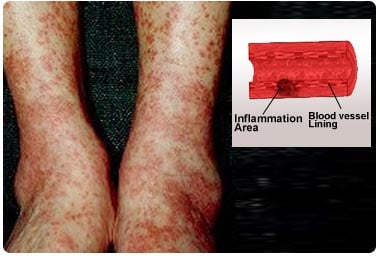
Microscopic Polyangiitis

MPA shares some common features with another vasculitis i.e. Wegener’s granulomatosis. Patients with MPA develop kidney disease similar to Wegener’s granulomatosis. Blood levels of ANCA are high is both conditions. However, unlike in Wegener’s granulomatosis, accumulations of cells called granulomas are not seen in MPA. MPA affects the smallest blood vessels, while Wegener’s granulomatosis usually affects the medium sized blood vessels. Wegener’s granulomatosis often affects the upper airways. Upper airway disease is usually not seen in MPA.

Ways To Boost Your Immune System - Slide Show

MPA should also be differentiated from another vasculitis called Polyarteritis Nodosa. In MPA, very small vessels like capillaries, venules or arterioles are inflamed. These vessels are usually not affected in Polyarteritis Nodosa.

Advertisement

EmailEmail RSS FeedsRSS Feeds Print this pagePrint Save this pageSave LinkLink SyndicateSyndicate
Share it!

Related Links

Polyarteritis Nodosa


Polyarteritis Nodosa (PAN) is a vasculitis that typically affects medium-sized muscular arteries. Most cases are idiopathic, i.e. arise from an ...

Vasculitis


Vasculitis is an inflammation of the blood vessels of the body that can affect people of all ages; it is usually due to an autoimmune ...

Wegener's Granulomatosis


Wegener's Granulomatosis is a type of vasculitis that usually affects the upper airways, lungs and ...

Ways To Boost Your Immune System


Do you feel stressed all the time? If yes, beware, for your immune system could be going downhill! ...

Autoimmune Disorders


Autoimmune disorders occur when the immune system fails to recognize the body as 'self' and attacks ...

Immune System


Immune system is the first line of defense against Viruses, bacteria, fungi, worms and other parasites, which enter the body through the skin, nose, ...

Polyarteritis nodosa


A progressive disease of connective tissue that is characterized by nodules along arteries; nodules may block the artery and result in inadequate ...

Understanding Autoimmune Disease


Cambridge: Type 1 diabetes, lupus and rheumatoid arthritis are autoimmune diseases, which are a result of the inadequacy of the immune system to ...

New Vasculitis Therapy may Help Patients Keep Infertility, Cancer at Bay, Say Researchers


Researchers found that a drug previously approved for the treatment of non-Hodgkin's B cell lymphoma and rheumatoid arthritis, can treat severe ...

Study Highlights Why Autoimmune Diseases Go into Remission During Pregnancy


A study has revealed that a biological mechanism that affects the immune system is what makes many women experience remission of autoimmune diseases ...

UV Rays from Sunlight can Cause Autoimmune Diseases in Women


A new research has cited that ultraviolet (UV) radiation from sunlight can instigate certain autoimmune diseases, particularly in women. ...
Comment & Contribute
Comments should be on the topic and should not be abusive. Comments are normally moderated and are reviewed after they are posted.
* Your comment can be maximum of 2500 characters

Notify me when reply is posted
I agree to the terms and conditions
  
If you have a question about health related issues, you can now post it in our Ask An Expert section on our community website Medwonders.com and get answers from our panel of experts.
Posted by:  rosemary85  Posted on: 10/28/2011
I would like to connect with others that have this disease. What treatments have you tried, what has helped, what type of specialist do you see, etc. I have had this disease for a very long time but it has only been recently that a biopsy of my kidney was done and this disease diagnosed. I currently see a nephrologist, am on cellcept...had 4 infusions of rituxan. What symptoms do you have? Rosemary85


Posted by:  Concernedwife(Guest)  Posted on: 11/14/2011
My husband was diagnosed [after several hospitalizations with undiagnosed symptoms..high potassium, etc.] in May 2011. His kidneys have not responded to treatments. He is on dialysis. No doctors in our area are skilled in treatment. He developed infections requiring hospitalization when trying cytoxin. He is trying to be approved for rituxan. Did it help? He is fatigued, and he is in pain in his back and legs.


Posted by:  rosemary85  Posted on: 12/18/2011
The rituxan I had in August is helping in reducing some of the inflammation....you can see improvement over the course of a year after the treatment. I take cellcept, did the 4 treatments [infusions] of rituxan and on prednisone. I live in N. Idaho...where are you from?


Posted by:  ennairam_23  Posted on: 02/03/2011
A very informative article! Autoimmune diseases such as this significantly affects one's life. I hope that diseases such as this one will have a cure in the near future so that suffering will be alleviated.


Posted by:  WhiteDove600(Guest)  Posted on: 06/13/2012
I was diagnosed with MPA in 2007. I was given cyclosphomide, prednisone and other toxic medicine that threw the illness into remission. Eventually the toxic drugs were replaced with milder ones and in the Spring of 2010 I was gradually taken off the drugs. I take raprinil, not so much for blood pressure control, but more to protect my kidneys that took a hit back in 2007 before I was diagnosed. Prior to the attack I had survived two battles with breast cancer, but the pain of MPA made the cancer seem like a walk in the park. They say that I am still in remission, and for a while I forgot and worked in the garden breaking concrete, planting trees, moving furniture around and this after working full-time 5 days a week. Then recently, I noticed the rash on my ankles, inflamed sinuses, fatigue going up the stairs, dropping things, losing my balance. It happens when I get tired and then I remember, MPA is still in the background.


X
Citing this Health Article
The information on Medindia is factual, unbiased and authentic. If you find the content useful - PLEASE INCLUDE A LINK TO THIS PAGE.

Highlight the text, right-click, and select “copy”. Paste the link into your website, email, or any other HTML document.