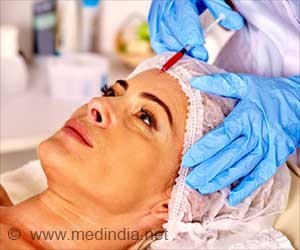
Baldness or hair loss can be of various types such as telogen effluvium, androgenic alopecia (male pattern baldness [MPB]; female pattern hair loss [FPHL]) and alopecia areata.
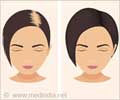
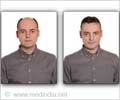
Androgenic alopecia (AGA) is more pronounced in males; it affects nearly 70 percent and 40 percent women in varying degrees. This kind of alopecia manifests itself in males as balding in the crown region of the head and hairline recession, and in females as diffuse thinning over the top of the scalp. Women having excessive androgen activity can develop more pronounced male –like pattern of hair loss.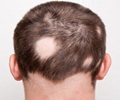
What Causes Hair Loss
The cause of hair loss may vary from a local condition affecting the scalp to an ailment affecting the whole body.
The cause of hair loss may vary from a local condition affecting the scalp to an ailment affecting the whole body.
The hair follicles on the occipital region (the area at the lower back of the head) have less androgen receptors and therefore this region is not affected by dihydrotestosterone. The hair loss is mainly confined to front, sides and the top of the head.
Kevin McElwee and colleagues discussed promising therapies for treating and/or preventing androgenic alopecia in an article published in Skin Therapy Letter.
The researchers stated, “In women, serum ferritin levels may also be assessed to determine iron deficiency, thyrotropin levels may be evaluated to rule out thyroid dysfunction, and free testosterone is assessed when androgen excess is suspected. If serum ferritin is low, iron supplementation has been recommended as an enabler of response to other treatments.”
Androgenic alopecia is currently treated with finasteride and minoxidil while hair transplantation is the surgical option.
Advertisement
Hair Loss in Women
Hair loss or Alopecia can be emotionally devastating to women but understanding reasons behind hair loss can help in prevention and treatment of hair loss.
Hair loss or Alopecia can be emotionally devastating to women but understanding reasons behind hair loss can help in prevention and treatment of hair loss.
Minoxidil
Advertisement
Trichotillomania: Hair Loss From Pulling Your Hair
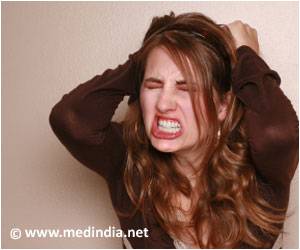
Trichotillomania is an Impulse control disorder, which occurs when a person suffers from stress overload and anxiety. The sufferer starts pulling hair from scalp, eyelashes to cope with stress.
Trichotillomania is an Impulse control disorder, which occurs when a person suffers from stress overload and anxiety. The sufferer starts pulling hair from scalp, eyelashes to cope with stress.
Finasteride
Finasteride decreases the conversion of testosterone to dihydrotestosterone, and improves hair thickness and hair count. Finasteride can affect the development of male embryos and is not recommended in women.
Dutasteride
Dutasteride is currently used for treating benign prostatic hyperplasia and recent researches have shown its efficacy in promoting hair growth. It has similar adverse effects to finasteride. According to the researchers, “The efficacy of dutasteride 2.5 mg/day was superior to that of finasteride 5 mg/day.”
Prostaglandin Analogues
Bimatoprost and latanoprost are used for treating glaucoma and ocular hypertension. Bimatoprost can help in the growth of eyelashes. Latanoprost can enhance pigmentation. These drugs are under investigation for the treatment of androgenic alopecia.
Ketoconazole
Ketoconazole is an anti-fungal agent used to treat dandruff and dermatitis. Ketoconazole improves the microflora of the scalp. It is also an anti-androgen agent and enhances the hair growth, and is extensively used in shampoos.
Anti-androgens
Anti-androgens in combination with estrogens are used for the treatment of hair loss in FPHL. Anti-androgens such as spironolactone and cyproterone acetate are available in the market.
Estrogens
Estrogens are the indirect anti-androgens and are sometimes used for treating androgenic alopecia.
Laser Treatment
Laser treatment is extensively used for the treatment of hair loss in recent years. Laser treatments are available in cosmetic and dermatological clinics. Lasers of varying wavelength and of different modes are used for the purpose.
Surgical Treatment
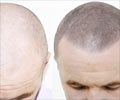
Hair transplantation is the permanent cure for androgenic alopecia. Follicular unit transplantation (FUT) is the commonly available in dermatological clinics. The researchers note, “More recently, specialized techniques have been developed involving individual hair follicle and unit extraction (FUE) to avoid scarring from strip graft harvesting.”
Cell-Mediated Treatment
Cell-mediated treatment for androgenic alopecia is the area of focus of many manufacturing companies and research groups. The main approaches are:
1.Use of cell-secreted factors as hair growth promoting products
2.Direct injection of cultured cells
3.Platelets-rich plasma isolated from whole blood. This treatment is becoming popular and is also seen as a standalone cure for androgenic alopecia.
Alternative Treatments
A variety of consumer products are available in the market with vitamin, herbal and mineral components. They claim to promote growth of hair. Some common herbs used for the purpose are black cohosh (Actaea racemosa), dong quai (Angelica sinensis), palmetto (Serenoa repens), false unicorn (Chamaelirium luteum), red clover (Trifolium pratense) and chaste berry (Vitex agnuscastus). They are known to possess estrogen-promoting or androgenic properties.
The authors also note, “Other products may contain biotin, caffeine, melatonin, copper complexes, and various proprietary compounds with diverse purported modes of action.”
Finally, it can be said that an array of treatment options are available for curing androgenic alopecia but minoxidil and finasteride are the best currently available drug choices. The other newer therapeutic approaches are under investigation.
Reference:
Promising Therapies for Treating and/or Preventing Androgenic Alopecia; Kevin McElwee et al; Skin Therapy Letter 2012
Source-Medindia