About
India is home to the world's third-largest population suffering from HIV/AIDS. About 95,000 adolescents are living with HIV according to a UN report (2011). Efficient screening and better drug availability have drastically reduced the prevalence. 6.6 million people were on antiretroviral therapy at the end of 2010.
There are a number of tests that are used to find out whether a person is infected with Human Immunodeficiency Virus (HIV), the pathogen responsible for AIDS.
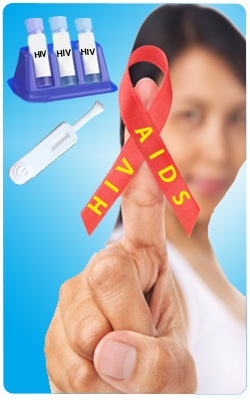
HIV tests detect the presence of HIV in serum, saliva, or urine.
Antibody Tests (ELIZA /EIA)
Antibodies are special proteins produced by the body’s immune system against agents called antigens. HIV antibody tests that detect antibodies are inexpensive and accurate. These tests are used for routine diagnosis of HIV among adults. Most people develop detectable HIV antibodies within 6 to 12 weeks of infection (this can take up to 6 months in rare cases).
The enzyme-linked immunosorbent assay (ELISA), or enzyme immunoassay (EIA) was the first HIV test to be widely used. ELISA tests are very sensitive and can detect very small amounts of HIV antibody. But their ability to distinguish HIV antibodies from other antibodies is low, i.e. the specificity is low. Hence there are chances that a result can be ‘false positive’, i.e. although a person may not be infected with HIV, their antibody test may come back positive.
To avoid complications due to false positive results, a confirmatory test called Western Blot is performed. Western Blot test is one that searches for particular proteins.
Rapid HIV tests
Rapid tests are those that are easy to use, fast. They can be performed anywhere and do not require laboratory facilities or highly trained staff. Results come as fast as in 20 minutes. The basic principle is the same as that is used in ELISA. These tests are not devoid of false positives either.
Any positive test is confirmed using the Western Blot technique.
These include:
- Home Access Express HIV-1 Test is the only FDA-approved home test
- OraQuick
- Orasure
- Uni-Gold
- Clearview Complete HIV 1/2 and Clearview HIV 1/2 Stat-Pak
- iDiagnostics Rapid HIV Test
- The INSTI HIV-1/HIV-2
- Rapid Antibody Test
- Reveal HIV
Not all of these tests are FDA approved ones.
Antigen Tests
Antigens are substances that trigger the production of antibodies in the body. The antigen on HIV that is routinely tested is called the protein P24.
P24 is produced in excess early in the course of infection and is detectable in the blood stream. The levels may be undetectably low in established infections.
P24 antigen tests are not routinely done because of the low sensitivity. They are useful only in early infection.
Nucleic-acid-based tests (NAT)
These tests detect particular nucleic acid sequences located in specific HIV genes. NATs are expensive.
A PCR test (Polymerase Chain Reaction test) can identify HIV in the blood within two or three weeks of infection. ‘Viral Load Test’ is an alternative name.
FAQs
1) Which specialist doctor conducts screening for HIV/AIDS Test?
Any general physician or an Infectious disease doctor can conduct a screening test for HIV/AIDS.
2) What is window period?
‘Window Period’ describes the period of time between HIV infection and the production of antibodies. Antibody tests give ‘false negative’ results during window period. Antibody tests are hence recommended three months after potential exposure to HIV infection so as to avoid false negative results.
If the test remains negative even after 3 months, then the person may not be infected with HIV. It is important to know that a person can transmit virus to others during the window period. In very rare cases, it can take up to 6 months to develop antibodies to HIV.
3) What if my HIV test is positive?
Testing positive for HIV is a life-changing event. Seek medical attention as soon as possible.
4) Are home self-tests available?
Rapid HIV tests are available as already mentioned.
5) Are there urine tests?
Yes just like blood tests and oral fluid tests, urine tests are available. Accuracy is low.
6) If I test HIV negative, does that mean that my sex partner is HIV negative also?
HIV test reveals only your HIV status. Hence a negative result doesn’t mean that your partner is HIV negative.
7) Is HIV testing important during pregnancy?
Yes. It is vital since timely antiviral therapy can prevent infections. It can also prevent vertical transmission of infection from mother to child.
8) When should I get tested for HIV?
Exposure to any of the following requires tests for HIV:
- injected drugs or steroids or shared equipment (such as needles, syringes, works) with others
- unprotected vaginal, anal, or oral sex with men who have sex with men, multiple partners, or anonymous partners
You need to get tested if you have been diagnosed with or treated for hepatitis, tuberculosis (TB), or a sexually transmitted disease (STD), like syphilis.
9) How long after a possible exposure should I wait to get tested for HIV?
Read the section about window period.